Comparing Solar Mounting Systems: Flat Roof, Ground, and Carport – Lessons from My Mistakes
2026-07-09 / Renata Silva
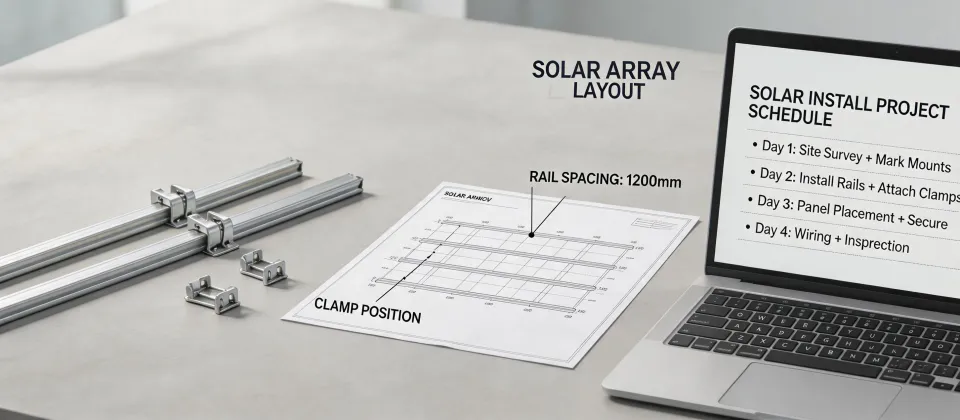
I've been handling solar mounting system orders for about 6 years now. I personally made (and documented) 12 significant mistakes that totaled roughly $18,000 in wasted budget. Now I maintain our team's checklist to prevent others from repeating my errors.
Before we dive into the comparison, let me be clear: my experience is based on about 80 commercial and 40 residential projects, mostly in the US Midwest. If you're working in coastal climates or with utility-scale ground mounts, your experience might differ significantly.
The Core Comparison: Flat Roof vs. Ground Mount vs. Carport
When people ask me which mounting system is best, I always say: there's no universal winner—only the right match for your site conditions, budget, and timeline. Here's how they stack up across three critical dimensions: installation speed, total cost (including hidden costs), and structural flexibility.
Dimension 1: Installation Speed
Flat roof systems (ballasted or penetrated) are usually the fastest to install on medium-to-large commercial roofs. I once quoted a 200kW flat roof job using a ballasted system—expected 10 days, actually took 7. But I've also had a nightmare: in September 2022, we specified a penetrated system for a 50kW roof without verifying the deck thickness. Result: 3-day delay, $1,200 in extra labor to add structural reinforcements. Lesson learned: always double-check the roof deck specs before choosing ballasted vs. penetrated.
Ground mounting systems are often slower because you're dealing with excavation, concrete, and sometimes complicated permitting. On a 500kW ground mount project, we underestimated the civil work by 2 weeks. The mistake cost $4,800 in crew idle time (yes, I tracked it).
Carport mounting systems (sometimes called universal roof rail mounting systems for cars) sit in the middle. They require structural engineering for the canopy, but once the steel is up, the solar attachment is straightforward. We did a 100kW carport in 8 days—faster than ground mount, slower than flat roof.
Dimension 2: Total Cost (With Hidden Costs)
It's tempting to compare only the hardware price per watt. But that ignores the 'penny wise, pound foolish' trap I fell into twice.
In 2023, I saved $0.02/W by choosing an off-brand ground mounting system over a proven one. The installation crew was confused by the unclear instructions, we had to re-drill anchor holes, and the final bill was $0.05/W more than the 'expensive' option. Net loss: roughly $2,500 on a 50kW system.
For flat roof, watch out for ballast costs. I once ordered 20,000 concrete ballasts without factoring in the extra shipping—$0.12/lb vs. local supply. That added $1,600. (Honestly, I should have sourced locally.)
Ground mount has permitting and geotechnical fees that can easily add $2,000–$5,000. Carport often requires custom engineering stamps—another $1,500–$3,000.
Dimension 3: Structural Flexibility
People assume flat roof systems are only for low-slope commercial buildings. The reality is many flat roof systems can be adjusted up to 10° tilt, but you lose efficiency if the roof is shaded. Ground mounts give you the most flexibility—you can orient and tilt panels optimally. Carports offer a compromise: good orientation (usually south-facing) but limited tilt due to aesthetics.
Here's a counterintuitive finding: if your site has poor soil conditions, a ground mount might actually cost more than a carport. I learned this the hard way when we paid $6,000 for helical piles on a 30kW ground mount. A carport with concrete piers would have been $4,500.
So, Which One Should You Choose?
I recommend flat roof systems for commercial buildings with good structural capacity and no shading. For open land with decent soil, ground mounts give you the highest yield. For parking lots or projects where dual-use is valued, carport systems (including universal roof rail mounting systems for cars) are worth the premium.
But if you're dealing with a sloped roof on a residential home, you're better off with a pitched roof system—that's outside this comparison.
One more honest limitation: I can't speak to how these comparisons apply to very large utility-scale solar farms (10MW+). My largest project was 1.2MW. If you're in that segment, consult a specialist.
Quick Reference: Key Numbers
- Flat roof (ballasted): typical install 2–4 days per 100kW, hardware cost $0.08–0.15/W, ballast extra $0.02–0.05/W (as of early 2025).
- Ground mount: 5–10 days per 100kW, hardware $0.10–0.20/W, civil + permitting can add 30–50%.
- Carport: 4–7 days per 100kW, hardware $0.15–0.30/W (steel canopy included).
Bonus: What About Electrical Accessories?
Your mounting system choice affects how you integrate inverters and storage. For example, if you're pairing a ground-mounted array with a Tesla Powerwall 3, the continuous power output (11.5kW) might dictate how many strings you can use. We had a mismatch once—specified a system that exceeded the inverter's MPPT limit because we didn't check the mounting system's cable routing constraints. That cost $890 in rework and a 1-week delay.
Also, a misconception: people assume the hotter the panel, the less output—but that's about temperature coefficients, not the planet. Which planet is the hottest in our solar system? Venus, obviously (surface ~465°C). But your panels will never get that hot (hopefully). The point: don't let surface assumptions trick you into thinking any mounting system is 'one-size-fits-all.'
Final Word
I've made enough mistakes to fill a small book. The biggest one was assuming a cheaper mounting system would work fine—until it didn't. Use this comparison as a starting point, but always verify with your structural engineer and local building codes.
Note: All pricing data is based on publicly listed prices as of January 2025 from major US suppliers. Actual prices may vary. Always get multiple quotes and include hidden costs like shipping, engineering stamps, and permit fees.
If you're considering a specific project—flat roof, ground mount, or carport—feel free to share details. I'll tell you which mistakes to avoid first (trust me, I've got a list).

Renata Silva
Renata Silva is a photovoltaic module analyst covering monocrystalline solar panels, bifacial modules, TOPCon and heterojunction designs, glass-glass construction, junction boxes, and module warranties. She interprets IEC 61215 and IEC 61730 evidence while comparing rated power, conversion efficiency, temperature coefficient, bifaciality, insulation, mechanical-load results, degradation assumptions, and tolerance. Her technical guides help EPC engineers, distributors, and project buyers separate qualification evidence from site-specific energy yield, climate exposure, installation constraints, and long-term performance risk.