Not All Solar Modules Are Created Equal: A Buyer's Guide to Choosing the Best Panels for Your Mounting System
2026-07-17 / Renata Silva
There's No Single "Best" Solar Module
If you're searching for "what are the best solar modules," I'll save you some time: there isn't one right answer. After managing procurement for commercial solar installations since 2020—processing around 60 orders annually across eight vendors—I've learned that the "best" panel depends entirely on your project profile. Honestly, the conventional wisdom that you should always buy the highest-efficiency panel available? That advice has cost some of my colleagues serious money.
Here's a better approach: instead of asking which module is best, ask which module is best for your specific mounting scenario. Below, I break down three common scenarios and the panels that make sense for each.
Scenario A: The Space-Constrained Commercial Flat Roof
The situation: You're installing on a flat roof with limited surface area, using a ballasted solar mounting system. The roof can't support extra weight, so you're working with a fixed number of rails and a tight layout. Every panel counts.
The module choice: In this scenario, you want high-efficiency monocrystalline panels (21%+). Think premium-tier modules from Tier 1 manufacturers like Longi, JinkoSolar, or Trina.
From experience: two years ago, we installed on a 10,000 sq ft rooftop for a logistics center. The original bill of materials specified 340W panels. I pushed for 400W panels instead (they were about $0.03/W more). That choice saved us 12 panels worth of racking, reduced ballast by roughly 15%, and cut installation labor by two full days. The mounting system vendor was happy because the rail layouts simplified. The client was happy because we hit their target kW under budget.
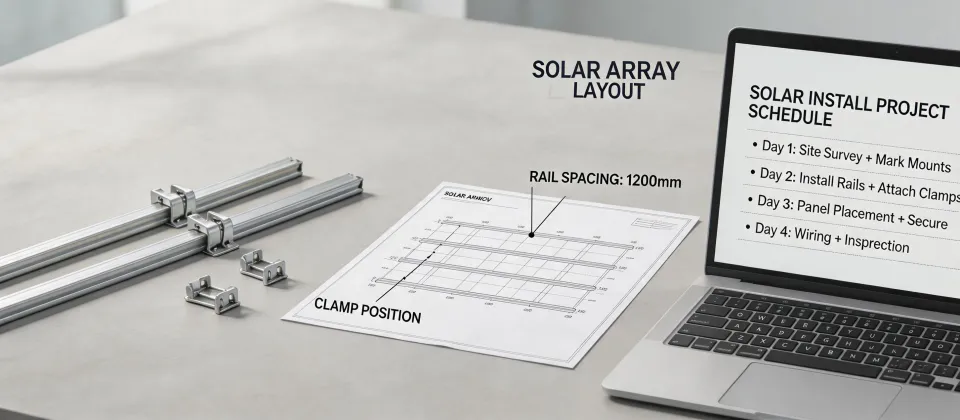
Pro tip: For ballasted flat roof systems, higher wattage modules mean fewer penetrations and less ballast weight. Check if your mounting system's rail spacing and clamp kits are compatible with the larger panel dimensions. Most major brands offer compatibility sheets.
Scenario B: The Budget-Sensitive Pitched Roof
The situation: You're retrofitting a residential or small commercial pitched roof, and the client's priority is the lowest cost per watt. They're not chasing maximum efficiency; they need the system to pencil out within a strict budget.
The module choice: Consider polycrystalline or lower-cost monocrystalline panels (18-19% efficiency). Brands like Canadian Solar, JA Solar, or even some Tier 2 options can work here.
I still kick myself for a decision I made in 2022. We installed premium 370W panels on a 30 kW pitched roof residential project. The client was cost-sensitive, and we overshot their budget by 12%. The high-efficiency panels reduced our racking costs by maybe 5%, but we could have achieved the same kWh output using standard 330W panels with an extra row of rails. The client was unhappy, and I had to explain the cost variance to finance.
What I learned: on pitched roofs, mounting costs scale roughly linearly with the number of modules, not their wattage. Unless you're truly space-limited, standard efficiency panels paired with a well-priced wholesale metal sheet roof mounting system often gives the best ROI. The metal roof's clip-based attachment means labor is lower per module anyway, so a few extra panels don't hurt as much.
Scenario C: The Long-Term Utility-Scale Ground Mount
The situation: You're deploying a ground-mount system with a 25+ year PPA or lease. The mounting structure (ground screw or driven pile) is a long-term asset, and panel replacement costs are high. Reliability and degradation rate matter more than upfront price.
The module choice: Here, I'd recommend bifacial monocrystalline modules from established Tier 1 manufacturers with linear degradation warranties (0.45% per year or better). Industry data suggests that modules with a 0.45% annual degradation retain roughly 89% of their output after 25 years, versus 83% for a 0.7% degradation product. Over a 5 MW ground mount, that difference can mean thousands of MWh over the project's life.
We spec'd bifacial modules for a 2.3 MW ground mount last year. The mounting system used single-axis trackers, which let the bifacial gain pick up reflected light from the ground. The extra $0.05/W for bifacial panels paid back in about 4 years—faster than we'd projected, because the tracker mounting system complemented the panel's design better than a fixed-tilt would have. I was skeptical at first, but reverse validation: the early adopter on that project convinced me when we saw the production data.
How to Decide Which Scenario Fits You
Here's a quick framework I use when evaluating projects. Ask yourself these three questions:
- Is available mounting area the primary constraint? If yes, focus on efficiency (Scenario A). If no, move to question 2.
- Is the project driven by minimum upfront cost? If yes, focus on cost per watt (Scenario B). If no, move to question 3.
- Does the project have a long-term (20+ year) financial commitment? If yes, focus on degradation rate and warranty strength (Scenario C).
That's it. Three questions, three recommendations. I'd rather spend five minutes helping you understand your scenario than have you end up with mismatched expectations—like I did back in '22. If you're still unsure, check your mounting system's compatibility list: most reputable mounting system manufacturers publish detailed module compatibility guides. That's often the fastest way to narrow your options.
Trust me on this one: knowing your scenario first will save you a lot of headaches (and budget fights with finance).

Renata Silva
Renata Silva is a photovoltaic module analyst covering monocrystalline solar panels, bifacial modules, TOPCon and heterojunction designs, glass-glass construction, junction boxes, and module warranties. She interprets IEC 61215 and IEC 61730 evidence while comparing rated power, conversion efficiency, temperature coefficient, bifaciality, insulation, mechanical-load results, degradation assumptions, and tolerance. Her technical guides help EPC engineers, distributors, and project buyers separate qualification evidence from site-specific energy yield, climate exposure, installation constraints, and long-term performance risk.