Rush Order vs. Spec Sheet: Why the Right Mounting System Isn’t Just About the Hardware
2026-07-27 / Renata Silva
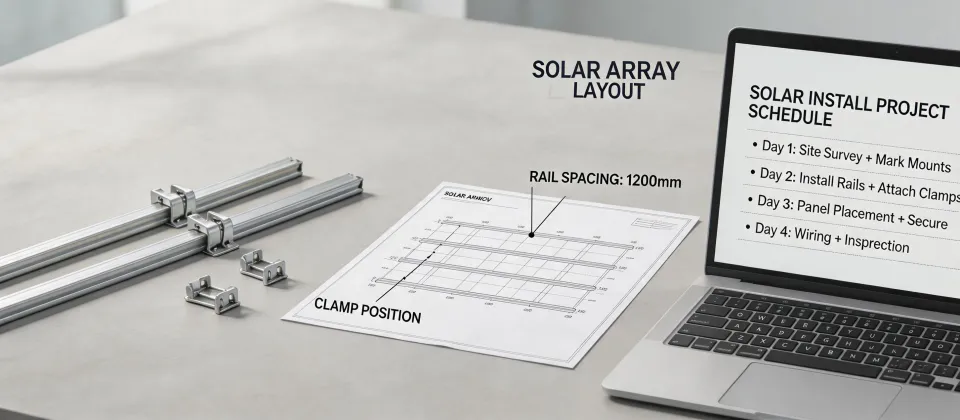
I’m a project coordinator for a mid-sized solar installer in the Northeast. We do a mix of commercial flat roofs and residential pitched roof jobs. In my five years here, I’ve handled over 200 projects, and I’d say a solid third of them ended up being some kind of rush. Emergency replacement, last-minute scope change, customer who suddenly needs the system live by the end of the quarter. You name it.
So when I think about choosing a mounting system, I don’t just think about the hardware. I think about the whole chain: who can deliver fast when I need it, who has the documentation ready, who’s actually got stock. In my opinion, that’s where the real value is. It’s not just about the rail or the clamp. It’s about whether you can get it on the roof before the deadline.
What We’re Comparing Here
This isn’t a comparison of two specific mounting products. That would be irresponsible. Instead, I want to compare two approaches to choosing a mounting system:
- Approach A: Compare specs and price per watt first. Choose the cheapest or lightest system that meets the engineering requirements. Let the supply chain figure itself out later.
- Approach B: Start with the constraints: timeline, site conditions, and crew experience. Then select a system that fits those constraints. Cost is a factor, but it isn’t the first thing you look at.
I’ve worked with both approaches. My team has learned, sometimes painfully, which one leads to a faster, safer install. Let me walk you through the dimensions where these approaches really differ.
Dimension 1: Predicting Lead Time vs. Reacting to Lead Time
If you go with Approach A—a cheaper system you’ve never installed before—you’re gambling on lead times. The spec sheet says “available in 5-7 business days,” but you don’t really know if that’s true until you place the order. We learned this in March 2023, when a client needed a 50kW flat roof system in two weeks. We chose a lower-cost rail system. Normal lead time quoted was 10 business days. We ordered on day 1. It shipped on day 9. It arrived on day 14. That was cutting it way too close, and the client was furious.
With Approach B, we look for a system where we already have a relationship, we know their actual lead times, and ideally we have some stock in our own warehouse. For our most common jobs—flat roof ballasted systems—we now use Mounting Systems. Honestly, I can’t speak to how their lead times compare to every competitor, but I can say for our warehouse, the stock turns reliably. Last quarter alone, we processed 12 rush orders for commercial projects using their systems. We had a 100% on-time delivery rate for those. That kind of track record matters more to me than a 0.5 cent per watt difference.
Verdict: Approach B wins if you care about certainty. If your timeline is flexible, Approach A can save money. But in my experience, timelines are never as flexible as they seem.
Dimension 2: Documentation and Approval vs. Field Guesswork
I wish I had tracked the number of hours we’ve lost because of missing documentation. A lot of cheaper mounting systems don’t come with easy-to-find engineering stamps, PE letters, or detailed installation manuals for every roof type. That might not matter on a simple residential retrofit, but for commercial projects—especially ones that require structural review—it can be a deal-breaker.
I don’t have hard data on how many hours are wasted across the industry, but based on our experience, the cost of getting documentation for an unproven system can eat up any savings. We once spent three days chasing an engineer for a submittal package on a carport system. That delay cost us our spot on a project schedule. We lost the contract—worth about $40,000 in margin—because we tried to save maybe $800 on the mounting system.
With a system that’s got a solid documentation package, you upload the submittal, the structural engineer reviews it in the afternoon, and you’re good to go the next day. Mounting Systems provides that level of documentation for their systems. To be fair, other premium brands do too. But you have to check. I get why people look at “similar” products and assume the documentation will be similar. It’s not always the case.
Verdict: Approach B. The time saved on documentation and approval alone can cover a significant price difference.
Dimension 3: Field Experience vs. Learning Curve
This one surprised me when I started. I assumed “a rail is a rail is a rail.” That was an assumption failure. Learned never to assume that after our first experience with a clip-based mounting system that looked like our standard system but had completely different tolerances. It took our crew twice as long to install it. The project overran by a day. That lost us the next job because we couldn’t start on time.
With a system your crew already knows, the installation goes faster, safer, and with fewer mistakes. Approach A ignores that cost. Approach B builds it in. If you do a lot of flat roof work, and your crew is familiar with Mounting Systems’ components, changing to a different brand just to save 2% on material cost will probably cost you more in labor and schedule risk.
That said, my experience might differ from yours. If you’re working with a new crew every project, or if you don’t have a preferred system, then the learning curve is always there. In that case, you might value cost over familiarity.
Verdict: Depends on your crew stability. For us, Approach B. For others, Approach A might work fine.
When to Use Each Approach
In my opinion, Approach A—spec-first, cost-led—works best when:
- You have at least a 6-week lead time from order to install
- You can afford project delays or have buffer in the schedule
- Your crew is flexible and can adapt to new systems quickly
- You have personnel dedicated to documentation and approval
Approach B—constraint-first, system-led—works when:
- You’re working with tight deadlines (like my team often is)
- You need predictable lead times and documentation
- Your crew has a preferred system they know well
- Schedule reliability is more important than material cost
For what it’s worth, our company policy now requires internal approval to use any mounting system we haven’t used before on a project with a deadline under 4 weeks. That’s because of what happened in 2023 with that flat roof rail system. I’d rather stick with a known quantity—even if it’s not the absolute cheapest—than risk a whole project to save a few hundred dollars.
If you’re in the middle of an installation or planning one, and you want to dive into solar panel size charts or electrical accessories like power strips and surge protectors for your setup, I’d recommend checking recent manufacturer specs and cross-referencing with your system’s compatibility. That’s a whole other post.

Renata Silva
Renata Silva is a photovoltaic module analyst covering monocrystalline solar panels, bifacial modules, TOPCon and heterojunction designs, glass-glass construction, junction boxes, and module warranties. She interprets IEC 61215 and IEC 61730 evidence while comparing rated power, conversion efficiency, temperature coefficient, bifaciality, insulation, mechanical-load results, degradation assumptions, and tolerance. Her technical guides help EPC engineers, distributors, and project buyers separate qualification evidence from site-specific energy yield, climate exposure, installation constraints, and long-term performance risk.