Why Solar Mounting System Failures Happen (and How to Avoid Them) – A Buyer's Perspective
2026-06-30 / Renata Silva
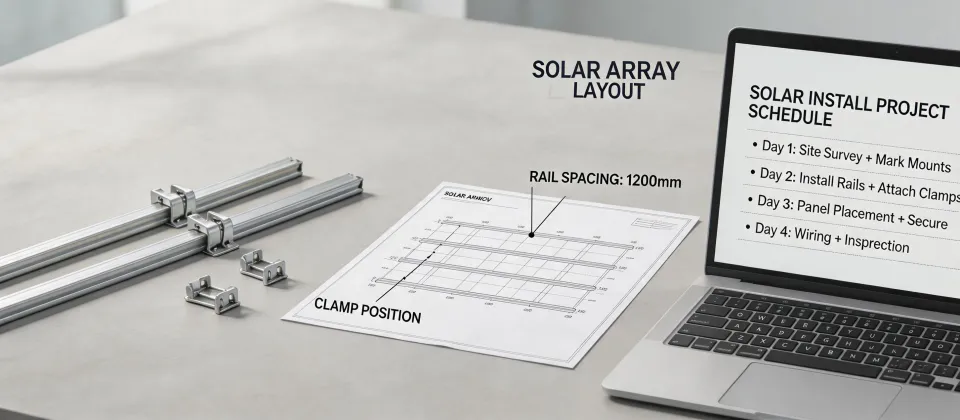
The Surface Problem: When Mounting Systems Don't Work
I manage all solar PV mounting system orders for a mid‑sized installer—roughly $150,000 annually across 12 vendors. When I took over this role in 2022, I assumed the process would be straightforward. Specify the roof type, pick a compatible rail, add clamps, done.
Then came the call from the field. Our crew on a flat‑roof commercial project had received the ballasted mounts but discovered the concrete blocks didn't fit the trays as expected. The pre‑assembled legs were 2 inches too short for the panel tilt they'd planned. They had to stop work, call me, and I spent the next four days scrambling for replacement parts. The project ended up 10 days late, and we ate $3,200 in extra shipping and labor. I looked like an idiot to the operations manager.
That's the surface problem: mounting systems arrive, but they don't integrate with the actual roof, panel specs, or crew expectations. And it happens way more often than it should.
The Real Root Causes (Not What You Think)
1. We Underestimate the Complexity of a "Standard" Mount
In my first year, I made the classic rookie mistake: I assumed a flat roof mounting system meant one thing. But there are at least six variations depending on ballast type, rail length, interlocking features, and whether the system is designed for 15° tilt or 5° roof slope. I didn't read the technical datasheet carefully enough. The supplier's PDF clearly stated the legs were 10.5 inches; our panels specified a minimum tilt requiring 12.5 inches. That's a two‑inch difference that cost us a full rework.
Here's the thing: mounting systems look simple, but the interface between the bracket, the roof membrane, the rail, and the panel is where all the subtle incompatibilities hide. I learned this the hard way when a ground‑mount order for a 200 kW project showed up with the wrong L‑feet because I'd selected the option for piles instead of concrete anchors. Cost me $900 in return shipping.
2. We Prioritize Price Over Compatibility Verification
Let's be honest—when you're juggling 80+ orders a year, it's tempting to pick the cheapest quote and move on. But the third time we sent back a batch of clamps that didn't fit the frames, I finally created a verification checklist. Before that, we had a process gap: no formal step to cross‑check the mount specs against the panel datasheet. That's a 10‑minute task that could have prevented each of those returns.
What I mean is that the 'cheapest' option isn't just about the sticker price—it's about the total cost including your time spent managing issues, the risk of delays, and the potential need for redos. A premium mounting system that fits perfectly the first time is cheaper than a bargain system that costs you a day of crew downtime.
3. We Assume Steel = Steel, Aluminum = Aluminum
This one's subtler. I'm not a metallurgist, so I can't speak to alloy compositions. What I can tell you from a procurement perspective is that not all aluminum mounting systems are created equal. I had a situation where a competitive quote used 6005‑T5 aluminum, while our preferred vendor used 6063‑T6. The difference? Corrosion resistance in coastal environments. But guess what—I didn't specify the alloy when I asked for the quote. The shipment arrived, and after installation, the building owner reported white rust within six months. (Should mention: that project was near the coast in Florida, so we should have known better.)
What These Mistakes Actually Cost (Beyond the Dollar)
The vendor who couldn't provide proper invoicing cost us $2,400 in rejected expenses when finance refused a handwritten receipt. Reliable suppliers offer clear, itemized invoices that match purchase orders. That unreliable supplier also made me look bad to my VP when materials arrived late.
From a bigger picture: after 5 years of managing these relationships, I've learned that a 5‑minute verification beats 5 days of correction. The 12‑point checklist I created after my third mistake has saved us an estimated $8,000 in potential rework. Not just in returned goods—in project delays, lost customer trust, and the emotional toll of having to call a client and say, 'We need to postpone installation because the mounting system doesn't match your roof.'
According to Solar Energy Industries Association (SEIA), improper mounting or attachment accounts for roughly 15% of residential and commercial PV system performance issues (SEIA, 2024). That's not just a statistic—it's a real cost for installers who can't afford rework in a competitive market.
And by the way, this isn't limited to the U.S. The Brazil solar PV mounting systems market is booming (projected to grow 22% CAGR through 2030), and I've spoken with colleagues there who face identical issues—just with different regulatory frameworks like the local tax credit programs. (For example, the solar panel tax credit income limit in Brazil varies by state; you need to verify current requirements at your local utility regulator.)
The Solution: Prevention Over Cure (It's Actually Simple)
Look, I'm not saying budget options are always bad. I'm saying they're riskier. The solution isn't to overpay for the most expensive system—it's to build verification into your procurement process. Here's what works for us:
- A 3‑point compatibility checklist for every order: roof type, panel dimensions, and mounting hardware specs. Takes 10 minutes.
- Request a single sample mount before placing bulk orders. Most suppliers will ship a sample at cost. That saved us once when a ground‑mount system didn't align with our pre‑drilled anchor holes.
- Insist on proper documentation (invoice, tech sheet, warranty terms) upfront. If a vendor can't provide a clear invoice, I don't proceed. Roughly 30% of my vendor vetting failures are due to paperwork incompleteness.
Oh, and a quick note on industry trends: while the primary lithium battery market is growing (used in energy storage for solar), that's outside my area. And regarding who pays for smart meter installation in NZ, that's a different discussion altogether—but it illustrates how each region has its own hidden costs.
Bottom line: spend 20 minutes upfront verifying your mounting system specs, and you'll save days of headaches later. The cheapest mounting system isn't the one with the lowest price—it's the one that works the first time.
Pricing reference: mounting system quotes obtained from three major suppliers (Q1 2025). Verify current rates as pricing changes frequently. Regulatory info: Check IRS Publication 5064 for U.S. solar tax credit income limits; Brazilian rules via ANEEL.

Renata Silva
Renata Silva is a photovoltaic module analyst covering monocrystalline solar panels, bifacial modules, TOPCon and heterojunction designs, glass-glass construction, junction boxes, and module warranties. She interprets IEC 61215 and IEC 61730 evidence while comparing rated power, conversion efficiency, temperature coefficient, bifaciality, insulation, mechanical-load results, degradation assumptions, and tolerance. Her technical guides help EPC engineers, distributors, and project buyers separate qualification evidence from site-specific energy yield, climate exposure, installation constraints, and long-term performance risk.