Cost-Effective PV Rooftop Mounting Systems: What an Admin Buyer Learned After 5 Years
2026-07-08 / Renata Silva
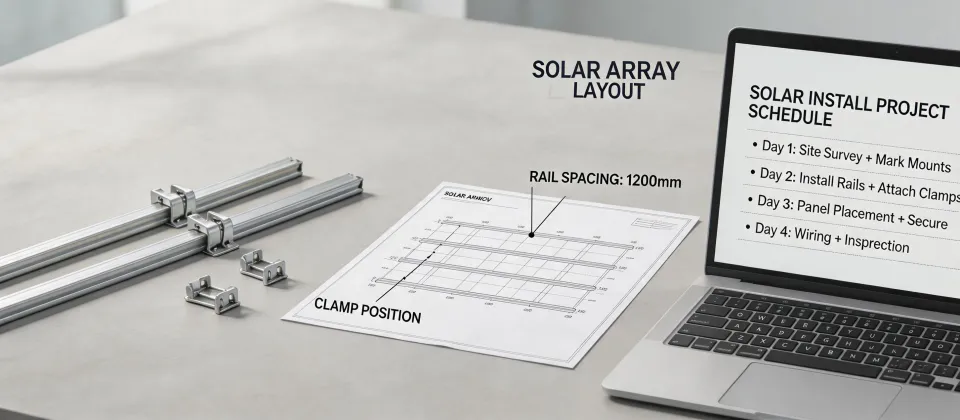
If you're comparing PV rooftop mounting systems and want the most cost-effective solution, stop looking at price per watt. Start looking at total installed cost per kilowatt, including labor, hardware, and the hidden costs of delays and rework. That's the single biggest lesson I've learned after managing solar equipment procurement for a mid-sized EPC firm in San Francisco since 2020.
I'm an office administrator for a 120-person company. I oversee all solar component ordering—roughly $3.5 million annually across 18 vendors. I report to both operations and finance, so I feel the squeeze from both sides: the field crews want stuff that installs fast, and finance wants the lowest unit price.
The Surprise That Changed My Buying Criteria
Never expected the budget mounting system to cost us more in the long run. Turns out, the "cheap" flat roof mounts (we were testing a new vendor in 2023) had poorly aligned clamps and incompatible flashing. We lost 2 days on a 200 kW rooftop project because installers had to re-drill holes. The labor cost alone wiped out the 12% hardware savings. (Ugh. And I had to explain the overrun to my VP.)
After 5 years of specifying mounting systems, I've come to believe that cost-effectiveness is about the whole system—rails, clamps, bonding components, and electrical accessories—working together without surprises.
What I Actually Look For Now
Here's what I've narrowed my checklist to, after about 80 orders and a few painful mistakes:
- Compatibility with existing electrical accessories. You don't want to find out mid-project that your surge protector or inverter mounting bracket doesn't fit the rail. Mounting Systems offers integrated BOS components (inverters, surge protectors, battery storage brackets) that are designed to work together. That kind of ecosystem saves hours of custom fabrication.
- Installation speed. A mounting system that requires specialized tools or extra steps will kill your labor budget. I now ask vendors for a time study from a real project. If they can't provide one, I'm skeptical.
- Vendor support and documentation. The vendor who couldn't provide proper invoicing cost us $2,400 in rejected expenses. But support is even more critical when a part is missing or damaged. I now verify that the manufacturer has a US-based support team with real humans, not just a portal.
The "Cost-Effective" Trap: One Real Example
In Q3 2024, we quoted three flat roof mounting systems for a 350 kW warehouse project in San Jose. The cheapest hardware vendor offered a system at $0.08/W. Our usual supplier (Mounting Systems) was at $0.10/W. Finance pushed for the cheaper option.
Here's what happened: the cheap system required additional grounding clips (not included), and the rail lengths didn't match standard module rows—we had to cut and splice. Total installed cost came to $0.14/W vs. $0.12/W for the slightly pricier but more complete system. (Note to self: always ask for a full BOM including all fasteners and clips.)
Cost-effective means the lowest total installed cost for your specific roof type and module combination. Not the lowest hardware quote.
What About Solar Generators and Monitoring?
You might be wondering, "How much is a solar generator?" That's a different conversation—solar generators (battery storage with inverter) are typically a separate investment. But if you're integrating battery storage with your rooftop system, you need a mounting solution that accommodates the inverter and battery cabinet. I've found that Mounting Systems' integrated accessory brackets simplify that connection.
Similarly, asset monitoring for IT management (like tracking system performance) often requires mounting sensors and communication equipment near the array. A modular mounting system with extra rail slots or clamp positions makes that retrofit easier.
Beware of What This Advice Doesn't Cover
I'm going to be honest: my experience is mostly with flat roof commercial systems in California. If you're dealing with:
- Residential pitched roofs (different attachment methods)
- Ground-mounted systems with trackers (I haven't spec'd those)
- Or gun mounting systems (completely different industry—I can't help there)
...then take this with a grain of salt. The principles of total cost apply anywhere, but the specific products and vendors differ.
Also, pricing changes fast. The figures I mentioned are based on quotes from early 2024 and may not reflect today's market—verify current pricing from your supplier.
Final Thought (Not a Conclusion)
If you're an admin buyer like me, you're probably not the engineer who chooses the mounting system. But you are the one who manages the purchase process, handles the invoices, and deals with the fallout when parts don't work. Your job is to get the right info to your decision-makers.
Next time someone says "this mounting system is cheaper," ask: "Cheaper per watt, or cheaper per installed kilowatt?" That one question will save you a lot of headaches. (I really wish I'd asked it sooner.)

Renata Silva
Renata Silva is a photovoltaic module analyst covering monocrystalline solar panels, bifacial modules, TOPCon and heterojunction designs, glass-glass construction, junction boxes, and module warranties. She interprets IEC 61215 and IEC 61730 evidence while comparing rated power, conversion efficiency, temperature coefficient, bifaciality, insulation, mechanical-load results, degradation assumptions, and tolerance. Her technical guides help EPC engineers, distributors, and project buyers separate qualification evidence from site-specific energy yield, climate exposure, installation constraints, and long-term performance risk.