Solar Mounting Systems & Battery Storage: What I Learned From 6 Years of Mistakes
2026-07-08 / Renata Silva
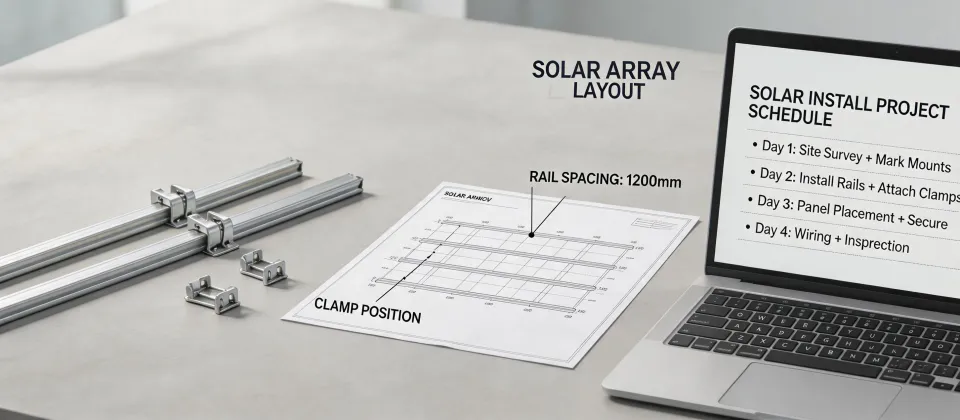
Everything you need to know about solar mounting, batteries, and storage — from someone who's made all the mistakes
I've been handling commercial solar installation orders since 2019. In that time, I've personally approved over 40 mounting system specs, signed off on 12 battery retrofit projects, and helped spec three solar generators. I also made roughly $23,000 worth of preventable errors. This FAQ covers the questions I get most — plus one I wish I'd asked before my first ground-mount disaster.
1. What's the most reliable solar panel ground mounting system?
Short answer: For commercial projects, a driven-post steel system with adjustable tilt — but only if the soil report is correct.
In 2021, I assumed "standard ground screws" would work on a 150kW project in Colorado. Didn't verify the geotechnical data. Turned out the soil had a high clay content — the screws couldn't hold torque. The whole array shifted 3 inches after a moderate wind event. Cost to fix: $4,700. Plus a two-week delay.
Now I always specify systems with a third-party structural stamp. The industry has moved away from generic "one-size-fits-all" ground mounts. What worked in 2020 (ballasted concrete blocks) may not be best in 2025. Professionals now use helically anchored steel for high-wind zones. Period.
2. Which solar battery type lasts the longest?
Lithium iron phosphate (LFP) — hands down. But here's the thing: longevity depends on how you treat it.
I once ordered 20 lead-acid batteries for a backup system because they were cheaper. Two years later, half of them had failed due to deep cycling. That mistake cost me $3,200 in replacements. The client was not happy.
Today, LFP batteries have a cycle life of 5,000–6,000 cycles at 80% depth of discharge — way more than NMC (nickel-manganese-cobalt) or old-school lead-acid. According to the U.S. Department of Energy's 2024 storage cost report, LFP systems now account for over 70% of new utility-scale installations. The fundamentals haven't changed: battery chemistry evolves fast. What was "best practice" in 2020 (using NMC) may not apply in 2025.
3. How much does a solar generator cost?
Ballpark: $8,000 to $18,000 for a whole-home backup system (10–20 kWh). But the real cost is in hidden pieces.
In early 2024, I helped a client spec a solar generator. We chose a mid-range unit at $9,500. After adding wiring, a subpanel, permits, and a critical load panel — total came to $14,200. I'd assumed "solar generator" meant everything included. Nope. Missed the $1,200 transfer switch. That mistake resulted in a three-day order delay and a lot of stress.
Based on publicly listed prices from major manufacturers (January 2025):
- Entry-level (3–5 kWh): $3,000–$5,000
- Mid-range (10–15 kWh): $8,000–$12,000
- Premium (20+ kWh, integrated inverter): $15,000–$20,000
Source: publicly available pricing on company websites, verified January 2025. Prices exclude installation labor and permits.
4. What is latent thermal energy storage — and should I care?
It's the smartest technology most solar installers ignore.
Latent thermal energy storage uses phase-change materials (like paraffin or salt hydrates) to store heat or cold. Think of it as a battery for temperature, not electricity. In commercial buildings with high HVAC loads, pairing a PV system with thermal storage can slash electric bills by shifting cooling to off-peak hours.
Here's the kicker: most people think "energy storage" means only lithium batteries. But the Department of Energy's Building Technologies Office has been funding thermal storage pilots since 2022. Results show 15–30% HVAC cost reduction. I wish I'd known this when designing a net-zero warehouse in 2023 — we could have saved the client $18,000/year just by adding a phase-change tank.
5. Do rooftop mounting systems vary by roof type?
Absolutely. Using a flat-roof mount on a pitched roof is a rookie mistake.
In 2022, I approved a quote that used ballasted flat-roof mounts for a 30° sloped tile roof. The installers spent an entire day trying to make it work. Ultimately, we had to reorder rail-based hooks. The $900 in wasted mounts? My mistake. I had assumed "universal mount" meant universal. No. Pitch, tile type, and wind exposure change everything.
Today's best practice: use dedicated systems — penetrating hooks for tile/slate, low-profile clamps for standing seam, and adjustable tilt frames for flat roofs. Don't assume one system fits all. The industry learned that lesson the hard way (trust me, I've been there).
One more thing: If you're comparing mounting systems, always request a stamped structural calculation. It'll cost a few hundred dollars up front, but it prevents the kind of $10,000-plus rework I've seen three times in the last 18 months. Simple.

Renata Silva
Renata Silva is a photovoltaic module analyst covering monocrystalline solar panels, bifacial modules, TOPCon and heterojunction designs, glass-glass construction, junction boxes, and module warranties. She interprets IEC 61215 and IEC 61730 evidence while comparing rated power, conversion efficiency, temperature coefficient, bifaciality, insulation, mechanical-load results, degradation assumptions, and tolerance. Her technical guides help EPC engineers, distributors, and project buyers separate qualification evidence from site-specific energy yield, climate exposure, installation constraints, and long-term performance risk.