I Spent $45,000 on the Wrong Solar Mounting Systems: A Lesson in Not Following the Crowd
2026-07-13 / Renata Silva
-
How I Misjudged the Solar Mounting Systems Market
-
The Initial Misjudgment: Following the Giant
-
Where It All Went Wrong: Ground Mount Design and Inverter Integration
-
The Reckoning: Data Doesn't Replace Experience
-
Lessons Learned: What I Now Include in Every RFP
-
The Bottom Line: Market Share Is a Starting Point, Not an Answer
How I Misjudged the Solar Mounting Systems Market
Let me start with a scene: September 2019, a rooftop in Denver, Colorado. I was standing with our installation crew, looking at a set of flat roof racks that had been spec'd by yours truly. The problem? They didn't fit. Not even close. The entire delivery — 342 pieces, roughly $45,000 in mounting hardware — was sitting on pallets, completely unusable.
When I first started designing commercial solar projects in 2017, I assumed the solar pv mounting systems market share leaders were the safe bet. My logic was simple: if everyone else is using them, they must be the best, right? Three years and a few expensive mistakes later, I realized I was completely wrong. The biggest names have the most engineers and marketing spend, but they don't necessarily have the best solution for your specific project.
Honestly, I thought I was playing it safe. But safe was expensive.
The Initial Misjudgment: Following the Giant
In 2019, our company landed a 500 kW commercial rooftop project. The client had a flat roof with a 20-year-old membrane, and they wanted a ballasted system. I went straight to the mounting-systems brand with the largest market share. Their rep was responsive, the documentation looked polished, and they had case studies plastered everywhere. It felt like a no-brainer.
The surprise wasn't the price difference — it was the technical mismatch. Their in-roof mounting systems were designed for new construction, not retrofits on aging membranes. The penetrations required violated the warranty terms, and the ballast calculator didn't account for the roof's specific load-bearing capacity. I'd missed this because I was so focused on the brand's reputation.
What most people don't realize is that 'standard' mounting solutions often have hidden assumptions. The big players optimize for volume, not for edge cases. Our project was an edge case. It failed. Completely.
Where It All Went Wrong: Ground Mount Design and Inverter Integration
So we pivoted in November 2019. The client agreed to a ground-mount portion on adjacent land. I thought, okay, this is different — I'll be more careful. I designed a solar ground mount design using a system from the same manufacturer, thinking I'd learned my lesson.
Did I really learn it? No. I made the same mistake with different variables.
The conventional wisdom says to pick a trusted brand and stick with it. My experience with that 500 kW project taught me the opposite. The ground mount system had a different set of problems: the rack's channel spacing didn't match the frameless modules we'd already ordered, and the grounding clips weren't compatible with our module frames. Worse, we sourced our inverters from a solar inverter China manufacturer — a decision made purely on cost. The electrical accessories (surge protectors, disconnects, monitoring gear) didn't match the inverter's communication protocol. The inverter was fine; the mounting system's electrical integration kit was a mismatch.
Here's something vendors won't tell you: compatibility across the entire BOS (Balance of System) isn't guaranteed unless you buy a complete kit from a single supplier. And even then, it's not always seamless. Buying from the market share leader doesn't guarantee your in-roof mounting systems will play nice with your Chinese inverter.
We discovered this when the surge protector failed during commissioning. A $90 part killed a $4,200 inverter. The mounting system supplier said it wasn't their problem. The inverter supplier blamed us for the electrical design. We were stuck with the redo cost: $4,200 for the inverter, plus 2 weeks of lost production revenue (about $8,000 for a 500 kW system). Total waste: $12,200. And that was just one error.
The Reckoning: Data Doesn't Replace Experience
After the third rejection from the client's engineering consultant in Q1 2024 — three different mounting systems, three different incompatibility issues — I created our pre-check list. But by then, the damage was done. The project was delayed by 4 months, and our credibility with that client was damaged. We didn't lose the client, but we lost the easy 'trust' you earn after a flawless first project.
The question everyone asks is, 'Which mounting system has the best reviews?' The question they should ask is, 'Which mounting system fits this specific roof, with these specific modules, and this specific inverter?' It's not a binary question. The market leader is the market leader for a reason — but that reason might not apply to you.
I started asking around the industry. A senior PM at an EPC firm in Texas told me their rule: never spec a mounting system without seeing the actual roof drawings and module data sheet. That sounds basic, but when you're busy, you skip it. I'd skipped it. Twice.
Lessons Learned: What I Now Include in Every RFP
Here's the checklist I use now, based on $45,000 worth of mistakes and 4 months of lost time:
- Roof-specific engineering: Does the mounting system have a certified structural engineer who can review your roof drawings? Not a generic calculator, a real human.
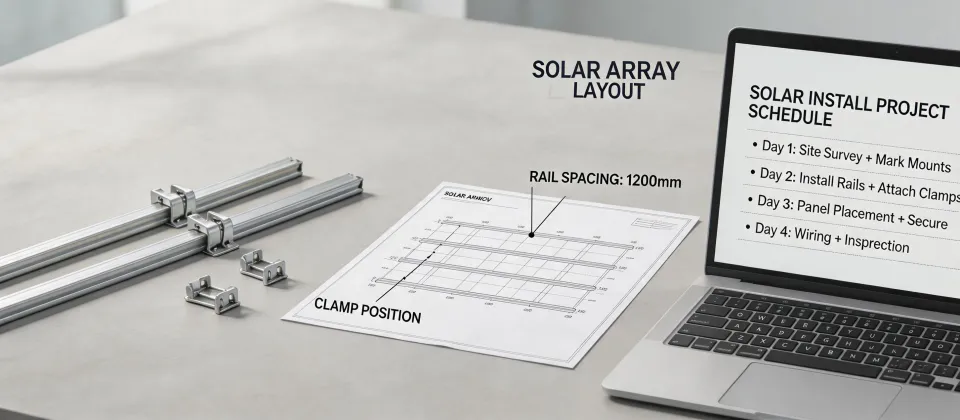
- Module compatibility: Will the mounting system's clamps fit your specific module dimensions and frame thickness? We found a 2mm difference in frame thickness that meant buying new clamps — $1,200 additional cost.
- Inverter & electrical integration: Does the mounting system offer a full electrical kit (surge protectors, combiner boxes, wiring harnesses) that's tested with your inverter brand? Or rely on generic components that may or may not work?
- Ground mount design flexibility: Can they adjust the racking for different soil types and wind zones? We had a 50-year wind load calculation that the standard design didn't support — required custom engineering.
These lessons aren't about avoiding the big brands. They're about verifying. It's like asking 'what planets in our solar system have rings?' — not every planet (or system) has the feature you assume based on reputation alone.
The Bottom Line: Market Share Is a Starting Point, Not an Answer
What I learned is that the solar industry has evolved significantly since 2020. Best practices from 5 years ago — like 'just pick the biggest brand' — don't apply in 2025. The market has fragmented. Specialized manufacturers (like Mounting Systems, for example) offer comprehensive solutions for flat roofs, pitched roofs, ground mounts, and carports. They also bundle electrical accessories that are tested for compatibility, reducing integration risks.
But the fundamentals haven't changed: you still need to do your homework. A mounting system's market share doesn't guarantee it will work for your specific project. The industry is too diverse for one-size-fits-all solutions. I wasted $45,000 learning that lesson. Don't make my mistake.
Prices discussed are based on actual project invoices from 2019–2024. Verify current pricing with suppliers as costs and availability change frequently.

Renata Silva
Renata Silva is a photovoltaic module analyst covering monocrystalline solar panels, bifacial modules, TOPCon and heterojunction designs, glass-glass construction, junction boxes, and module warranties. She interprets IEC 61215 and IEC 61730 evidence while comparing rated power, conversion efficiency, temperature coefficient, bifaciality, insulation, mechanical-load results, degradation assumptions, and tolerance. Her technical guides help EPC engineers, distributors, and project buyers separate qualification evidence from site-specific energy yield, climate exposure, installation constraints, and long-term performance risk.