Mounting Systems for Solar on Metal Roofs: Stop Guessing, Start Specifying
2026-07-22 / Jane Smith
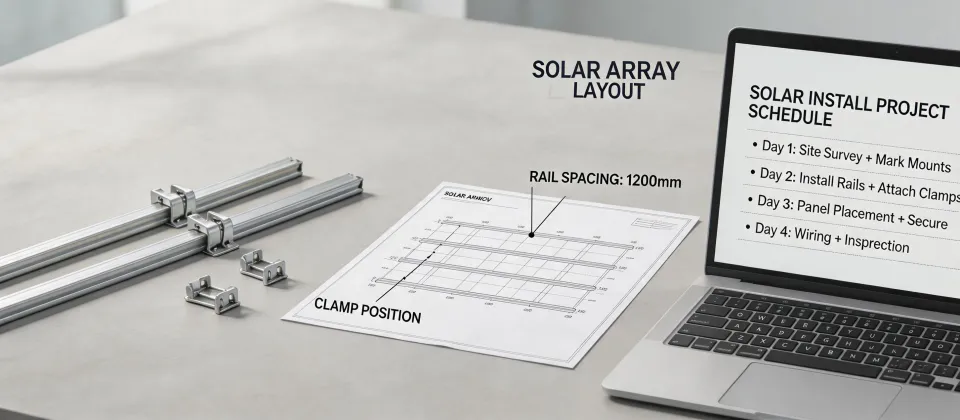
Let me save you the headache I created for myself in 2019. I was specifying a solar mounting system for a commercial metal roof—a standing seam, trapezoidal profile, the kind you see on warehouses everywhere. My default was a universal clamp kit. It worked on paper. It fit the budget. The client approved it.
Then the installation started, and everything fell apart. The clamps didn't seat correctly on the seam. The panel alignment drifted by nearly an inch across the array. We had to stop work, re-engineer the attachments, and order dedicated brackets. The delay cost us a week and roughly $4,200 in labor and materials.
That project changed how I think about mounting systems for metal roofs. Ever since, I've been documenting what works—and what absolutely doesn't. This isn't a theoretical comparison. It's based on eight years of ordering, failing, and fixing.
If you're trying to decide between a universal mounting solution and a roof-specific system, let me walk you through the trade-offs. They're not what you might expect.
What We're Actually Comparing
The core decision on a metal roof comes down to this: universal clamp systems versus profile-specific mounting systems.
- Universal systems use adjustable clamps that grip the seam from both sides, often with replaceable inserts for different profiles. They're flexible—one kit claims to fit 15 different roof types.
- Profile-specific systems are designed for a single seam geometry. The clamp matches the exact curvature and thickness of the roof panel. No adjustments, no guesswork.
I've used both extensively. Here's where they differ—and where I've made costly mistakes.
Dimension 1: Installation Speed & Learning Curve
Universal kits look faster. You open one box, grab the clamps, and start mounting. But in practice, that speed only holds if the roof is perfectly standard. The moment you hit a slight variation in the seam spacing or a transition near the ridge, the adjustment process starts.
On one project in 2022, three installers spent two full days dialing in the clamps on a 10,000-square-foot roof. Every row required tweaks. The universal system promised quick installation. It delivered frustration.
Profile-specific systems, by contrast, install like they were made for the roof—because they were. On the same roof area, a dedicated system took less than a day. The brackets snapped into place. The rails aligned without shimming.
The conclusion here is straightforward: if your crew has experience with universal clamps and the roof is simple, the difference is minor. But on complex roofs with tight deadlines, a dedicated system saves real time. In my experience, that's 30–40% faster installation, conservatively.
Dimension 2: Seam Compatibility & Long-Term Risk
Here's the dimension that surprised me. You'd think universal systems would be more accommodating. They adjust, right?
The issue is that universal clamps apply clamping force across a generic surface. If the seam profile is non-standard—say, a thinner gauge metal or a rounded top—the clamp doesn't distribute pressure evenly. Over time, thermal expansion can loosen the grip. I've seen panels shift by 3 mm after a summer of temperature swings.
I should add: that movement isn't catastrophic for small arrays. On a 50-panel system, minor shifting is often undetectable. But on a 200-panel commercial system, even 2 mm of accumulated movement can misalign the row and cause shadowing on adjacent panels.
Profile-specific systems avoid this entirely. The clamp is a precise match for the seam. There's no adjustment range, but there's also no guesswork about whether it will hold for 25 years.
The unexpected conclusion: universal systems are riskier on large arrays or roofs with non-standard metal profiles. For smaller residential jobs, the risk is manageable. For commercial installations, the added certainty of a dedicated system is worth the premium.
Dimension 3: Cost & Total Project Economics
I went back and forth on cost for a long time. Universal kits are undeniably cheaper upfront. A typical universal clamp runs about $8–12 per bracket. A profile-specific bracket can run $15–22. On a 100-panel array, that's $400 to $1,000 more for the dedicated system.
But here's what you're not seeing: what happens when the universal clamps slow you down?
In 2023, we bid a project using universal clamps. The quote came in $1,200 lower than a competitor who specified a profile-specific system. We won the bid. Then the installation took three extra days. Three days of a four-man crew at $85/hour works out to roughly $8,160 in unplanned labor. The "savings" evaporated before lunch on day two.
My rule now: if the deadline is tight, I never use a universal system. The cost of a delay far exceeds the bracket price difference. Earlier this year, we paid about $600 extra for a profile-specific system on a rush project. The alternative was missing a $50,000 installation window. The math was obvious.
That said, for projects with flexible schedules and experienced crews, universal systems can be perfectly fine. The risk is real but manageable.
My Final Framework for Making This Decision
After eight years and at least 15 metal roof projects where the wrong choice cost us time or money, here's how I decide:
- Use a universal system (carefully) when: the roof is a standard standing seam profile, the array is under 50 panels, and you have at least 3–4 days of buffer in the schedule. Your crew should have installed the same universal clamps before.
- Specify a profile-specific system when: the roof has a non-standard seam geometry (trapezoidal, curved, or thin-gauge metal), the array is over 100 panels, or the deadline is fixed. If you can't risk a delay, the dedicated system pays for itself.
I can only speak to my context: mid-to-large commercial projects with predictable ordering patterns. If you're doing small residential work with a flexible timeline, the calculus might be different. But for anyone facing a tight deadline and a metal roof, I'd strongly advise against gambling on a universal kit.
The premium for a dedicated mounting system isn't just hardware—it's certainty. And when you're racing against a construction schedule, certainty is worth more than the price tag suggests.

Jane Smith
I’m Jane Smith, a senior content writer with over 15 years of experience in the packaging and printing industry. I specialize in writing about the latest trends, technologies, and best practices in packaging design, sustainability, and printing techniques. My goal is to help businesses understand complex printing processes and design solutions that enhance both product packaging and brand visibility.