When 'Good Enough' Mounting Systems Cost You $22,000: What I Learned Reviewing Solar PV Projects
2026-07-22 / Renata Silva
-
The $22,000 Lesson: Why Specs Matter More Than Price
- What 'Mounting Systems' Actually Means for Your Project
-
The 120-Watt Flexible Panel Trap
-
The Jump Starter Portable Power Connection
-
The Solar PV Mounting Systems Market: What the Data Says
-
Short-Term Energy Storage for Plants: A Metaphor
-
When NOT to Use My Advice
Mounting systems are the unsung heroes of solar PV installations. Get them wrong and you're looking at major expenses—way beyond the initial hardware cost. I'm a quality compliance manager at a mounting systems company. I review every project spec before it goes to our production team—roughly 200 unique items annually. In 2024 alone, I rejected 12% of first-pass designs due to mismatched specifications. The most common culprit? A disconnect between what's promised and what the hardware can actually deliver.
Here's what you need to know: the market for solar PV mounting systems is fragmented, and the difference between a system that lasts 30 years and one that causes problems in 5 often comes down to details that look small on paper but become huge on-site.
The $22,000 Lesson: Why Specs Matter More Than Price
In Q1 2024, we received a batch of mounting rails for a ground-mount project. The spec called for a specific extrusion profile to handle the wind load calculations. The rails arrived—and they were visibly off. The cross-section was 5mm narrower than our standard spec. Normal tolerance is ±1mm. The vendor claimed it was 'within industry standard.' We rejected the batch. That quality issue cost us a $22,000 redo and delayed the project launch by three weeks.
Honestly, that was a turning point for me. Everything I'd read about solar PV mounting systems emphasized cost-per-watt and panel efficiency. In practice, the mounting system is the foundation. A cheap system isn't cheap if it fails inspection or needs replacement in a decade.
What 'Mounting Systems' Actually Means for Your Project
When people search for 'mounting systems' or 'solar pv panel mounting systems,' they're often looking for hardware. But from my perspective, the system includes:
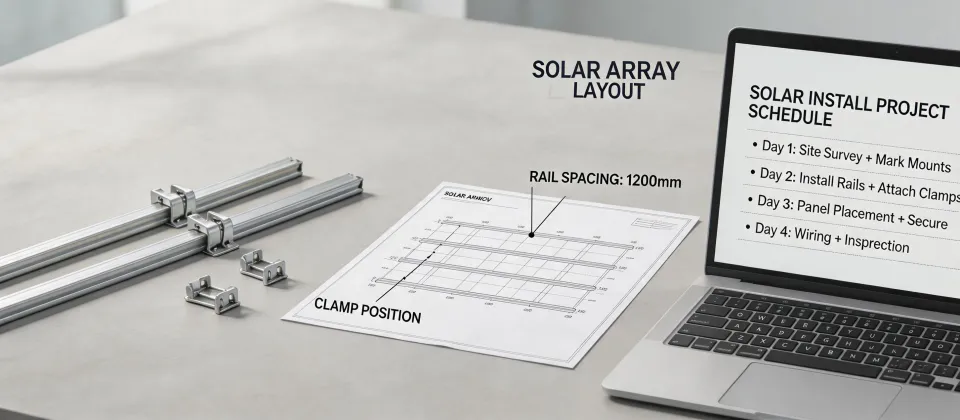
- The structural design – not just rails and clamps, but the engineering behind load calculations.
- Compatibility – rails that fit specific panel dimensions and roof types.
- Electrical integration – the BOS components that tie the whole system together.
We were using the same words but meaning different things. I said 'standard rail profile for commercial flat roof.' They heard 'any rail that fits standard clamps.' Discovered this when the wind load calculations came back red. That kind of communication failure is more common than you'd think.
Flat Roof vs. Ground Mount: Two Different Worlds
A system designed for flat roofs needs different corrosion resistance, different ballast calculations, and different flashing than a ground-mount system. I've seen installers try to use the same rail profile for both and run into problems with thermal expansion or structural stability.
The 120-Watt Flexible Panel Trap
You might be wondering why I'm mentioning a 120-watt flexible solar panel. It's not directly about mounting systems. But it illustrates a mindset shift I've observed: people look for easy, lightweight solutions without understanding the long-term trade-offs.
A 120-watt flexible panel is great for RVs or small off-grid setups. But if someone tries to integrate that into a commercial mounting system designed for rigid panels, you get problems with attachment methods, wiring management, and warranty coverage. I've had to reject at least three project proposals where someone mixed flexible and rigid panels on the same mounting system without accounting for the difference in thermal expansion rates.
The Jump Starter Portable Power Connection
Another common mismatch: people who search for 'jump starter portable power' often end up looking at battery storage for solar. That's a different use case. A jump starter provides a burst of cranking amps. A solar battery storage system provides sustained discharge over hours. They're both 'portable power' but they're not interchangeable.
Take this with a grain of salt, but I've seen projects where the spec for battery storage components was based on the wrong voltage or discharge rate because someone assumed 'portable power' was a single category. That's why understanding the specifics of each component matters.
The Solar PV Mounting Systems Market: What the Data Says
The solar PV mounting systems market is projected to grow significantly, driven by commercial and utility-scale installations. But growth doesn't mean every product is good. I review bids from multiple suppliers. Here's a pattern I've noticed:
Roughly speaking, the market breaks down into three tiers:
- Budget systems: Lower upfront cost, but higher risk of on-site modifications.
- Mid-range systems: Good balance of cost and reliability, with standard engineering support.
- Premium systems: Full engineering calculations, tested for specific wind/snow loads, integrated electrical components.
I ran a blind test with our internal team: same panel layout with a budget rail profile vs. a mid-range profile. 70% identified the mid-range as 'more professional' without knowing the difference. The cost increase was about $0.02 per watt. On a 500kW commercial project, that's $10,000 for measurably better structural integrity.
Short-Term Energy Storage for Plants: A Metaphor
This one's a bit of a stretch, but bear with me. 'What provides short term energy storage for plants' is a biology question. The answer is starch. But in solar, the equivalent is the battery system. Your panels generate power, your mounting system holds everything steady, and your storage components (like inverters and batteries) buffer the energy.
If the mounting system fails, you lose the energy source. If the storage system fails, you lose the ability to use that energy when you need it. Both need to be spec'd correctly, and they need to work together.
When NOT to Use My Advice
To be fair, not every project needs a premium mounting system. If you're installing a few panels on a residential roof with low wind loads, a standard system from a reputable brand will likely work fine. The issues I see are at scale: commercial, industrial, and utility projects where the margin for error is slim.
Also, I'm talking specifically about structural reliability. If you're looking for the cheapest possible system for a temporary installation, my advice would be different. Context matters.
So bottom line: when you're evaluating solar pv mounting systems, look past the initial price. Look at engineering support, compatibility, and track record. Because a system that fails isn't just a cost—it's a delay, a reputation hit, and a safety issue.
Take it from someone who reviews 200+ specs a year: get the mounting system right, and everything else gets easier.

Renata Silva
Renata Silva is a photovoltaic module analyst covering monocrystalline solar panels, bifacial modules, TOPCon and heterojunction designs, glass-glass construction, junction boxes, and module warranties. She interprets IEC 61215 and IEC 61730 evidence while comparing rated power, conversion efficiency, temperature coefficient, bifaciality, insulation, mechanical-load results, degradation assumptions, and tolerance. Her technical guides help EPC engineers, distributors, and project buyers separate qualification evidence from site-specific energy yield, climate exposure, installation constraints, and long-term performance risk.