Mounting Systems Specs vs. Field Reality: What a Quality Manager Checks
2026-08-04 / Renata Silva
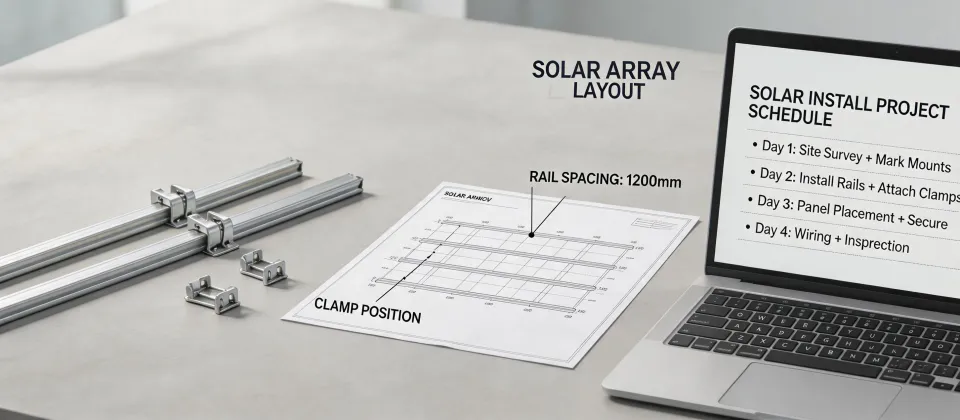
Search "mounting systems" online and you'll find kayak mounting systems, garage storage hooks, and projector ceiling mounts. In the solar industry, though, mounting systems are the unsung structural backbone of every PV installation—the rails, clamps, and flashing that hold panels on roofs and trackers in fields. They're also the product I review for a living.
I'm the quality and brand compliance manager at Mounting Systems, a solar PV mounting manufacturer. I review every specification sheet, test report, and product drawing before it reaches customers—roughly 200 items a year. In our Q1 2024 quality audit, I rejected 18% of first deliveries because the physical product didn't match the approved spec. That number was a wake-up call.
The Surface Problem: Spec Sheets That Look Too Similar
In almost every tender I read, engineers compare mounting system quotes and the spec sheets look nearly identical. Rail height, material thickness, load rating, coating mass. The numbers line up. The conclusion? "All products are essentially the same, so let's pick the lowest-priced option."
I made that assumption myself once, early in my career. I assumed "same specifications" meant identical results across vendors. Didn't verify. Turned out each supplier had slightly different interpretations of what "2mm" meant, what "tested to 60 PSF wind load" assumed about the roof substrate, and what "compatible with standard solar panels" actually covered.
Here's the thing: spec sheets don't lie. But they don't tell the whole story either. The gap between what a spec sheet promises and what a product does on a specific roof is where projects fail.
The Deep Cause: Standards Leave Room for Interpretation
Why do two products with nearly identical spec sheets perform differently? In my experience, three reasons stand out.
Material Numbers Are Ranges, Not Fixed Points
A "2mm aluminum rail" is rarely 2.00mm across its entire length. It's 1.95mm at the edges, 2.03mm in the center. Both are "2mm" if the tolerance is ±5%. Same for steel coatings: Z275 galvanizing is a different animal than Z350 in coastal environments, though both are "hot-dip galvanized." The spec sheet lists the nominal value. The actual value depends on the mill, the batch, and how rigorous the supplier's incoming inspection is.
When a vendor claims "within industry standard," they're usually right. But industry standard is a range—and the range is wide enough to cause real differences in lifespan and performance.
Load Ratings Are Conditional
Every mounting system advertises a load rating. But that rating comes from a specific test setup: a particular roof substrate, a particular fastener schedule, a particular rail span. Change any variable and the rating changes.
We saw this in our own lab when we tested another manufacturer's mounting system on a steel substrate instead of the timber deck used in their test report. The wind uplift capacity dropped 22%. The product didn't fail dangerously—it just didn't meet its published rating under a different condition. The label wasn't false. It was conditional. Too few buyers read the conditions.
When I review a test report, I go straight to the conditions section. What was the substrate? What was the fastener pattern? What was the rail support spacing? If those don't match the installation site, the rating is a reference point, not a guarantee.
Compatibility Is a Spectrum, Not a Yes/No
"Compatible with standard solar panels" sounds simple. In practice, panel frame heights vary, clamp lip geometry varies, and the difference between a secure fit and a sloppy fit can be 2mm.
I've seen a rail system spec'd as universal that clamped beautifully on a 35mm frame but barely caught the edge of a 30mm frame from a different panel brand. The installation crew ended up adding custom shims—on the roof, in the sun, at double the planned labor cost.
Where It Gets Specific: Metal Roofs, Inverters, and Storage
Wholesale Metal Sheet Roof Mounting Systems
Wholesale metal sheet roof mounting systems are a growing category, particularly for commercial rooftops where metal roofing was installed or replaced during a retrofit. But "metal sheet roof" covers trapezoidal profiles, corrugated sheets, standing seam, and sandwich panels. Each has different clamp requirements, and within trapezoidal profiles, the sheet height, width, and spacing vary by manufacturer.
I received a batch of 8,000 clamps once for a trapezoidal roof project. The spec said "compatible with 30mm trapezoidal sheets." Turned out the supplier's interpretation of 30mm was the sheet height at the seam. On-site, the actual sheets were 35mm. The clamps fit—sort of—and the rubber gasket compressed unevenly. The installer stopped before torqueing down the bolts. The vendor remade the clamps at their cost, but the project lost two weeks.
Now every wholesale contract asks for the exact roof profile drawing before production begins. Not the profile category—the drawing, with measurements. That's the difference between a spec sheet and a verified spec.
Inverters: The Footprint Question
Inverter selection affects mounting layout more than most buyers expect. A 10,000 watt power inverter (10kW) has a different footprint than a 15kW hybrid solar inverter, and the clearance requirements around each vary. In one project I reviewed, the racking layout was planned for a standard string inverter, then the owner upgraded to a hybrid unit with battery inputs—and there was no space on the mounting structure or the roof for the additional components. The hybrid inverter saves space indoors, but it often adds equipment outdoors near the array: combiners, disconnects, monitoring. Someone has to mount that equipment, and the plan has to exist before the racking ships.
Storage: Lunar Energy vs Tesla Powerwall as an Example
The storage conversation I keep hearing in 2025 is the comparison of Lunar Energy vs Tesla Powerwall. Both are reputable systems, but they approach sizing, AC coupling, and mounting differently. A Tesla Powerwall is wall-mounted and heavy; Lunar Energy's system has a different footprint and clearance requirements. From a mounting perspective, the key is deciding which storage architecture you're using before you finalize the racking layout—not after. A battery that weighs 120+ kg has structural implications for the wall or floor it mounts on, and the clearances around it affect service access. Someone has to verify that the structural mounting plan actually accommodates the chosen unit.
I'm not here to tell you which battery wins. That comparison depends on your project's load profile, tariff structure, and preference for AC or DC coupling. What I will say: the mounting and integration specs have to be part of that comparison, or you'll discover the true cost after the purchase order goes out.
The Price of Getting It Wrong
I keep a mental list of the real costs of spec mismatches.
- A 1mm difference in roof sheet profile: $5,000–15,000 in replacement clamps and labor
- An incorrect substrate assumption: $8,000–20,000 in additional structural engineering
- A last-minute inverter or battery change: 2–6 weeks of project delay
That quality issue with the 8,000 clamps cost our customer roughly $22,000 in rework and delayed their launch by two weeks. It wasn't a catastrophic failure. It was just a spec that wasn't verified against reality.
So glad we caught the substrate issue in our own testing before the system shipped. Almost didn't—the test report referenced a different substrate, and no one thought to question it until I ran the numbers.
A Brief, Practical Checklist
I said this would be practical, so here's the short version. Four questions. Ask them before you order, and you'll catch most of the mismatches I see in quality reviews.
- Can you send the full test report, not the summary? Summary spec sheets omit the conditions. The full report shows the substrate, fastener schedule, and failure mode.
- What is NOT included in the price? I've learned to ask "what's NOT included" before "what's the price." The vendor who lists all fees upfront—even if the total looks higher—usually costs less in the end. This applies to freight, hardware, engineering support, and any hidden extras.
- Does the compatibility statement cover my exact product? "Compatible with standard panels" is not the same as "tested with the 30mm frame you specified." For metal roofs, send the profile drawing before ordering wholesale metal sheet roof mounting systems.
- Who installs this, and in what conditions? The specification has to be achievable with your crew's tools and skill level on the actual roof. If it requires a specific fastener schedule, the schedule needs to be in the stamped drawings, not in a sales email.
That's it. Four questions. Simple.
Closing Thought
There's something satisfying about a product that matches its documentation exactly. After years of reviewing specs and rejecting what doesn't hold up, I've learned that the suppliers with the most transparent specifications are usually the easiest to work with. Transparent pricing, transparent test data, transparent compatibility statements. If a supplier hesitates when you ask for the full test report, treat that hesitation as information.
The cost of verifying a mounting system before you buy is small. The cost of discovering the truth after the container arrives is not.

Renata Silva
Renata Silva is a photovoltaic module analyst covering monocrystalline solar panels, bifacial modules, TOPCon and heterojunction designs, glass-glass construction, junction boxes, and module warranties. She interprets IEC 61215 and IEC 61730 evidence while comparing rated power, conversion efficiency, temperature coefficient, bifaciality, insulation, mechanical-load results, degradation assumptions, and tolerance. Her technical guides help EPC engineers, distributors, and project buyers separate qualification evidence from site-specific energy yield, climate exposure, installation constraints, and long-term performance risk.