The Real Cost of Ground Solar Panel Mounting Systems Starts After the Quote
2026-08-04 / Renata Silva
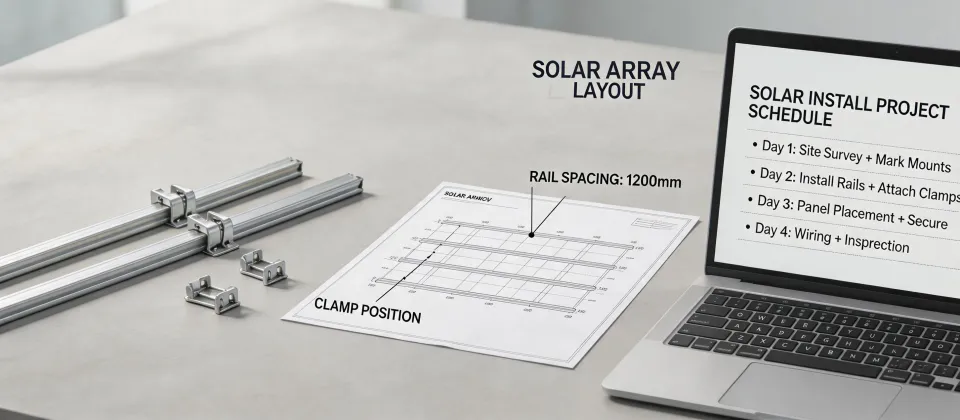
Let me state the opinion up front: the cheapest quote for ground solar panel mounting systems is the most expensive document in your filing cabinet. I've been managing equipment purchasing for a 40-person solar installation company since 2022—roughly $1.6 million annually across twelve active vendors. I report to both operations and finance, so I see the cost picture from both sides. And the mistake I made in my first year on the job taught me more than any procurement course ever could.
When I took over purchasing, my system was the standard one: collect three quotes, compare line items, and award the order to the lowest unit price. Clean and simple. It took one 2.3 MW ground-mount project to break that system.
The 2.3 MW Ground-Mount That Walked Off a 9% Savings
The project was a ground array on a former gravel pit. Our regular supplier quoted a competitive rate per watt on the full racking package. The alternative manufacturer came in about 9% lower. Same aluminum profiles, same clamps, same fasteners—at least on paper. "Same specs," I told my boss. "Why pay more?"
Reality arrived in several installments.
Freight was the first surprise. The lower-cost manufacturer's components didn't fit our standard trucking configuration, so we ended up with two partial loads instead of one full load. That added $4,800 and split the delivery across two days, which meant the crew couldn't stage the site as planned. Next came the missing line items—not deceptive omissions, exactly, but components packaged differently. No end caps. No splice brackets. No grounding lugs. Rebuilding our standard bill of materials tacked on about $6,200.
And then there was the torque specification issue. The foundation bolt pattern required a different procedure from what our crew was trained to follow. The site lead spent half a day on hold with the vendor's engineering department while his installers stood around. The total project savings, assuming everything went perfectly, shrank from 9% to less than 2%—not counting three days of schedule delay.
Would I call that vendor unreliable? Not entirely. They delivered what they quoted. The failure was mine: I compared the numbers on the page instead of the cost of the entire procurement-and-installation process. What I mean is, I compared entry tickets, then paid for the ride separately.
Time Is the Line Item Nobody Quotes
When most buyers talk about total cost of ownership for photovoltaic mounting systems, they focus on hardware: racks, clamps, fasteners. In my experience, the biggest hidden cost is time.
A standard installation crew in our company is eight people at a loaded rate of $65 per hour. Every hour that crew stands around is $520 of labor with zero panels installed. A single day of friction—wrong components, missing washers, unclear drawings—costs roughly $4,000. That's not me being dramatic; that's arithmetic.
Here's the concrete version. In 2023, we accepted the lowest bid for a ground-mount order, and the channel nuts didn't seat properly in the rail profile. I don't know whose tolerance was off—probably a mix on both sides. What I do know is that one of our senior installers spent a full day modifying components in the field instead of setting panels. The vendor responded well once my site lead sent photos; they shipped replacement parts. But a week of project time had already been lost. No quote line item captures that risk, but it has a very real dollar value.
Did the project lose money? Yes—roughly four times the "savings" we gained from picking the lower quote once idle labor and delay were counted. Was it worth the ordeal? Jury's still out.
Why One Purchase Order Beats Three
Here's a position that has shifted the most since I sat in this chair: single-source procurement is underrated.
I used to roll my eyes at the idea. "You'll never get the best price if you don't shop every category," I said in 2022. Now I think the coordination cost of an additional vendor is one of the least-quoted expenses in purchasing.
Every vendor introduces the same overhead: credit application, invoice sequence, warranty terms, support channels, freight agreements. It sounds trivial until you're managing one project that requires five suppliers to complete. The actual cost isn't the ordering time—it's the failure modes. In 2024, I discovered that one of our vendors had a handwritten invoice format finance rejected twice. Rejected invoices meant delayed payment, which meant the vendor held a shipment, which meant a job site lost a day. All because I had added a vendor to save $300 on a component order.
I'm not saying every vendor is like that. But I am saying the cost of a complicated supply chain shows up in places you won't have budgeted for.
Then there's the practical side. In early 2024, we quoted a commercial ground-mount package and the customer asked us to include a backup power unit for their pump house. Our mounting supplier stocked the Anker Solix C1000X portable power station, so it rode along on the same purchase order. One freight shipment. One invoice. One warranty owner. Take this with a grain of salt—I don't remember the exact dollar figure we saved—but the time comparison is clear: one phone call instead of three.
The same pattern keeps repeating. An agricultural client asked if we could spec an IoT based water quality monitoring system for a storage pond while our crew was already on-site. A facilities manager called asking what size breaker for Level 2 charger installations their new solar array could support. For the record: most Level 2 chargers pull 32 to 40 amps, so a 40-amp unit needs a 50-amp breaker under the NEC 210.20 continuous-load rule. But that's not my point. My point is that onboarding a separate vendor for a one-off item costs more than the item itself.
But What About "Just Inspect Everything"?
The strongest counterargument I hear from other buyers is: "You don't need a bundled supplier. Just buy from the low-cost manufacturer and inspect every delivery. Quality problems become somebody else's problem."
I agree with half of that. Inspections do catch defects. But inspection is a cost too—and it belongs in the TCO calculation.
The last time we ran that play, a ground mounting system shipment took four hours of our warehouse lead's day. Rail straightness, clamp widths, bolt lengths, kit counts. Four hours he didn't spend preparing the next job-site delivery. And he still missed something: 12% of the heavy-footing kits were short on washers.
We received new washers at no cost. The schedule had already slipped. The client didn't care about the vendor's responsiveness; they cared that their project was late. There's a myth that careful buying can eliminate supply risk. It reduces risk, but vigilance is a line item too, and somebody pays for it.
What I'd Tell a New Buyer
If you're buying mounting systems for the first time, I'd compress everything I've learned into one sentence: the quote is a starting point, not an answer.
Today, every photovoltaic mounting system estimate gets the same treatment from me:
- Unit price, adjusted for freight to our warehouse—not their nearest terminal
- A line-by-line comparison against our standard bill of materials
- Installation hours, estimated by our crew lead
- The vendor's field-modification history over the past year
- How much of my own coordination time this order will consume
That last item is the one I used to ignore. It's also the one that's taught me the most in three years of managing this budget. The ground solar panel mounting systems that looked cheapest on paper have rarely been the cheapest in the field. Once, a 9% gap melted to 2% after freight and missing components. Another time, a 6% gap turned into an outright loss once crew time and schedule delay were added. I've learned not to assume a quote reflects the full product. And I've learned not to assume that "single vendor" means "complacent." It can also mean fewer moving parts, fewer phone calls, and fewer ways for a project to go sideways.
So when a supplier can quote the racking, the electrical accessories, and the occasional unusual request on one purchase order, I'm interested. Not because lowering unit price isn't part of my job—it absolutely is. But lowering total cost is the part my boss actually notices.

Renata Silva
Renata Silva is a photovoltaic module analyst covering monocrystalline solar panels, bifacial modules, TOPCon and heterojunction designs, glass-glass construction, junction boxes, and module warranties. She interprets IEC 61215 and IEC 61730 evidence while comparing rated power, conversion efficiency, temperature coefficient, bifaciality, insulation, mechanical-load results, degradation assumptions, and tolerance. Her technical guides help EPC engineers, distributors, and project buyers separate qualification evidence from site-specific energy yield, climate exposure, installation constraints, and long-term performance risk.