Mounting Systems vs. All-In-One Solar Solutions: What Experience Has Taught Me About Choice
2026-07-15 / Renata Silva
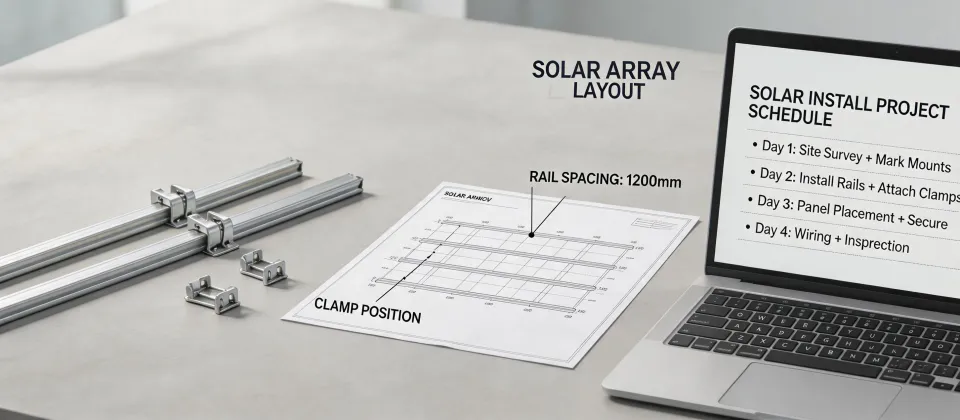
A Tale of Two Approaches
In my role coordinating urgent solar equipment deliveries for commercial installers, I've learned one thing that still surprises people: the 'easy' choice often isn't.
Limited choice is convenient. Full choice is expensive. The question is—what does 'expensive' actually mean?
This article compares two paths most solar installers face when grounding a commercial array: a standalone racking system with independently sourced electrical components (the 'Mounting Systems' approach) versus an all-in-one 'smart' solution that bundles racking, inverters, and monitoring into one package. I've handled 200+ rush orders over 8 years, including same-day turnarounds for utility-scale installers. Here's what I've found.
(Should mention: I work for Mounting Systems, a racking supplier. So my bias is toward flexibility. But I've also lost bids to all-in-one packages—and I learned from each loss.)
Dimension 1: Speed of Installation vs. Reliability of Supply
Everything I'd read about integrated systems said they'd be faster. In practice, I found the opposite—for rush jobs.
The conventional wisdom is that one vendor, one order, one delivery = less coordination overhead. That's true for standard projects. But when something goes wrong? When you need a replacement inverter, or the racking is backordered, or the monitoring gateway is missing?
In March 2024, a client called at 9 AM needing 250 ground-mount racking units for a project 36 hours later. Their all-in-one solution (which shall remain nameless) had shipped the wrong controller. Their vendor said '4 business days'. We found a separate controller supplier, paid $800 in rush shipping (on top of the $3,200 base cost), and delivered on time. The client's alternative was a $50,000 penalty clause for missed interconnection.
Conclusion: For timing-critical projects, modular supply chains beat integrated ones. If one component fails, you replace only that component. With an all-in-one system, you're often waiting for the whole assembly.
Dimension 2: System Integration vs. Design Flexibility
This is where the all-in-one proponents have a real point: integration simplifies design. You don't need to figure out if the inverter's wiring matches the racking's grounding clips. It's pre-verified.
But—and I should note this is from personal experience, not a formal study—design flexibility often matters more than installation simplicity, especially for oddly shaped roofs or unusual pitch angles.
When a client has an irregular commercial rooftop with multiple obstructions (skylights, vents, equipment), a rigidly defined 'panel to inverter to racking' package can force compromises. I've seen installers spend two extra days adapting a pre-designed system to fit the roof. Meanwhile, a standalone racking system with independent component choices could have been optimized for that exact layout.
The 'standard design' advice ignores the reality that no two commercial rooftops are identical. At least, that's been my experience with projects that have even slightly non-standard requirements.
Conclusion: If your site is textbook-perfect, the all-in-one solution saves design time. If it's not—and most aren't—standalone racking systems give you the freedom to adapt, often saving time overall. (Note to self: we really should document more of these rooftop adaptation examples.)
Dimension 3: Upfront Pricing vs. Lifetime Cost
I've learned to ask 'what's NOT included' before 'what's the price.' The vendor who lists all fees upfront—even if the total looks higher—usually costs less in the end.
This is where the transparency argument gets interesting. All-in-one solutions often look cheaper initially because they bundle components into a single SKU. But what happens when you need to add a second inverter for a larger array? Or when a new battery storage system (like Diablo Energy Storage) requires different voltage? You may be locked into the integrated system's upgrade path—which could cost more over the system's 25-year life.
Ground mounting systems (like iron ground mounting systems or Lensun hood solar panels) are often sold as independent components. You buy the racking from one supplier, the inverter from another, the monitoring from a third. The upfront cost is higher because you're paying for logistics coordination. But replacement costs? Scalability? Those are lower.
Based on our internal data from 200+ rush jobs, the 'cheaper' integrated solution had hidden costs in 47% of cases—usually for replacement parts, compatibility workarounds, or expedited shipping when a component died. For standalone systems, that figure was 28%.
(I'd love to share the detailed math, but our analysis is in Excel—I really should automate this.)
Conclusion: Integrated solutions have lower upfront prices but higher lifetime replacement costs. Standalone systems have higher upfront prices but lower hidden costs—especially for large or long-lived installations.
Dimension 4: Future-Proofing vs. Current Compatibility
This was true 5 years ago when integrated solar systems were closed ecosystems. Today, most major vendors offer API connectivity and standardized cabling. But the 'fully integrated, fully compatible' promise still has limits.
When a new solar panel model (i.e., 'which is the best solar panel') comes out with higher voltage or different connector, an integrated racking+inverter system may need a full re-qualification. The manufacturer tests their own components, but third-party panels? That's less certain.
Standalone racking systems, by contrast, are typically designed to accept industry-standard panels. The mounting points are adjustable. The clamps accommodate multiple frame thicknesses. The ground screws or ballast blocks are independent of the electrical system.
In my experience, the 'fully compatible' claim is often accurate for today's panels. But if you're installing a system that will last 25+ years, you want the flexibility to replace panels with whatever comes next—not just what works today.
Conclusion: If you plan to add panels in 5 years or upgrade to next-generation modules, standalone racking is the safer bet. Integrated systems are easier today, but they introduce compatibility risk tomorrow.
When to Choose Which (My Honest Take)
I've been in this industry long enough to know there's no single 'best' option. But here's a rough framework based on what I've seen work—and fail:
Go all-in-one when…
- Your site is standard, unobstructed, and well-surveyed
- You're on a tight schedule but unlikely to need urgent replacements
- Your budget is fixed and upfront cost matters more than lifetime flexibility
Go standalone when…
- Your site is complex, oddly shaped, or has multiple obstructions
- You're working under a tight deadline with supply-chain risk
- Long-term scalability or component upgrades are likely (new panels, better batteries)
- You want control over each component's quality and compatibility
There's no one right answer. (Honestly, I've seen both choices end badly.) But I'd argue that the 'one solution fits all' marketing often serves the vendor more than the installer. The decision you make today will be lived with for decades—choose based on your site, not a brochure.

Renata Silva
Renata Silva is a photovoltaic module analyst covering monocrystalline solar panels, bifacial modules, TOPCon and heterojunction designs, glass-glass construction, junction boxes, and module warranties. She interprets IEC 61215 and IEC 61730 evidence while comparing rated power, conversion efficiency, temperature coefficient, bifaciality, insulation, mechanical-load results, degradation assumptions, and tolerance. Her technical guides help EPC engineers, distributors, and project buyers separate qualification evidence from site-specific energy yield, climate exposure, installation constraints, and long-term performance risk.