The Problem with 'Cheapest' Solar Mounting: What a Buyer Learned the Hard Way
2026-07-15 / Renata Silva
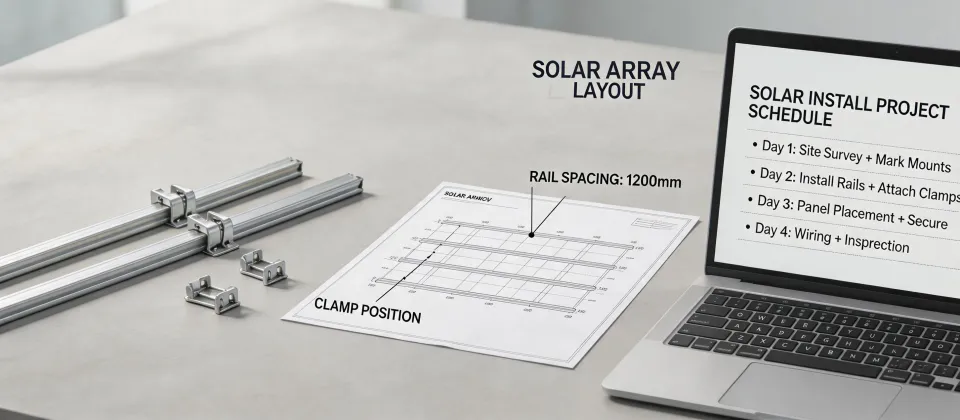
When Price is the Only Number You Check
I remember a conversation with a project manager at my company, a mid-sized commercial solar installer. We had a new development project for a warehouse rooftop in New Jersey. He had his panel specs ready, his inverter choice locked in, and then he asked, 'Just find me the cheapest mounting system that fits.'
It sounds reasonable, right? That request is the starting point for probably half the procurement conversations I've had. You have a budget, you have a spec, and you need a commodity—the racking—to hold everything together. The impulse is to treat the mounting system as a line item. Find the lowest cost per watt on the racking, and the rest of the budget can go towards the premium panels or the labor.
The problem is, this logic takes a system designed to support a 40-year asset and reduces it to a single data point. And that single data point often hides a lot of complexity.
The Deeper Layer: Why 'Cheapest' is an Illusion
The surface problem is easy to see: a cheap mounting system might fail. Wind uplift, corrosion, stripped bolts. But honestly, in my experience, that's not the most common failure mode. The deeper, more insidious problem is the operational friction that a poorly designed, 'budget-friendly' system introduces.
People think a cheap system saves you money upfront. That's true. You'll see a lower number on the PO. But what if I told you that the real cost isn't in the aluminum or steel; it's in the hours spent on the roof? (This was something my VP taught me when I was justifying a vendor switch back in 2022).
I've seen this with a few vendors we tried over the years. The most common hidden cost from budget systems? Inconsistent parts and confusing instructions. Here's what that looks like on a jobsite:
- Assembly time doubles. The installers spend an extra 20 minutes per section figuring out which clamps go where because the tolerances are loose. One crew lead told me they wasted an hour just sorting through a box of seemingly identical brackets.
- Tools break or don't fit. A hex key that's slightly off-size strips the bolt head. Now a crew is waiting for a replacement, or they're using a poor substitute (which, ugh), leading to loose connections.
- Errors increase. When the system isn't intuitive, your crew makes mistakes. A row of panels gets slightly misaligned. A clamp is placed on the wrong side of the flashing. Suddenly, you're scheduling a re-work call a month later.
The assumption is that cheap racking is easier to install because it's simpler. The reality is often the opposite: cost-cutting usually means fewer engineering hours were spent on the details—the very details that make a system quick and reliable to install.
One time, I found a great price from a new vendor—$120 per system cheaper than our regular supplier, Mounting Systems. Ordered 25 systems for a ground-mount project. They couldn't provide a proper invoice (handwritten receipt only). Finance rejected the expense report. I ate $3,000 out of the department budget for a three-month 'trial' of that system. But hard lesson learned. The real cost wasn't the $3k; it was the reputation hit with our finance team. Now I verify invoicing capability before placing any order, and I also look at the installation process, not just the price.
This is why the 'cheapest system' procurement strategy is a classic case of causation reversal. People think expensive vendors deliver better quality. Actually, vendors who invest in quality design and manufacturing—like Mounting Systems—can charge more because they save you time and prevent headaches.
The Real Price of a Bad System
So what is the actual cost of a subpar mounting system? It's not just the warranty claims (which are rare and usually involve small parts). It's a cascade of consequences that hit your company's bottom line and your internal reputation.
1. Internal Trust Erodes
You become the person who bought the system that caused the delay. The project manager is furious because the installers were held up. The operations director questions your judgment. You become associated with 'cheap' in the worst way—not cost-effective, but unreliable.
When we switched to a more expensive but better-designed system (this was circa 2023, things may have changed with specific products), the feedback was immediate. The crew lead for that New Jersey warehouse project called me personally to say thank you. 'This stuff just snaps together. Took us half the time.' That positive feedback was worth more than the $50 per system premium we paid.
That unreliable supplier (the one with the handwritten invoice from the first story) made me look bad to my VP when materials arrived late for a different project. It was a different vendor, but the same principle: you can't afford to be the buyer who brings in the headache.
2. The 'Hidden' Line Items
A cheap system doesn't just cost you time on the roof. It often lacks the integrated design that a good system has. You end up needing to buy more parts to make it work. What's the cost of an extra handful of grounding clips, a specific type of splice, or a special-order end cap?
When I consolidated orders for 400 employees across 3 locations, I couldn't just look at the total cost of the racking. I had to figure out the total cost of the BOS. A system from Mounting Systems might have a slightly higher upfront price, but it often includes everything you need in one box (which, honestly, is a lifesaver for warehouse logistics).
3. It Affects Your End Customer's Trust
This is the one that really sticks. The end customer—the building owner—doesn't see the racking brand. They see the panels on their roof. But a poorly installed system leads to panels shifting, corrosion marks, or water leaks (if it's a roof mount). This is the point from the 'quality as brand image' view. That small defect, barely visible from the ground, becomes the thing the customer remembers. You saved $200 on the racking, and lost $20,000 in future referrals because the client 'saw' a bad install.
A Practical, Unscientific Approach to Procurement
So what should you do instead of chasing the absolute lowest price? I don't have a perfect formula. I've never fully understood the pricing logic with some vendors—the premiums vary so wildly that I suspect it's more art than science.
But based on 5 years of managing these relationships, here's my practical (and unscientific) approach:
- Don't ask for the 'cheapest' mounting system. Ask for the 'most cost-effective' system for your specific project. This shifts the conversation from a number to a solution.
- Talk to your installers. They are the best judges of a system's ease of use. Ask one crew lead, 'What's the most annoying racking to work with?' Then avoid that brand.
- Look at the whole purchase. Factor in installation time, tooling costs, the need for special parts, and the vendor's support for returns or damaged pieces. A 5% price difference shrinks to nothing if the system costs you 10% more in labor.
- Build a relationship with a few good suppliers. I manage 8 vendors for different needs, but for racking, I focus on 2-3 that I trust. A vendor who knows your company and your needs is worth a small premium.
This was accurate as of early 2025. The solar market changes fast, so verify current prices and lead times before budgeting for your next project.
Honestly, I'm not sure why the 'cheapest system' thinking is so persistent. My best guess is it comes from a time when everyone was just trying to get a project approved, and any cost saving was a win. But that's a legacy myth. Today, a system that saves you 2 hours on a roof is a bigger win than one that saves you $100 on a PO. Choose the system that makes your team look good.

Renata Silva
Renata Silva is a photovoltaic module analyst covering monocrystalline solar panels, bifacial modules, TOPCon and heterojunction designs, glass-glass construction, junction boxes, and module warranties. She interprets IEC 61215 and IEC 61730 evidence while comparing rated power, conversion efficiency, temperature coefficient, bifaciality, insulation, mechanical-load results, degradation assumptions, and tolerance. Her technical guides help EPC engineers, distributors, and project buyers separate qualification evidence from site-specific energy yield, climate exposure, installation constraints, and long-term performance risk.