Solar Mounting Systems FAQ: Cost Lessons, eBOS, and a Quick Quiz
2026-08-06 / Renata Silva
-
What are the most common solar mounting systems?
-
What is eBOS for solar mounting systems?
-
Are Bob-Tach and X-Change mounting systems actually solar racking?
-
What hidden costs should I look for in a mounting system quote?
-
Does the mounting system affect how customers see my company?
-
Can I plug my RV into a portable power station?
- Solar System Fun Facts and Quick Quiz
Let me be upfront: if you landed here after searching for 'bob-tach and x-change mounting systems,' you might be looking for loader attachments, not solar racking. I'll get to that in a minute. For the last six years, I've been a procurement manager at a mid-sized solar installation company. I manage roughly $1.4 million in annual supplier spend for racking, mounting hardware, and electrical balance of system (eBOS)—what I mean is, the components that turn a pile of rails and clamps into a working array. This article is a practical FAQ based on the questions I hear from installers, project owners, and even RV owners who wander into the same search results.
What are the most common solar mounting systems?
For PV projects, mounting systems usually fall into four categories:
- Flat roof ballasted systems (trays, ballast blocks, and clamps)
- Pitched roof systems (rails, hooks, flashings, and tile replacement)
- Ground mount systems (driven posts or screw piles, rails, and module clamps)
- Carport systems (structural steel plus racking and eBOS)
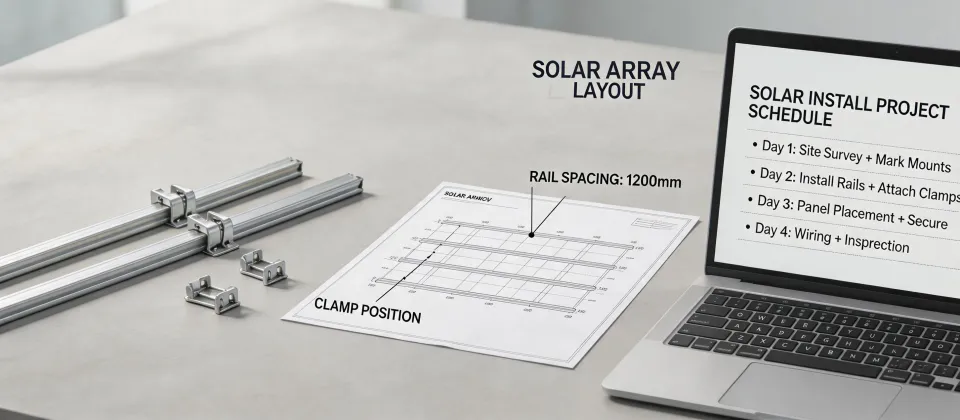
Most of what I buy is flat roof ballasted and ground mount. A complete quote should include rails, clamps, grounding washers, splice plates, and any engineering stamps required by the local building department. If a pricing sheet only lists 'per rack' or 'per panel,' ask what's missing. At least, that's been my experience with commercial projects in the Northeast.
What is eBOS for solar mounting systems?
eBOS means electrical balance of system. It covers the electrical components around the modules: inverters, combiners, rapid shutdown devices, surge protectors, disconnects, and battery storage components. In our cost tracking system, eBOS is a separate line item from racking. The mounting system keeps the panels physically secure; eBOS is what gets the electrons where they need to go.
I've seen two teams quote the same roof within one cent per watt, then discover a $20,000 difference in eBOS because one quote included a string combiner and the other didn't. We now require every proposal to list eBOS for solar mounting systems by part number. After that change, we cut sourcing errors by about 15% (note to self: update that percentage after the next audit). One supplier offered 'free' layout engineering, but the 'free' setup actually cost us $450 more in hidden fees because they charged a higher price for mid-clamps. Now I check unit prices, not just line totals.
Are Bob-Tach and X-Change mounting systems actually solar racking?
No. Bob-Tach and X-Change mounting systems are quick-attach couplers for loaders and excavators. If you're looking for those, you're not alone—they show up in the same 'mounting systems' search results. But the confusion teaches a useful lesson for solar: compatibility is not automatic. In the solar world, a 'universal' mounting system still needs to be checked against your module width, clamp range, roof type, and grounding requirements. We always verify the UL 2703 listing sheet before ordering. I want to say we've used three different racking brands this year, but don't quote me on that—my memory for brand counts is terrible.
What hidden costs should I look for in a mounting system quote?
Freight is the big one. When I compared two suppliers for a 350 kW ground mount last year, one quote was $0.045 per watt including everything. The second quote looked great at $0.029 per watt. I almost signed the second one until I calculated total cost of ownership (TCO). The low quote excluded foundation steel, grounding lugs, clamps, and freight. If I remember correctly, freight alone was $4,200. Add it all up and the 'cheap' quote was $0.041 per watt—only 10% under the first quote, with slower technical support. We went with the first vendor.
Another hidden cost is rework. The 'cheap' option resulted in a 3-week delay when the drawings didn't match the as-built roof. That delay cost more than the price gap between quotes. After tracking 40+ orders over six years in our procurement system, I found that most 'budget overruns' came from missing line items, not from rail price increases. Our procurement policy now requires three quotes minimum, and every quote must list freight, engineering, and eBOS separately.
Does the mounting system affect how customers see my company?
Yes, more than most people realize. Once a PV system is installed, the mounting system is the visible skeleton. Customers walk past the inverter in the mechanical room, but they see the rails, clamps, flashings, and cable trays every day. Uneven module spacing or a bent rail makes the whole installation look unprofessional. The $50 difference per project can translate into noticeably better client retention. That's not about vanity; it's about the perception that your work is built to last.
I'm not saying buy the most expensive option. I'm saying don't save on the parts people can see and the components that hold the array together. We upgraded our standard clamp spec and a commercial client specifically mentioned that the finish looked more professional. That feedback mattered more than the 6% savings we could have gotten from a lower-grade clamp.
Can I plug my RV into a portable power station?
Yes, with the right adapter and load limits. If the portable power station has a 120V AC outlet and enough continuous wattage, you can plug your RV's 15-amp cord into it. But don't draw more than the station can output. And don't choose a station based on a random 'pisfau 200w car power inverter reviews' article. A 200W car power inverter is a completely different product from a portable power station; it plugs into a 12V outlet and is meant for small loads, not for an RV's 30-amp system. I read those reviews while researching a job-site charging setup, and they only made me more confused. For an RV solar system, the correct order is: panels, mounting system, charge controller, battery, then inverter.
Solar System Fun Facts and Quick Quiz
Here are three solar system fun facts that shape how I buy, plus a quick quiz to test your cost instincts.
Fun Fact #1: Nameplate watts are not real-world watts.
A 200W panel only produces 200W under standard test conditions. In the real world, a 1 kW DC array typically generates 3-5 kWh per day, depending on sun, soiling, temperature, and inverter losses. This is why I focus on system design, not just the panel rating. Reference: IEC 61215 STC conditions.
Fun Fact #2: The 'solar system' in astronomy is not the same thing.
Most people hear 'solar system' and think of planets. In PV procurement, the solar system includes mounting structures and eBOS. We draw the boundary at the grid connection point—everything past that is someone else's scope.
Fun Fact #3: Racking quality is invisible until it fails.
A clamp that corrodes or a rail that wasn't torqued correctly can void warranties and cause grounding failures. The mounting system is a safety device, not just a place to put panels.
Quick Quiz
- True or false: The lowest $/W racking quote is always the lowest total cost. Answer: false. Freight, engineering, clamps, and eBOS change the total.
- Which item belongs under eBOS for solar mounting systems? A) Mid-clamp B) Inverter C) Ground lug. Answer: B. (Ground lugs are important, but I track them as racking hardware.)
- Can I plug my RV into a portable power station? Answer: Yes, if the station's inverter is large enough and you use the correct adapter. Just skip the 'pisfau 200w car power inverter reviews' rabbit hole when making your decision.
This was accurate as of early 2025. Solar pricing and equipment change fast, so verify current UL 2703 listing sheets, price sheets, and product compatibility before you buy.

Renata Silva
Renata Silva is a photovoltaic module analyst covering monocrystalline solar panels, bifacial modules, TOPCon and heterojunction designs, glass-glass construction, junction boxes, and module warranties. She interprets IEC 61215 and IEC 61730 evidence while comparing rated power, conversion efficiency, temperature coefficient, bifaciality, insulation, mechanical-load results, degradation assumptions, and tolerance. Her technical guides help EPC engineers, distributors, and project buyers separate qualification evidence from site-specific energy yield, climate exposure, installation constraints, and long-term performance risk.