Solar Mounting Systems South Africa: 7-Step Procurement Checklist (2025 Update)
2026-08-06 / Renata Silva
-
Step 1: Lock down your assumed wind load before you request quotes
-
Step 2: Demand an itemized bill of materials — refuse per-watt pricing
-
Step 3: Check which "optional extras" are actually mandatory
-
Step 4: Verify local stock and lead times — freight changes total cost
-
Step 5: Match ground-mount foundations to your actual site soil
-
Step 6: Ask for three South African project references — then call them
-
Step 7: Count everything on delivery — before the driver leaves
-
Final checks before you sign
This checklist is for procurement managers, EPCs, and developers buying solar mounting systems in South Africa — the people stuck comparing quotes that never show the same line items. I've been the procurement lead at a 40-person solar EPC in Cape Town for 6 years. I manage an equipment budget of roughly R15 million a year, sit on the panel that approves every mounting system purchase, and track every order in a cost database I built after getting burned on hidden fees twice. These 7 steps are what I run through before approving a single rail.
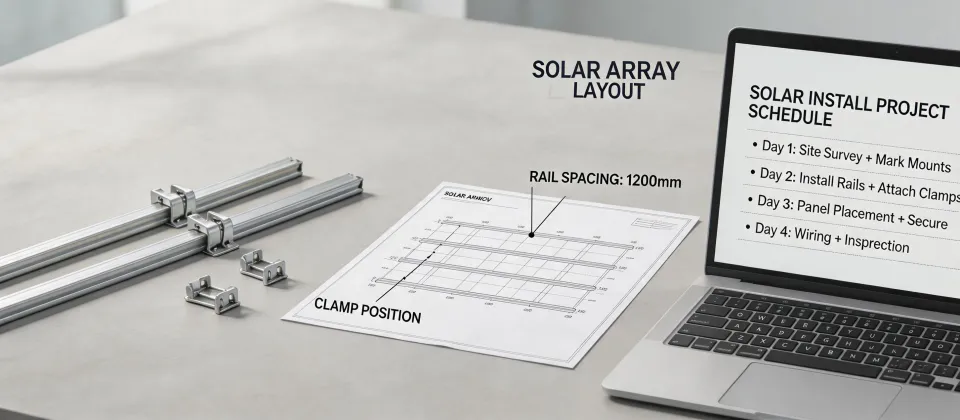
One clarification first. "Mounting systems" is a broad term — if someone asks for "TV wall mounting systems nearby," that's AV hardware, not solar PV. We get that mix-up from new clients regularly. For solar, the mounting system covers rails, clamps, grounding, and flashings — the physical structure that keeps panels attached to your roof or ground. That's what this checklist covers.
Step 1: Lock down your assumed wind load before you request quotes
I've asked five suppliers for "a mounting system price" and received five different prices — because I hadn't specified wind load, module dimensions, or roof profile. You end up comparing apples to watermelons.
South Africa has three broadly different wind regions, and the South-Easter makes coastal sites a separate category. Use SANS 10160-3:2019 (the South African National Standard for wind actions) to determine your design wind speed, then confirm the supplier's system is rated for it — in writing. A system designed for Johannesburg isn't automatically rated for Struisbaai. I once caught this before signing a coastal project; we were one signature away from approving a mounting system 30% under-rated for the site.
Step 2: Demand an itemized bill of materials — refuse per-watt pricing
Per-watt pricing hides more than it reveals. I've seen quotes at R0.82/W that looked fantastic until the BOM arrived and showed only rails and clamps. No mid-clamps, no end caps, no grounding lugs, no flashings. What I mean is: each supplier stuffs different components into that single number, and the difference is exactly where hidden costs live.
Ask for a line-item BOM with part numbers, quantities, and unit prices. Lay the quotes side by side. The first time I did this exercise, the "cheap" quote turned out to be R4.20 per panel more than a competitor once all components matched. That's a 9% difference hiding in fine print. If a supplier won't share an itemized BOM before you order, treat that as a red flag. In six years, the suppliers who refused were consistently the ones with the most "variation orders" later.
Step 3: Check which "optional extras" are actually mandatory
This is the step I never skip now. I've learned to ask "what's NOT included" before I ask "what's the price."
When I audited our 2024 spending, 12% of our mounting-system costs went to items the original quotes never mentioned: grounding hardware, bolt kits, and installation tooling — things an installer physically can't do without. Some suppliers list these clearly; others wait for the change order. The vendor who shows all fees upfront — even when the total looks higher — usually costs less in the end.
Oh, and watch the engineering extras: PE stamps, sealed drawings, and structural calculation reports. If Supplier A adds R18,000 for these and Supplier B bundles them, the math flips. Last year, switching vendors on this basis alone saved us R84,000 across four projects.
Step 4: Verify local stock and lead times — freight changes total cost
Mounting systems are heavy and bulky. A container from Europe or China takes 6–10 weeks to land in Durban or Cape Town, plus clearing, inland transport, and — some years — significant port delays. I've seen freight add 18–25% to a quoted price, and it rarely appears on page one of the quote.
For RV solar panel installation or small rooftop kits, this matters less; courier-sized parcels are cheap to move. But for a commercial ground mount, I now ask two questions before anything else: "Where is the stock physically right now?" and "What's the delivered date, not the ex-works date?" A local warehouse with a slightly higher unit price often wins on total project cost because your installation crew isn't idle for a month.
According to GreenCape's 2024 utility-scale renewable market report, logistics and import delays ranked among the top five cost risks for South African solar projects that year. That matches what I've seen tracked in our own procurement system.
Step 5: Match ground-mount foundations to your actual site soil
Ground mounts are not one product. Driven piles work in open soil. Screw anchors suit rocky sites. A single-pole flag pole ground mount minimizes land disturbance and works when you're installing around an existing structure or water tank. Each has different foundation and installation costs.
We once approved a driven-pile quote based on a geotech report from a different site — our fault for assuming the geology was similar. The rock layer turned out to be sandstone, and we re-drilled eleven holes. A R60,000 lesson in reading the soil report before choosing the mount type. I should add that this wasn't the supplier's fault; it was ours for skipping the site-specific check.
Step 6: Ask for three South African project references — then call them
Any supplier can show installation photos from Germany, Australia, or California. Ask for three completed solar mounting systems South Africa projects — same system type, similar scale, and preferably within 200 km of your site. Then call the installer and ask two questions: "Did the delivered BOM match the quote?" and "Was technical support responsive when something didn't fit?"
I skipped this step once because we were rushing and "the brand is well known." That was the one time it mattered. The rails were fine, but the local structural adaptation was under-specified, and we paid a third-party engineer to redo the calcs. A single reference call would've surfaced it.
Step 7: Count everything on delivery — before the driver leaves
This one sounds obvious. It isn't. We had no formal receiving checklist when I started, and we paid for it when 400 missing mid-clamps shut down a site for two days. The third time we received the wrong quantity, I built a verification process. Should have done that after the first time.
The drill is simple: weigh pallets, count boxes, and compare against the signed BOM. Photograph the delivery before the truck pulls away. If something's short, a photo and a delivery note stamped "received 2 pallets only" gives you leverage with the freight forwarder. Without it, you'll be arguing for months.
Final checks before you sign
Things I verify in every contract, every time:
- Replacement part pricing and lead time — rails are useless if spares take 9 weeks
- Defect claim process — who covers the replacement shipment and when it's triggered
- PE stamp — included in the quote, or billed as a "variation" later
- Extras — clamps, flashings, grounding lugs — itemized in the BOM, not lumped into "miscellaneous"
Common mistakes I still see from other procurement teams: ordering by per-watt price alone, skipping wind-load verification for inland sites, and choosing a mounting system before reading the geotech report.
And if you're comparing renewables — yes, I've fielded the question "how much do the big wind turbines cost" too. A small turbine can set you back R2 million-plus for hardware alone, before installation. A ground-mounted solar array of comparable output is typically installed for less, and the mounting system is a fraction of that. But the mounting system is the part that keeps panels on the structure through a Cape storm. Under-spec it and you lose, regardless of which renewable you picked.
If you're running this checklist for the first time, don't try all seven steps at once. Start with Step 2 — the itemized BOM — on your next quote request. That one change catches more hidden costs than the other six combined, in my experience. At least, that's been the case across the 60+ procurement cycles I've tracked in our system.

Renata Silva
Renata Silva is a photovoltaic module analyst covering monocrystalline solar panels, bifacial modules, TOPCon and heterojunction designs, glass-glass construction, junction boxes, and module warranties. She interprets IEC 61215 and IEC 61730 evidence while comparing rated power, conversion efficiency, temperature coefficient, bifaciality, insulation, mechanical-load results, degradation assumptions, and tolerance. Her technical guides help EPC engineers, distributors, and project buyers separate qualification evidence from site-specific energy yield, climate exposure, installation constraints, and long-term performance risk.