Solar Mounting-Systems: Why I Stopped Chasing the Lowest Quote
2026-08-10 / Renata Silva
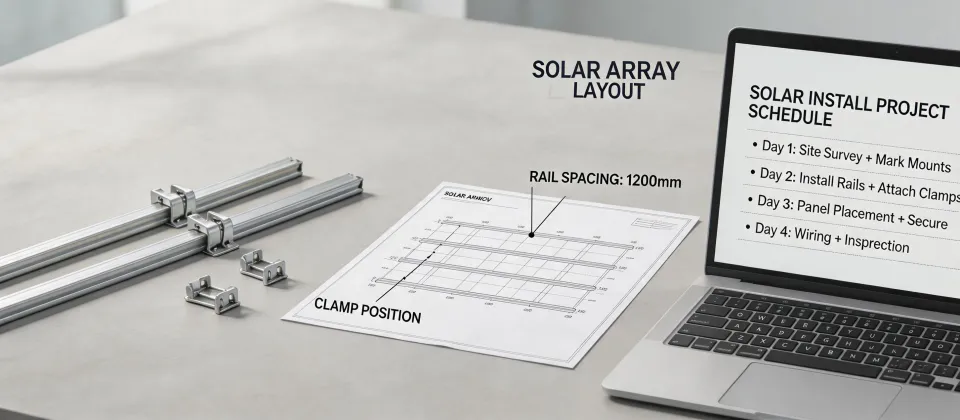
Here's an unpopular procurement opinion: when I buy solar racking, I'm not really paying for aluminum and steel. I'm paying for certainty. After five years of handling purchasing for a commercial solar installer, I'll happily pay more for a supplier who makes my job boring.
I'm an office administrator, not an engineer. I process the orders, check the invoices, and get yelled at when materials show up late. Since I took over purchasing in 2020, I've managed roughly $3 million in annual spend across about 30 supplier orders. I report to both operations and finance, so I get pressure from both sides. That doesn't make me a structural engineer. It makes me someone who has watched small procurement mistakes turn into five-figure field delays.
The day I stopped comparing line items
In 2022, I put two racking quotes side by side for the same 350 kW commercial roof. Quote A was about 9% cheaper. Quote B came with a full set of stamped drawings, an installation sequence, and a spec sheet that named every bolt. I chose A because the budget committee loved the savings. Then the installer started asking questions. Which clamp goes with the 40 mm frame? What is the torque spec? Is the rail spline rated for this row length? Quote A's response was a PDF that said 'call your rep.'
What I mean is: the money I saved on quote A wasn't savings. It was a prepayment for uncertainty. When I compared Quote B's drawing package to Quote A's three-page brochure, I finally understood why the more expensive quote was actually the cheaper project. The engineering was already done. My team was not spending field labor reinventing it.
What solar panel mounting systems manufacturers don't put in the brochure
The word mounting-systems sounds like a spreadsheet category. It's not. A mounting system is the structural connection between an expensive PV array and a building that has to stay dry, upright, and code-compliant for decades. Most marketing photos show the same shiny clamps and rails. The difference shows up in tolerances, documentation, and how fast questions get answered.
Here's something vendors won't tell you: a quoted lead time often includes buffer for their own raw material orders, credit checks, and production queue slots. That doesn't mean your order will be late. It means the 2 weeks in the quote is not the same as 2 weeks of attention on your job. A good manufacturer will tell you when the date is real and when it's an estimate.
I now watch solar mounting systems installation videos before I shortlist a manufacturer. You can tell a lot from how they assemble a rail splice or torque a clamp. A manufacturer that has clean, repeatable installation videos usually has clean manufacturing processes. The ones that don't? They send a PDF.
I'm not saying the cheapest racking can't work. I'm saying that when I can't verify engineering, I'm gambling with someone else's construction schedule.
The small purchases that cause the biggest delays
Solar procurement isn't only racking. There are inverters, combiners, monitoring, and, in our case, energy storage elements—battery modules, power conversion units, and all the little listed components that have their own lead times. Each one can stop a project.
Our office EV charging project taught me the same lesson in miniature. The tesla level 2 charger breaker size question came up because the charging unit we ordered had to be sized to the circuit, and the circuit had to be sized before an electrician pulled wire. A hardwired Tesla Wall Connector is typically installed on a 60A breaker, while a NEMA 14-50 plug requires a 50A breaker. Sounds simple, but the answer changes wire size, conduit, panel capacity, and inspection. The difference between 50A and 60A is not just a number; it determines whether the project passes inspection the first time.
People think buying hardware is the hard part. Actually, the hard part is having every specification locked down before the first truck arrives. The hardware is easy.
(Should mention: we also wasted a week on a charger that was not rated for the breaker size we thought was fine. That one mistake cost more than the extra fee I was trying to avoid.)
And to be honest, the same logic explains questions like how are wind turbines manufactured. When I finally watched a short factory tour, the part that stuck with me was tolerances. Blades are built to very specific dimensional accuracy; small variations affect aerodynamic performance. That is exactly how I see solar racking. You cannot look at a clamp and see the tolerance on the extrusion. The only thing I can check is whether the manufacturer has the drawings, testing, and quality systems to back it up.
Why I trust documents more than promises
I'm not an engineer, so I rely on external checks. For every commercial project, I want stamped structural drawings, wind calculations, and a clear instruction set. If a solar racking manufacturer makes me ask more than once for these, they drop down my list. If they cannot provide them at all, they're out. No amount of 'we've been doing this for years' replaces a signature.
That's also why I follow the actual standards instead of accepting sales talk. The National Electrical Code, NFPA 70, sets the framework for electrical work, including EV charging circuits. The Tesla installation manual gives specific breaker requirements, and it's worth reading before you buy, not after. For storage systems, the relevant UL standards and local AHJ requirements matter, and good suppliers know the difference. NREL's annual solar cost benchmarks also make the point that hardware is only one part of total installed cost; soft costs and schedule certainty eat much more budget in reality.
The assumption is that expensive suppliers deliver better quality because of their price. In my experience, it's the opposite: suppliers who invest in quality can demand a premium, and their premium pays for better engineering, testing, and support. The causation runs from quality to price, not price to quality.
But the budget, right? I hear that too.
Look, I'm not pretending every project has unlimited money. I've been in enough budget reviews to know that a difference of a few percent on racking can affect bid competitiveness. I want to say the better quote in 2022 was around 6% higher, but don't quote me on that—I remember the argument more than the decimal. If the cheaper product has proper stamped drawings, references, and an installation video that shows actual field conditions, I will consider it. I'm not married to expensive brands; I'm married to verifiable certainty.
What I refuse to do is treat a two-week lead time promise as equivalent to a confirmed production slot, or a compatibility chart as equivalent to a load calculation. The cost of being wrong is not the part cost. It's the crew waiting, the crane rental extension, the failed inspection, and the phone call I have to make to the project manager explaining why we can't hit the deadline.
The reason I'm willing to pay for certainty is not because I like spending money. It's because the penalty for missing a deadline is much larger than the premium. In March 2024, we paid $1,800 to expedite stamped drawings for a repair detail. It felt wasteful until the structural engineer returned them in three days instead of ten. The field crew stayed on schedule. That $1,800 bought a two-week construction schedule and the goodwill of a client who has already sent us two more RFQs.
My bottom line
If you're comparing solar panel mounting systems manufacturers, look past the unit price. Ask for the drawings. Ask for the installation videos. Ask who answers the phone when the crew is already on the roof. Then multiply any delay by your actual daily project cost, and you'll see why I'm so stubborn about certainty.
I would rather explain to accounting why I paid a little more than explain to a client why the project is late. One conversation is awkward. The other is expensive.
And one of those, I've learned, you don't get to do twice.

Renata Silva
Renata Silva is a photovoltaic module analyst covering monocrystalline solar panels, bifacial modules, TOPCon and heterojunction designs, glass-glass construction, junction boxes, and module warranties. She interprets IEC 61215 and IEC 61730 evidence while comparing rated power, conversion efficiency, temperature coefficient, bifaciality, insulation, mechanical-load results, degradation assumptions, and tolerance. Her technical guides help EPC engineers, distributors, and project buyers separate qualification evidence from site-specific energy yield, climate exposure, installation constraints, and long-term performance risk.