Solar PV Mounting Systems Compared: Roof vs. Ground, A Cost Controller’s Perspective
2026-08-12 / Renata Silva
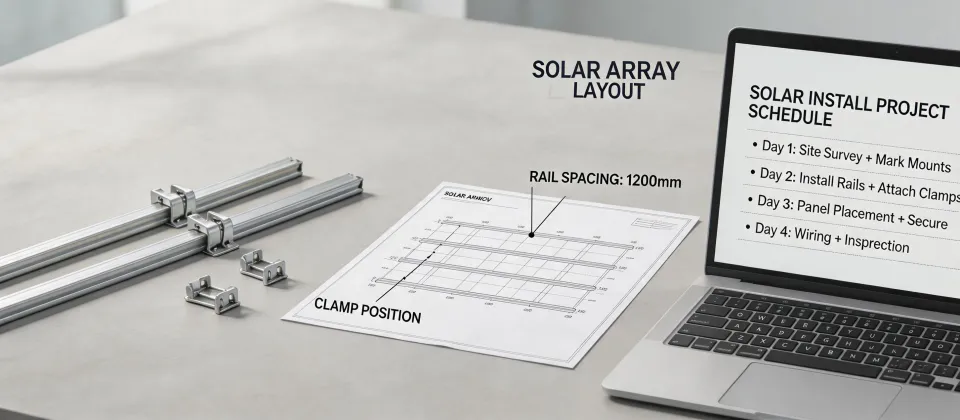
If you’re scoping a commercial solar array, the modules and inverters get the attention. The mounting system is just a frame, right? Not really. It’s where budget overruns and schedule slips hide. I’ve been the procurement manager at a 42-person solar installation company for six years. I manage about $300,000 a year in racking and BOS purchases, and I’ve reviewed every line item in our cost tracking system. This is how I compare rooftop and ground-mounted solar PV mounting systems.
Broadly, the types of solar panel mounting systems fall into two camps: roof-mounted and ground-mounted. Within those camps you have ballasted vs. penetrating, fixed-tilt vs. tracking, and carport structures. But for a typical commercial project, the first decision is roof vs. ground. I’ll walk through four dimensions: installed cost, engineering certainty, electrical integration, and lead time. Material, labor, timeline. In that order.
The comparison framework
Before you compare quotes, set a clear boundary. A racking quote should include rails, clamps, end caps, grounding features, and all required fasteners. If a quote is missing half the parts, it’s not cheaper—it’s incomplete. I’ve seen that mistake more than once, and it always shows up later as a change order.
Dimension 1: installed cost per watt
Rooftop looks cheaper at first. No land prep, no concrete, and you’re using an existing structure. But a roof project can hide costs: crane rental, monorail or scissor lifts, roof penetration flashing, parapet details, and warranty coordination. On a flat-roof retrofit in 2023, the racking material was $0.09 per watt. Total installed cost, including the lift and roof repairs? $0.31 per watt.
Ground-mounted systems have excavation, piers or driven piles, soil testing, and trenching. For a 300 kW fixed-tilt array we bid in 2024, the racking material was $0.08 per watt; total installed cost landed at $0.29 per watt. The ground mount won by a small margin, mostly because the crew could work at grade without lifts. Not ideal for every site, but workable on flat land.
Most buyers focus on material price and miss the cost of getting the material up on a roof. That’s an outsider blind spot. The conclusion for this dimension: flat, open ground can beat rooftop on total installed cost even when the roof seems like the obvious low-cost choice.
Dimension 2: engineering and permit certainty
This is the one that stings. A rooftop racking system needs wind uplift calculations, edge-distance details, and a roof plan. If the roof is irregular, the manufacturer’s standard stamped drawings may not apply. In Q1 2024, we picked a slightly cheaper rail system because the brochure looked identical to the brand we normally use. We didn’t verify the seller would provide a PE stamp for our parapet condition. They charged an extra $1,800 and needed two weeks to produce it. Then the city engineer requested revisions, and we lost three more weeks.
Ground-mounted systems carry a different engineering burden: soil bearing, frost depth, wind and snow loads per ASCE 7, and seismic if you’re in a seismic zone. But a pre-engineered ground rack from a company like Mounting Systems can include a sealed structural package for standard conditions. That certainty is worth a premium. We saved $4,100 on a “budget” custom rack for one project, then spent $5,900 on engineering revisions and contractor standby. Net loss: $1,800, not counting the delayed energization.
Conclusion: when the schedule matters, buy the vendor who can guarantee a stamped drawing before you order steel. The cheap option is not cheap if it stalls your permit.
Dimension 3: electrical integration, EV charging, and odd loads
Here’s what most buyers miss: the mounting system controls where inverters, surge protectors, battery storage, and conduit can live. A ballasted rooftop array may not leave a clean path for DC conduit down to a parking lot EV charging station. A ground-mount or carport system can be designed with a conduit corridor and a pad for the inverter.
We recently quoted a solar + storage project for a medical office that runs a remote patient monitoring system and needs two Level 2 EV charging stations for staff. The facility manager asked, “How much does an EV charging station cost?” Our quotes for that site ranged from $6,000 to $18,000 per charger, depending on trenching and service upgrades. The bigger conclusion was that choosing a carport mounting system over a ballasted roof cut the conduit run in half—and that saved more than the charger hardware difference.
If you’re adding battery storage, ask for accessory mounts. I assumed a carport system would include brackets for the inverter and battery cabinet. Didn’t verify. Turned out they were a separate accessory with a three-week lead time. A lesson learned the hard way.
For temporary commissioning power, check the Anker 522 portable power station specs: roughly 300Wh capacity with a 300W continuous AC output. It can keep a monitoring panel alive overnight, but it is not a substitute for permanent electrical accessories.
Dimension 4: lead-time certainty
This is where I’m most opinionated. In a perfect project, standard racking ships in three weeks. In real projects, galvanizing delays and freight issues happen. When you have a PPA deadline or an interconnection window, uncertain delivery is the most expensive line item you never write down.
In September 2024, we paid $400 extra for rush manufacturing on a ground mount because the alternative was missing an interconnection deadline. That extra $400 bought a confirmed ship date. We paid for certainty, not speed. No regrets.
Looking back, I should have asked for expedited drawings during engineering. At the time, the standard timeline seemed safe. It wasn’t. If you know your schedule is tight, price the guaranteed delivery and bake it into the total. That time-certainty premium is real.
So which mounting system should you choose?
Choose rooftop when you have a large, structurally verified roof, limited land, and a flexible schedule. Choose ground-mounted when the site is flat, the permit is straightforward, and you want easier access for service and future expansion. Choose carport when you need shade plus EV charging. There’s no universal winner, and any vendor who says there is one is selling you certainty you have to verify yourself.
Last year, switching from a distributor to a direct manufacturer for standard ground mounts saved us $8,400—about 17% of that line item. But the real savings came from better drawings and confirmed lead times. What I’ve learned is simple: compare material prices, then add labor, engineering, integration, and delivery confidence. Ask for stamped drawings. Ask what accessories are included. Then decide based on total cost and schedule certainty. That’s how I’d buy a solar PV mounting system.

Renata Silva
Renata Silva is a photovoltaic module analyst covering monocrystalline solar panels, bifacial modules, TOPCon and heterojunction designs, glass-glass construction, junction boxes, and module warranties. She interprets IEC 61215 and IEC 61730 evidence while comparing rated power, conversion efficiency, temperature coefficient, bifaciality, insulation, mechanical-load results, degradation assumptions, and tolerance. Her technical guides help EPC engineers, distributors, and project buyers separate qualification evidence from site-specific energy yield, climate exposure, installation constraints, and long-term performance risk.