Solar Mounting Systems FAQ: 7 Questions I Ask Before Ordering (South Africa Market Notes)
2026-08-11 / Renata Silva
-
What is a solar mounting system, exactly?
-
How is the South Africa solar PV mounting systems market different?
-
Are boat track mounting systems the same as standard solar rails?
-
What do you mean by 'solar system with names'?
-
Is a PWM solar charge controller 20A enough?
-
How do you reset a solar inverter with battery backup?
-
What's NOT included in the price?
After four years of ordering solar hardware for a twelve-person install crew, I've learned that the questions before the purchase matter more than the purchase order. I'm the office administrator for a solar installation company, and I manage roughly $850,000 per year in solar hardware across 14 vendors — mounting systems, inverters, charge controllers, batteries, cable management, the lot. I report to both operations and finance, so I get to hear when a part doesn't arrive on time and when it blows the project budget. When I took over purchasing in early 2022, I didn't know a mid clamp from an end clamp. Now I can tell you from memory which supplier's box usually includes the right bolts. This FAQ is the one I actually use when I'm comparing solar mounting systems.
What is a solar mounting system, exactly?
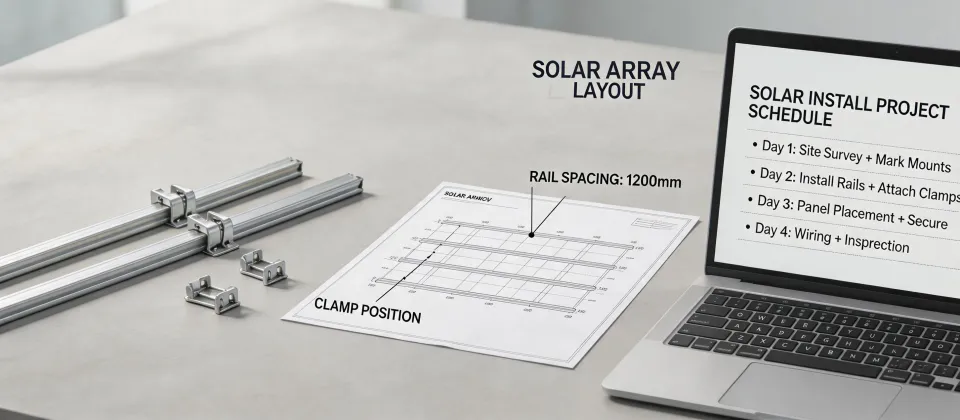
When I say mounting systems, I mean the racking, rails, clamps, and attachments that hold solar panels in place. Not the sexiest part of a solar install. But a good mounting system is boring in the best way: it goes on quick and stays put. The bad ones get remembered.
In our procurement system, 'mounting-systems' is the category code for roof hooks, rails, rail splices, clamps, bonding hardware, and ballast trays. Some suppliers include electrical accessories in the same quote, which is exactly what I want. One line item for the mechanical parts, one line item for the BOS components, no surprises.
When you compare quotes, check the clamp compatibility with your panel frame thickness. A 30mm frame and a 35mm frame often need different clamps. Ask whether the rail splice is included and whether the bonding hardware is listed. Small details like that have caused more site delays than the panels themselves. Another thing I check is whether the mounting system has a published installation manual. If the supplier won't share a manual before I order, I assume the actual install will be harder than it looks.
How is the South Africa solar PV mounting systems market different?
People ask me about the South Africa solar PV mounting systems market as if it's one uniform market. It isn't. In the Western Cape, coastal corrosion and wind load dominate. In Gauteng, security is part of the spec — stainless steel fasteners and lockable end clamps get ordered more often. In the utility-scale segment, projects tend to move in bursts when grid capacity auctions are announced.
According to SANS 10142-1, PV systems in South Africa have to meet specific electrical installation requirements. That's not a racking standard, but it affects how I order: every mounting system has to allow room for earthing and cable routes. Check the latest version before you finalise a project. (As of February 2025, that's the standard I reference at least once a week.)
Local content is another thing that comes up on large tenders. I'm not a tender specialist, but I've seen project developers ask for locally manufactured rails or local stock levels before they approve a vendor. What matters in the South Africa solar PV mounting systems market is not just the product spec; it's the supplier's ability to deliver without a month at the port.
For market numbers, I'd point you to SAPVIA and CSIR's annual renewable energy statistics. I don't want to quote a figure from memory and have it be wrong by the time you read this.
Are boat track mounting systems the same as standard solar rails?
Not exactly. Boat track mounting systems are designed for the aluminium channel track that boats use for seats, rails, and deck hardware. If a customer already has a boat track, a boat track mount lets you attach a solar panel with sliding bolts or T-bolts instead of drilling new holes in the deck. (Not that I recommend drilling into a boat deck unless the owner is sure.)
For standard roof and ground projects, I don't order these often. But marine installers do ask for them, and the same rules apply: check the panel dimensions, wind load, and corrosion specs. Marine environments are brutal on the wrong aluminium alloy.
Some boat track mounts have tilting feet that raise the panel off the deck for cooling. That can be a good thing, but it also adds height and windage. If the vessel hangs around salt water, pick stainless steel hardware and add a nylon washer or isolation tape between dissimilar metals. Galvanic corrosion is not something you want to explain to a boat owner. Also, measure the track width before ordering. A boat track is not a universal standard; some are 1 inch, some are 11mm, and some are metric. If the mount's bolt pattern doesn't match the track, it won't slide in.
What do you mean by 'solar system with names'?
If you google 'solar system with names', you'll get astronomy pages. In purchasing, I mean a labelled parts list. The BOM should say: solar panels, mounting rails, end clamps, mid clamps, inverter, charge controller, battery, combiner box, DC isolator, AC isolator, earthing hardware. If the label on the drawing doesn't match the line item on the invoice, the project is going to get messy.
I still kick myself for not checking a SKU number one time. The box looked right, the part number on the exterior was right, but the inner label had a different revision. The crew installed it anyway, and the clamp size was wrong. If I'd asked for a labelled diagram first, it would have taken ten minutes.
When I onboard a new supplier, I ask for their standard BOM template and a labelled single-line diagram. If they can't produce one, they go on the 'more checking required' list. It sounds like extra admin, but it's cheaper than a return trip.
Is a PWM solar charge controller 20A enough?
Depends on the battery voltage and the panel wattage. The number that matters is the charge current at battery voltage, not the panel's '12V or 24V' label.
A PWM solar charge controller 20A at a 12V battery handles roughly 260W (20A x 13V). At 24V, it can handle about 520W. If you oversize the panel array, the PWM controller clips the extra power. Not dangerous if the input voltage is within limits, but wasted capacity.
For small off-grid lighting and pump loads, a 20A PWM is often enough. For anything above 500W, I'd spend a little more on an MPPT controller. That's my opinion after ordering both. Also check the max PV input voltage on the controller datasheet. Some 20A PWM units are limited to 50V, which means you may not be able to run two panels in series on a 12V battery bank. Keep the wire length between the battery and the controller short; voltage drop can fool the controller into reading a lower battery state.
How do you reset a solar inverter with battery backup?
If you're here because you typed 'how to reset solar inverter with battery' into Google, you're in good company. First, check the manual. Hybrid inverters don't all reset in the same order.
Here's the general sequence I give our site crews:
- Switch off the AC breaker to the inverter.
- Turn off the battery breaker or battery switch.
- Wait at least 30 seconds. Some inverters need five minutes for the DC bus to discharge. (A tech once reset one after 10 seconds and the screen was still alive. That's how I learned the wait step.)
- Reconnect the battery first and wait for the inverter to recognise it.
- Reconnect the PV DC switch.
- Reconnect AC last.
If it still shows a fault, stop cycling power. The fault log will tell a technician more than a site crew can guess. I keep a laminated reset card in every project folder. It saves phone calls.
This is general guidance, not a substitute for the manufacturer's manual. Some inverters have a password-protected reset menu, and the sequence matters. If the inverter is warm, let it cool before resetting; some units won't restart while the internal temperature sensor is still hot.
What's NOT included in the price?
This is the question I think most buyers miss. I now ask 'what's NOT included?' before 'what's the price?'.
The vendor who lists all fees upfront—even if the total looks higher—usually costs less in the end.
To be fair, some extras are legitimate: engineering stamps, custom wind calculations, freight surcharges, crane access. The problem is when they're buried in fine print. I'd rather pay for the correct bracket than argue about a 'free' upgrade later.
Personally, I also watch for freight. A 10% lower unit price can disappear if the delivery is split into three shipments. Ask for the landed cost with a delivery date, and you'll see what's real.
Part of me wants to consolidate all orders with one vendor to keep things simple. Another part knows that a second source saved us during a mounting rail shortage in late 2024. I compromise with a primary plus one approved backup.

Renata Silva
Renata Silva is a photovoltaic module analyst covering monocrystalline solar panels, bifacial modules, TOPCon and heterojunction designs, glass-glass construction, junction boxes, and module warranties. She interprets IEC 61215 and IEC 61730 evidence while comparing rated power, conversion efficiency, temperature coefficient, bifaciality, insulation, mechanical-load results, degradation assumptions, and tolerance. Her technical guides help EPC engineers, distributors, and project buyers separate qualification evidence from site-specific energy yield, climate exposure, installation constraints, and long-term performance risk.