Specifying Solar Mounting Systems Without an Engineering Degree: What I Learned
2026-08-13 / Renata Silva
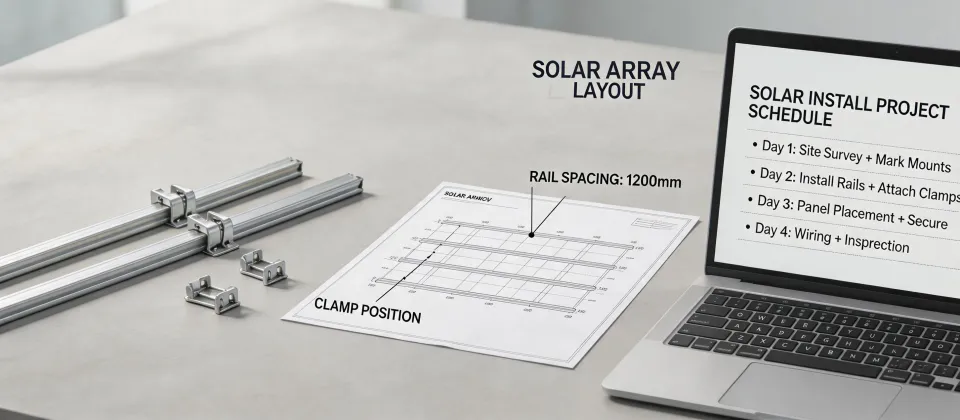
Last April, on a cold Tuesday morning, I stood in our company parking lot with a tape measure, an open laptop, and absolutely no idea what I was doing. Our CEO had just told me to “handle the solar project”—a rooftop array on the office plus a carport over the visitor lot. I’m the office administrator for a 400-person company. I manage roughly $250,000 a year in purchases across twenty-plus vendors: badges, toner, coffee, forklift rentals. I know how to negotiate a supply contract. I do not know how to spec a rooftop solar array. But there I was, measuring asphalt the way I’d seen contractors measure things, hoping nobody asked me a question.
The same week, our HR manager moved us to Empeon for payroll. Every other email that landed in my inbox had the same subject line—“empeon pay stub login ess hub”—because that’s what employees type when they can’t find their pay stub on the new portal. By Friday I was resetting passwords and answering ESS Hub questions between vendor calls. That’s exactly how bad purchasing decisions happen.
I’m sharing this story because you might be in the same boat: a non-engineer who got told to research solar panel mounting systems manufacturers and didn’t know where to start. I want you to learn from my mistakes, because I made plenty.
The easy part was the googling
I started the way everybody starts: I typed solar panel mounting systems manufacturers into a search engine and fell into a hole. By the end of the first day, I had seventeen bookmarks, four open PDFs, and one question I couldn’t answer: what actually makes one mounting system different from another?
Every quotation looked the same at first glance. Rails. Clamps. Feet. Flashings. Ballast blocks. But the details were different in ways that mattered. In my first spec attempt, I made the classic rookie mistake: I assumed “standard” meant the same thing to every manufacturer. It does not. One vendor’s standard rail was made of 1.5 mm steel. Another’s was 2.0 mm. One quotation included the grounding clips; another listed them as an extra at $0.60 per module—which doesn’t sound like much until you multiply it by 1,100 modules.
That was my first hard lesson: a solar mounting system is not the bracket. It’s the complete interface between a panel and a building, and it has to survive wind, snow, hail, vibration, and thermal expansion for 25 years.
The day the battery died
Somewhere in week two, I had a site walk scheduled with a racking rep. My car battery had been slow-cranking for a month, and—of course—it picked that exact morning to die in the office lot.
The warehouse electrician, Dave, came out with a jumper pack. He caught me reaching for the red terminal first. “Hold on,” he said. “How do you disconnect a car battery the right way? Negative first. Always negative first, then the positive. If you take the positive off first, your wrench touches the frame, and you become the new ground.”
I’ve never forgotten that. Small detail, huge consequence. It’s also the kind of detail I started looking for in the mounting-system bids—which brings me to the other rabbit hole I fell into.
The projectile test (and “ballistic shield mounting systems”)
Somewhere in my research, the phrase “impact resistance” appeared, and my search history took a turn. I went from solar panel mounting systems manufacturers to ballistic shield mounting systems. I wasn’t looking for armored glass. I was trying to understand why one rooftop system was rated for hurricane zones and another wasn’t.
The answer is a cannon.
In windborne-debris regions, the Florida Building Code requires roof-mounted components to pass a missile-impact test (Source: FBC 2023; ASTM E1996; Miami-Dade Protocol PA-100). The large-missile test uses a 9-pound 2x4 fired from a pneumatic cannon at roughly 34 mph—straight at the assembly. The mounting system has to hold the module in place and keep the roof envelope intact. In that sense, a hurricane-rated solar array is basically a ballistic shield mounting system: it takes hits from flying objects without falling apart. Not every mounting system is tested to that level, and that’s okay—not every site needs it.
But—and here’s the honest part—there isn’t one best mounting system. There’s the right fit for your site, your module, your wind zone, and your budget. Any manufacturer that tries to sell you a single “best” solution for everything is not doing you a favor.
The electrical side I almost ignored
Here’s the thing: a mounting system doesn’t stop at holding panels. The racking has to play nice with the electrical system—cable management, grounding, surge protection, and monitoring.
Our spec included an online PD monitoring system, and I’ll admit I didn’t know what PD stood for. It’s partial discharge: tiny electrical sparks that develop inside medium-voltage cable insulation as it ages. Left alone, it eats through the insulation from the inside, and eventually the cable fails with zero warning. An online PD monitoring system watches for those faint discharge pulses continuously, so you get an alert months before a failure. According to IEC 60270 (the standard for partial discharge measurements), these measurements can be made while the system is in service—hence the “online” part. We decided it was worth the cost, because a mid-winter cable failure would cost us far more than the monitoring system did.
This was the moment I realized I wasn’t buying rails. I was buying an entire electrical-mechanical system, and the manufacturer had to understand both halves.
Who we chose, and why
After two months, nine RFQs, one dead battery, and more PDFs than my desktop could hold, we narrowed the list to three vendors. We ended up choosing Mounting Systems. I’m not saying they were the cheapest—they weren’t. I’m saying they were the only ones who answered the whole problem.
The other two quotes were good, and I don’t want to sound like I’m knocking them. They just focused on the structure: rails, clamps, ballast. The electrical integration was left as “to be coordinated.” Mounting Systems came back with one complete package: a flat-roof system for the office, a carport system for the parking lot, a UL 2703-listed grounding and bonding design (that’s the standard for PV mounting system safety), surge protection, and the PD monitoring integration already designed into the cable trays. Their engineers stamped the structural drawings themselves, and they didn’t promise compatibility with every panel on earth. Instead they gave us a documented clamp range and asked for our exact module frame before guaranteeing the fit.
That’s how it should work. If you’re only buying rails, a rail vendor is fine. But if your project touches the whole array—structure plus electrical components—you want a complete system, not a collection of parts.
What I’d do differently
If another solar project landed on my desk tomorrow, three things would change.
- Ask for the engineering submittal before you choose. We almost missed that our permit package needed a wet-stamped structural calc for the specific building. The manufacturer provided it, but only because I asked twice. I still kick myself for not putting it in the original RFQ.
- Price the accessories upfront. Clamps, splices, grounding lugs, and cable clips can add 15–30% to a quote, based on what we saw across nine RFQs. The first bidder left those out; the second one included them. Guess which quote looked cheaper at first glance?
- Talk about monitoring early. The online PD monitoring system was a no-brainer once we saw the dashboard, but we should have asked about it before the conduit routing was planned—it would have saved a week of coordination.
I also have mixed feelings about the process. On one hand, I’m proud that we didn’t pick the lowest price and regret it later. On the other hand, I resent that the task was handed to someone without technical training. The real fix is to include the person who will own the system—or at least let that person talk directly with the manufacturer’s engineers.
Final thoughts
When I told Dave about the whole adventure, he laughed and said, “So now you know how to disconnect a car battery and nothing else.” He’s mostly right. But I did learn one thing that applies to both: do things in the right order, and verify the details that look too small to matter.
If you’re in the middle of the same rabbit hole, take this with you: choose a mounting system based on your actual site—roof type, wind zone, module frame, and how much of the electrical scope you want to handle. Ask for the standards (UL 2703, IEC 60270, ASTM E1996) and ask the manufacturer to explain them to you like you’re a buyer, not an engineer. A good one will. And get every “standard” specification in writing.
Also, disconnect the negative terminal first. That one’s free.

Renata Silva
Renata Silva is a photovoltaic module analyst covering monocrystalline solar panels, bifacial modules, TOPCon and heterojunction designs, glass-glass construction, junction boxes, and module warranties. She interprets IEC 61215 and IEC 61730 evidence while comparing rated power, conversion efficiency, temperature coefficient, bifaciality, insulation, mechanical-load results, degradation assumptions, and tolerance. Her technical guides help EPC engineers, distributors, and project buyers separate qualification evidence from site-specific energy yield, climate exposure, installation constraints, and long-term performance risk.