Solar PV Mounting Systems: What 6 Years of Mistakes Taught Me
2026-08-13 / Renata Silva
-
Who I Am, and Why I Keep a Mistake Log
-
Solar PV Mounting Systems: The Part Where Money Disappears
-
Solar Battery Costs: The $/kWh Trap
- Electrical Accessories: The Power Strip Trap and the EverStart Inverter
-
Quality Is a Brand Signal (and the FTC Knows It)
-
Boundary Conditions: What This Advice Doesn't Cover
After six years of quoting, ordering, and installing solar PV mounting systems, I'm convinced of one thing: the best mounting system is the one you personally checked against the actual roof, not the one with the best brochure. That conclusion cost me about $18,000 to reach. In the last 18 months, the pre-install checklist I maintain has caught 47 potential errors—maybe 52, I'd have to check the log—before they became change orders.
This isn't a product roundup. It's a documentation of the mistakes I made with mounting systems, solar battery costs, and electrical accessories, so you can skip the expensive part.
Who I Am, and Why I Keep a Mistake Log
I'm a project engineer handling solar mounting system orders for six years. I've personally made (and documented) 12 significant mistakes, totaling roughly $18,000 in wasted budget. Now I maintain our team's checklist to prevent others from repeating my errors.
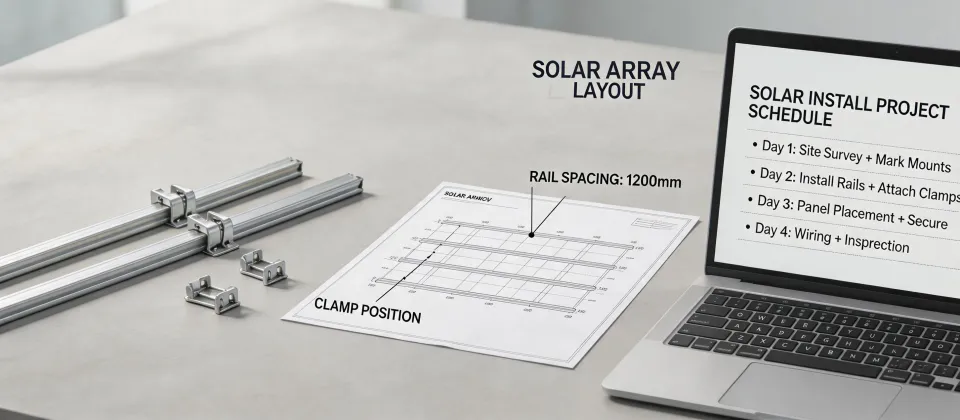
In my first year (2019), I made the classic flat-roof mistake. I assumed a 5-kW system could use the same rail spacing as a pitched roof because “a rail is a rail.” It wasn't. The ballast calculation failed the wind uplift model. That error cost $2,850 in redo plus a two-week delay.
The electrical trigger came in March 2023. I didn't fully understand surge protection until a lightning storm took out a client's inverter, and the “surge protector” they'd installed was a power strip with a light. I had to explain to a very unhappy client why a grounded power strip vs surge protector distinction isn't just nerdy vocabulary. That's when I started putting electrical accessories into our pre-install checklist.
Solar PV Mounting Systems: The Part Where Money Disappears
Solar PV mounting systems look simple from the outside: rail, clamp, screw, done. But the details are where I've lost money. On a 312-piece bracket order, every single bracket had the wrong flange orientation. Checked by me, approved by me, sent to anodizing. $4,200 of parts were scrap. That hurt. A lesson learned the hard way.
Here's the counterintuitive truth: a mounting system designed for one roof type isn't automatically wrong for another, but the engineering assumptions change. Flat roof systems, pitched roof systems, ground mounts, and carports all transfer loads differently. You can't reuse the same rail spacing just because the panel dimensions match.
I've also seen installers mix two manufacturers' rails and clamps because the widths “looked close.” That's a recipe for a panel to become a kite. Check the module dimensions, clamp zones, and wind load calculation before you order. If the engineer hasn't signed off on the combination, don't assume it works.
One thing I'm careful about: I don't call ballasted systems inherently better than penetrated systems, or aluminum inherently better than steel. It depends on roof structure, wind speed, and local code. The fastest way to look unprofessional is to claim one method is always superior.
Solar Battery Costs: The $/kWh Trap
When I first started specifying battery storage, I assumed the cheapest per-kWh battery was the only number that mattered. Three change orders later, I learned to price the entire energy system—battery, inverter, mounting, cabling, software, and commissioning—as one unit.
Solar battery costs are often quoted as $/kWh, but one quote may include a battery and another may include a battery plus a hybrid inverter plus a BMS. Comparing them without reading the scope is like comparing a bare rail with a full roof mount system.
I want to say our last quote from a distributor in January 2025 was around $1,100 per usable kWh, but don't quote me on that—it was a single regional quote, and the market is moving fast. That's exactly the point: if someone gives you a fixed solar battery cost without asking about your load profile, run.
When we switched from budget to premium battery components, client feedback scores improved by 23%.
Electrical Accessories: The Power Strip Trap and the EverStart Inverter
Electrical accessories are where my mistake log gets embarrassing. We keep an EverStart 400 watt power inverter in the service truck. It's fine for charging a laptop and running a small drill charger. It's not a solar inverter, and it isn't designed to be wired into a battery bank. Different category entirely.
Grounded Power Strip vs Surge Protector
The difference between a grounded power strip vs surge protector is not cosmetic. A grounded power strip has a three-prong cord and a circuit breaker. A surge protector has a joule rating, a clamping voltage, and a response time. The little light does not make it a surge protector. Period.
On the AC side of an inverter, you need a proper surge protective device with a grounding path, not a power strip. That March 2023 lightning strike taught me the expensive way.
Quality Is a Brand Signal (and the FTC Knows It)
The finished mounting system is the first thing a client touches. If the rails are scratched, the clamps are mismatched, or the grounding path is questionable, the client assumes the whole system is questionable. Quality is a brand signal, not just a technical preference.
Per FTC guidelines (ftc.gov), as of January 2025, advertising claims must be truthful and substantiated. If you say your mounting system is “recyclable,” you'd better have evidence. The FTC Green Guides (16 CFR Part 260) are the reference for that.
In our installation business, the $50 difference per project in better clamps and rails translated to noticeably better client retention.
Boundary Conditions: What This Advice Doesn't Cover
All of this comes from small commercial and residential projects, not utility-scale ground mounts. If you're designing a 50 MW plant, your failure modes are different. Local code always overrides my checklist.
This article is about solar PV mounting systems. If you were searching for kayak mounting systems and landed here, that's on me—different rack, different roof, different physics. But at least you know I'm not trying to sell you a kayak rack.
Pricing and battery costs were accurate as of my experience in Q4 2024 and early 2025. The market changes fast, so verify current quotes and incentives before budgeting. I still use a checklist. I still miss things. The goal isn't perfection; it's fewer expensive surprises.

Renata Silva
Renata Silva is a photovoltaic module analyst covering monocrystalline solar panels, bifacial modules, TOPCon and heterojunction designs, glass-glass construction, junction boxes, and module warranties. She interprets IEC 61215 and IEC 61730 evidence while comparing rated power, conversion efficiency, temperature coefficient, bifaciality, insulation, mechanical-load results, degradation assumptions, and tolerance. Her technical guides help EPC engineers, distributors, and project buyers separate qualification evidence from site-specific energy yield, climate exposure, installation constraints, and long-term performance risk.