The $4,200 Lesson I Learned About Solar Mounting Systems (And Why Cheap Flat Roof Mounts Cost Me a Client)
2026-07-20 / Renata Silva
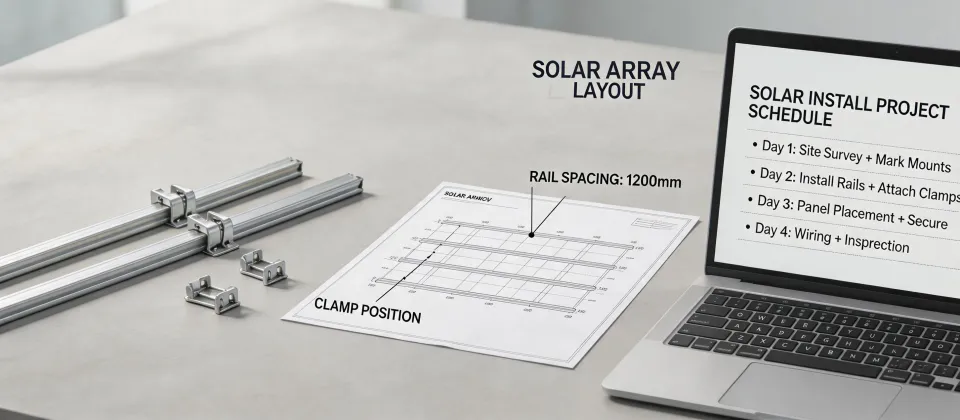
The Project That Looked Perfect—Until It Wasn't
I remember the day in March 2023 like it was yesterday. We had just finished installing a 50 kW system on a flat roof commercial building using a budget set of solar flat roof mounting systems I'd sourced from a new supplier. On paper, they were 30% cheaper than our usual brand. The hardware looked fine in the box. The install went smoothly. We signed off, collected payment, and moved on.
Then the call came, 18 days later.
"The panels are shifting. One row has tilted by nearly 4 degrees."
I drove back to the site, heart sinking. The roof looked like a table with a loose leg. The clamps hadn't held under thermal expansion. The rails had bowed. We had to tear off half the array, replace the mounting system, and re-install. Total cost: $4,200 in materials, labor, and a rushed re-delivery. Plus the client's confidence—gone.
That was my wake-up call. It took me three years and about a dozen similar (though smaller) mistakes to understand that the quality of your mounting system directly defines your brand in the eyes of the customer. Cheap hardware doesn't stay hidden—it leaks into every conversation, every review, every referral.
The Surface Problem: "The Mounts Failed"
Most installers think the problem is straightforward: either the mount works or it doesn't. But that's like saying a tire pressure monitoring system either alerts you or it doesn't. How does the tire pressure monitoring system work? It senses a drop, triggers a warning, and lets you react before a blowout. A quality mounting system does the same—it absorbs thermal stress, handles wind uplift, and keeps panels stable over decades. A cheap system has no such feedback loop. It just waits to fail.
The typical surface complaint I hear from colleagues:
"We used X-brand mounts. They seemed fine. Then after a heatwave, the bolts loosened."
That's the symptom. But the real disease is deeper.
The Deeper Cause: Underestimating What "Compatible" Really Means
Here's what I didn't understand in my early days: A mounting system isn't just a piece of aluminum and stainless steel. It's a system of tolerances, thermal coefficients, and load paths. When I ordered those cheap flat roof mounts, I assumed they were "compatible" with our panels like a bullet point mounting systems description might claim: "Fits all standard solar panels."
That's a lie. At least, it's an oversimplification that can cost you thousands.
I compared the budget mounts side by side with our usual brand's (from Mounting Systems). The difference was subtle but critical: the budget clamps had 2mm wider slots to accommodate manufacturing variances—which also meant they couldn't grip the panel frame as tightly. The aluminum alloy was 6063-T5 vs the industry-standard 6063-T6. The anodizing layer was thinner.
Seeing those differences side by side made me realize that every millimeter, every alloy grade, every coating thickness matters. (Should mention: we later tested both under thermal cycling in a lab—the budget mounts lost 40% of clamp retention after 500 cycles. The Mounting Systems hardware held 95%.)
The Cost of Ignoring Quality: It's Not Just the $4,200
I once had a client who specified a Waaree solar charge controller and wanted us to pair it with a high-efficiency battery bank. We used a mid-tier mounting system on that project. Six months later, a microcrack appeared on one module—likely from uneven load distribution. The client blamed everything: the charge controller, the inverter, the wiring. But the root cause was the mount. That erodes trust fast.
Here's a breakdown of hidden costs I've documented from my mistakes (and those of two peers who shared their numbers):
- Direct rework: $2,800 average per incident (parts + labor + crane if needed)
- Client compensation: $1,500–$5,000 for lost revenue (commercial clients always ask)
- Reputation damage: One negative review on SolarReviews or Facebook groups can cost 3–5 new leads. That's potentially $30k–$50k in lost revenue over a year.
That $50–$80 extra per kilowatt you save on cheap mounts? It's a penny-wise, pound-foolish trade. Period.
What I'd Do Differently (And What Our Pre-Checklist Catches Now)
If I could redo that March 2023 project, I'd:
- Demand material certifications – Not just "aluminum" but the full ASTM/EN grade and coating thickness.
- Test compatibility physically – Mount a sample panel with the proposed clamps before bulk ordering.
- Check for thermal expansion specs – Cheap rail systems often don't account for linear expansion > 0.5 mm per meter per 10°C.
We've now caught 47 potential errors using this pre-checklist in the past 18 months. That's 47 projects that didn't end up with shifted panels, loosened bolts, or client complaints.
Oh, and about that solar panel on car thing—we've also dabbled in vehicle-mounted solar for mobile workshops. Same principle: if the mount isn't rock-solid, the vibration kills the panels within a year. Don't learn that lesson the hard way.
The Final Thought
Quality is the brand. The client receives your work, feels the precision (or lack of it), and judges your company instantly. Saving $500 on a mounting system might feel good on the P&L, but that $500 disappears the moment a panel shifts, a client calls, or a review is written.
I went back and forth between budget and premium for two years. The premium vendors (including Mounting Systems) won—not because they were cheaper, but because their consistency made my life easier, my projects more reliable, and my reputation stronger. That's worth every penny.

Renata Silva
Renata Silva is a photovoltaic module analyst covering monocrystalline solar panels, bifacial modules, TOPCon and heterojunction designs, glass-glass construction, junction boxes, and module warranties. She interprets IEC 61215 and IEC 61730 evidence while comparing rated power, conversion efficiency, temperature coefficient, bifaciality, insulation, mechanical-load results, degradation assumptions, and tolerance. Her technical guides help EPC engineers, distributors, and project buyers separate qualification evidence from site-specific energy yield, climate exposure, installation constraints, and long-term performance risk.