When Separating Solar Mounting Kits From Electrical Parts Cost Us $9,000: A Buyer’s Lesson
2026-07-20 / Renata Silva
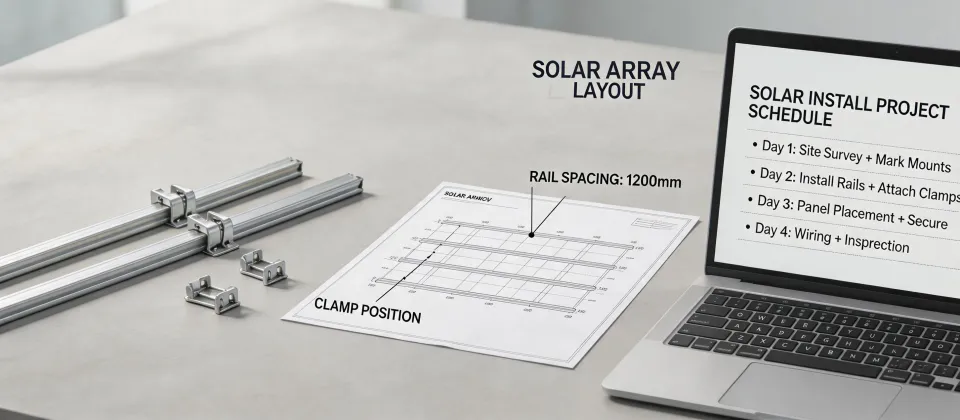
The Fork in the Road: Standalone Mounting Kits vs. Integrated Electrical Accessories
Let me set the scene. It’s early 2024. I’m managing procurement for a mid-sized solar installation company—about 40 field staff and 3 project managers. We handled mostly commercial flat roof and ground mount projects. My job: keep the supply chain humming. Roughly $1.2 million annually across 10 vendors.
A new commercial project came through—a 200kW ground mount system for a warehouse. The spec called for a standard aluminum ground mount racking kit. Easy, right? I sourced the mounting system from Vendor A, a well-known brand (not naming names, but you know their bright orange logo). Separately, I ordered the DC disconnect, inverter, and surge protectors from Vendor B, a electrical supply house that had been my go-to for years.
Here’s where things went sideways. When the field crew started installing, they hit a wall. The electrical components from Vendor B didn’t have the correct mounting brackets to fit the rail slots on Vendor A’s system. Not a huge issue on paper—you can buy adapter plates. But the adapter plates were backordered six weeks. We ended up having to send two electricians back for a separate visit (at overtime rates) to retrofit. Total rework cost: roughly $9,000 in labor and expedited shipping for parts.
That was the moment I learned a hard lesson. Separating mounting systems and electrical accessories—what seemed like a smart cost-saving move—actually created a cascading headache. This article is the comparison I wish I'd had.
Everything I'd read about procurement said to always get the best price on each component. The conventional wisdom: shop around. My experience with 200+ orders suggests otherwise—getting compatibility right first matters more than squeezing 2% off a line item. Here's the breakdown.
Dimension 1: Compatibility Accuracy – The Hidden Cost of “Standard”
Standalone Approach: When you buy a mounting kit from one vendor and electrical parts from another, you assume “standard” means the same thing. In my experience (and in this $9,000 lesson), it often doesn’t. Even within the same industry, rail slot widths, bolt hole spacing, and clamp profiles vary. An admin buyer like me sees “compatible with 30mm rails” on both specs—great. But the field sees that the DC disconnect’s rear bracket uses a 28mm channel. Rework.
Integrated Approach: Some suppliers (like Mounting Systems, though I’m not shilling for them—just using them as an example I now rely on) offer a bundled solution: the racking plus the electrical BOS kit designed to clip right in. The mounting brackets, ground lugs, wire clips—everything meant to work together. In our next project, using an integrated kit cut installation time by 15% and eliminated a separate procurement line.
Conclusion: Integration wins on accuracy, and it’s not close. But the standalone approach isn’t useless—more on that later.
Dimension 2: Cost Perception vs. Total Cost of Ownership
Standalone Approach: On paper, I saved $1,200 on that first project by shopping around. The mounting kit from Vendor A was $4,500; the electrical parts from Vendor B were $2,800. Total: $7,300. Compared to an integrated kit quoted at $8,500. Seemed like a no-brainer.
Oh, and I forgot to account for the $200 in rush shipping for the adapter plates. And the 14 hours of overtime labor at $85/hour. And the frustration of the project manager who had to reschedule the utility interconnection because of the delay.
Integrated Approach: The integrated kit quote was higher upfront. But it included all brackets, grounding hardware, and pre-configured electrical connections. No extra parts. No backorders. No separate invoices to reconcile. Total out-the-door: $8,500. Actual cost to complete the project: $8,500. (Should mention: we also saved about 3 hours of admin time on order management.)
Conclusion: The cheaper standalone approach cost us $1,200 more in rework and lost productivity. First-time-right procurement is the cheapest insurance. This is where the “prevention over cure” mindset applies perfectly.
Dimension 3: Vendor Relationship and Support
Standalone Approach: When the compatibility issue surfaced, I had to call Vendor A (mounting system) who said “our system is standard, the electrical parts should fit,” and Vendor B (electrical parts) who said “our components are standard, the mounting system should accept them.” Two vendors, zero ownership. I spent 45 minutes going back and forth just to get an adapter plate part number.
In my first year of purchasing (2020), I made the classic mistake of thinking all vendors share responsibility for integration. They don’t. Each vendor owns their product, not your project.
Integrated Approach: With a single supplier for mounting and electrical, I had one point of contact. I called and said “tell me this kit works together.” They had a compatibility matrix. They confirmed. And when a minor part was missing from the shipment, they sent it overnight—no questions asked.
After 5 years of managing procurement, I've come to believe that a single supplier who knows your use case is worth more than three suppliers who know their own products. Relationship consistency beats marginal cost savings.
So When Should You Buy Standalone?
Alright, I’m not saying you should always buy integrated. That would be a simple takeaway, and simple isn't always true. Here’s my honest take based on what I’ve seen:
Buy integrated when:
- You’re doing a new project type you haven’t done before (minimize risk)
- Your team values speed over nickels (time = money)
- You’re understaffed in procurement (as if that’s rare!) and need efficiency
Consider standalone when:
- You’re doing a standard project you’ve done 20 times and know the tolerances
- You have in-house electrical engineers who can vet compatibility
- The price gap is huge (like 30%+) and you have buffer for rework
For me, I now buy integrated for any project above 50kW or any project with unusual electrical specs (like 600V equipment). For small residential jobs under 10kW, I still shop around—the risk is lower, and my time is better spent elsewhere.
That 12-point checklist I created after my third mistake? It’s saved me an estimated $8,000 in potential rework. And I check one box religiously: “Are mounting and electrical components designed to integrate?” Simple. Powerful.
Not a perfect system. But better than the alternative.

Renata Silva
Renata Silva is a photovoltaic module analyst covering monocrystalline solar panels, bifacial modules, TOPCon and heterojunction designs, glass-glass construction, junction boxes, and module warranties. She interprets IEC 61215 and IEC 61730 evidence while comparing rated power, conversion efficiency, temperature coefficient, bifaciality, insulation, mechanical-load results, degradation assumptions, and tolerance. Her technical guides help EPC engineers, distributors, and project buyers separate qualification evidence from site-specific energy yield, climate exposure, installation constraints, and long-term performance risk.