The Real Cost of Flat Roof Solar Mounting: What I Learned From $40K in Mistakes
2026-08-03 / Renata Silva
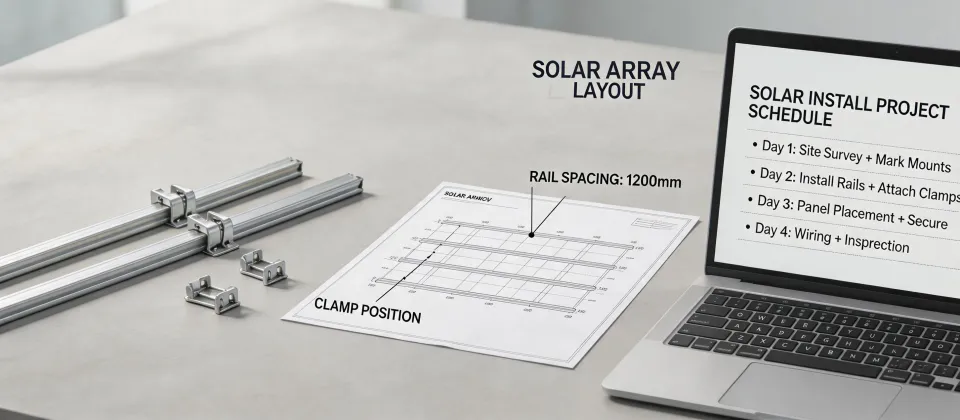
Stop comparing the per-watt price of mounting hardware. Compare the total installed cost per kilowatt — because the cheapest flat roof solar mounting system on paper was, in my experience, the most expensive one we ever installed. That lesson took me five years, roughly $40,000 in wasted budget, and more redlined invoices than I care to count.
In case you're here for a quick answer: for commercial flat roof projects, the mounting system that minimizes total cost is usually the one with the fewest parts, the most forgiving tolerance for roof variation, and a supplier who answers the phone when you're on site at 4 PM with a missing clamp. That combination matters more than the line-item price of the rail.
Why I'm the One Documenting These Mistakes
I'm a procurement lead handling solar mounting system orders for commercial and utility-scale projects — or rather, I've been doing this for five years. I started in 2020, which in retrospect was a strange time to enter the industry: supply chains were a mess, and the rush to lock in pricing caused a lot of us to make decisions we wouldn't have made otherwise.
I've personally made and documented eleven significant mistakes. The first was a classic: I chose a mounting system based on the quoted price per watt, without accounting for installation labor, accessory compatibility, or the electrician's time to wire everything together.
On a 400kW project, that decision added roughly 600 hours of labor and a three-week delay. If I remember correctly, the total premium was about $22,000. Don't hold me to that exact figure — but the point stands.
The Flat-Roof Trap: Where My $40K Went
Flat roof mounting systems look similar from the outside. Rails, ballast trays, clamps. But the differences show up in the details. I learned this the hard way on a 201-unit order where every single piece had a compatibility issue with the specified clamps.
Here's what nobody tells you about flat roof solar mounting systems:
- The base quote often excludes wind calc documentation — which your engineer will need before permitting. That's a $500 to $1,500 surprise on most projects.
- Some systems require perfectly level sub-structures. On an aging commercial roof, "perfectly level" doesn't exist. The more shimming required, the slower the installation.
- Ballasted systems are great — until they aren't. If your roof membrane has any integrity questions, the last thing you want is 40 pounds per square foot of additional load.
I'm not saying ballasted is inherently better or worse than penetrated. That depends on the roof, the wind zone, and the building's structural capacity. But I've seen project managers assume one approach is universally superior, and that assumption created more rework than any other single factor.
The mistake that hurt most was a $3,200 order — not enormous, but painful — where I approved a flat roof mounting system without checking the torque specifications against our crew's existing tools. The clamps required a specific torque wrench adapter our crew didn't carry. That cost $890 in reordered parts and a one-week delay. The project sponsor didn't say much, but the silence said everything.
Electrical Accessories Are the Real BOS Cost Leak
If you're sourcing electrical accessories for solar mounting systems, you probably already know the inverter isn't the whole story. But do you know the story of the small parts? Surge protectors, DC isolators, battery storage components — these are the items where hidden costs multiply.
I once ordered a grid connected solar inverter package for a commercial rooftop retrofit. Checked the specs myself, approved it, processed it. The inverter arrived on schedule, but the AC and DC disconnects — which I'd assumed were included — weren't. The electrician had to source them locally at retail markup. That's a $700 mistake plus a two-day delay.
(Should mention: we now ask for an itemized accessory list on every inverter quote. Optional, but it's the difference between comparing apples to apples and comparing apples to surprise invoices.)
The other lesson: don't assume "certified" means "certified for your jurisdiction." A surge protector can be UL-listed and still not meet a specific AHJ requirement. In Rockville, MD, for example, I've seen inspectors require additional labeling on EV charger installation projects that weren't necessary in the neighboring county. Same state, different rules.
The overall point: total cost of ownership includes the price of the electrical accessories, the time to source them, the labor to install them, and the risk of rework. The $500 quote that turns into $800 after shipping, setup, and revision fees is always more expensive than the $650 all-inclusive quote.
The Complete Energy Picture
One question that comes up in almost every commercial solar conversation is: how many houses does one wind turbine power? It's a fair question — it helps put the scale of renewable generation into perspective. For context, a modern 2.5 MW wind turbine produces roughly enough electricity for 1,200 to 1,500 average U.S. homes per year. A commercial rooftop solar array in the 200 kW range, using the right mounting system, covers about 30 to 40 homes. These aren't competing numbers; they're complementary pieces of the same distributed generation puzzle.
And that's why the mounting system matters even when it feels like a small piece of the budget. If the array tilts off by two degrees, if the rail spacing is off by an inch, if the electrical accessories have a compatibility gap — the generation numbers drop, and the project's financial case weakens.
Looking back, I should have built a TCO calculator in my first year instead of my third. At the time, I thought procurement was about getting the lowest quote. Now I recognize that time is also a cost — the crew's time, the engineer's time, the inspector's time. Every hour lost to poor hardware selection is money that isn't recoverable.
I also want to be honest: even after choosing a vendor, I kept second-guessing. What if their quality wasn't as good as the samples? The two weeks until delivery were stressful. Didn't relax until the first pallet arrived, and the anodizing looked right.
When This Advice Doesn't Apply
This advice is based on my experience with commercial and utility-scale projects in the mid-Atlantic region. It worked for us, but our situation was specific: we work with experienced installers, we have decent lead times, and we're usually on roofs less than 20 years old.
Your mileage may vary if you're installing on an older roof with structural question marks, or if your crew is more comfortable with one mounting approach than another. If you're dealing with a custom carport structure or a ground mount with challenging soil conditions, the flat roof calculus doesn't transfer directly.
I can only speak to domestic operations. If you're dealing with international logistics, there are probably factors I'm not aware of.
One more caveat — the market changes fast. I got burned once by assuming last year's pricing was still valid. This assessment was accurate as of Q1 2025. Verify current rates, current lead times, and current labor costs before budgeting your next project.
If you take one thing from this: find a supplier that treats mounting systems and electrical accessories as one integrated conversation — not two separate catalogs. The less coordination friction you have, the lower your total installed cost. That's the math that matters.

Renata Silva
Renata Silva is a photovoltaic module analyst covering monocrystalline solar panels, bifacial modules, TOPCon and heterojunction designs, glass-glass construction, junction boxes, and module warranties. She interprets IEC 61215 and IEC 61730 evidence while comparing rated power, conversion efficiency, temperature coefficient, bifaciality, insulation, mechanical-load results, degradation assumptions, and tolerance. Her technical guides help EPC engineers, distributors, and project buyers separate qualification evidence from site-specific energy yield, climate exposure, installation constraints, and long-term performance risk.