What I've Learned Reviewing 250+ Solar Mounting Systems: The Problem Isn't Strength
2026-08-03 / Renata Silva
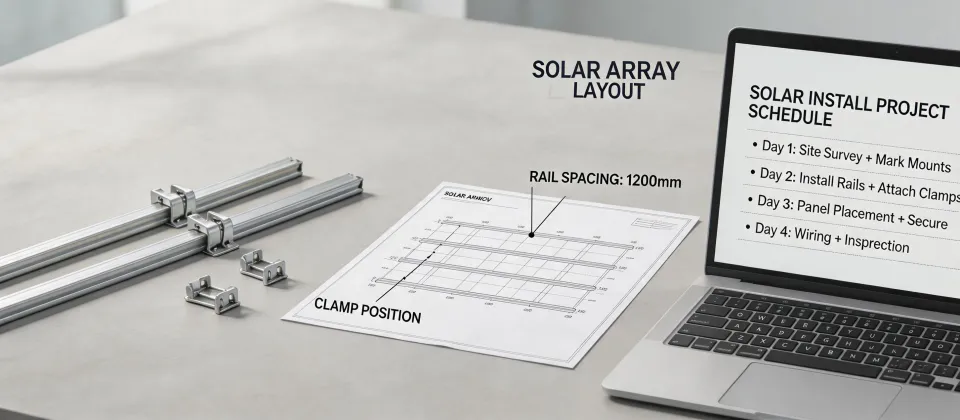
When I tell people I work in mounting systems, they sometimes ask if I mean Bob-Tach and X-Change mounting systems—the quick-attach plates on skid steer loaders. Not exactly. I'm the quality/compliance manager for a solar PV mounting company. I review every mounting layout before it ships, roughly 250 unique systems a year. I've rejected about 12% of first engineering submittals in 2025 because the details didn't match the panel frame specs.
That rejection rate is not because a mounting system was 'weak.' It's because the real problem with mounting systems has almost nothing to do with brute strength.
The Surface Problem: 'Which Mounting System Is Strongest?'
From the outside, choosing a mounting system looks like a strength contest. Buyers ask for the 'strongest rail' or the 'highest wind rating.' That's the surface problem. We're trained to think in ultimate loads, pullout forces, and material yield strength. I get it. A rail that bends under a snow load is a scary thought.
But here's the thing I've learned from hundreds of engineering reviews: the rail is usually the least of your worries. I've seen submittals where the rail, clamp, and panel were all fine on paper. Separately. The failure only appeared when the three came together. The reality is almost every field issue I've reviewed traces back to an interface detail—a torque value, a rail spacing, a grounding requirement—not a rating. I do not mean the rail is irrelevant. It matters. But it matters less than the connection.
The Deeper Problem: Interfaces, Not Components
To understand why, it helps to answer the beginner question: what is a PV panel? A PV panel, or photovoltaic panel, is a laminated assembly of solar cells that convert sunlight into DC electricity. The front is covered by solar module glass, which is not just a transparent cover. It's a load-bearing plate. It supports the panel's own weight, resists wind uplift, and transfers loads to the frame. The cells underneath are thin, brittle silicon wafers. If the glass bends too far, the cells can develop micro-cracks that don't appear on day one but show up later as reduced output.
That's why 'compatible' is such a dangerous word. It's tempting to think that any rail will work with any panel if the mounting holes line up. But the panel frame spec says how much clamping force is allowed, where the rail should be placed, and what deflection limits the glass can tolerate. If your mounting system pushes beyond those limits, the component that fails isn't the rail—it's the module. More clamps are not necessarily better. Every clamp adds a point of concentrated stress. Too many clamps, or clamps torqued beyond the frame spec, can distort the frame and stress the glass. That's an oversimplification, I know, but it's the right direction.
Most panel manufacturers test their modules to IEC 61215, and their installation instructions define mounting limits. In North America, racking is usually evaluated to UL 2703. Those documents are not exciting reading, but they define the boundaries. When a project skips that step, the boundary gets discovered the hard way.
What Does This Mean for RV Solar?
RV solar mounting systems face different stresses than a commercial roof. The roof isn't flat; it's curved and often flexible. The panel is exposed to vibration at highway speed, gusting wind from passing trucks, and thermal cycling between hot asphalt and cold nights. A low-profile bracket that looks fine on paper can create a flex point that eventually cracks the panel frame or the solar module glass.
I've seen a 100 W panel mounted with four generic Z-brackets crack after a 1,000-mile drive. The bracket didn't break. The load path was wrong—the rail spacing was too wide, and the glass was forced to carry bending loads it was never designed for. It wasn't the panel's fault. It wasn't the bracket's fault. It was the interface.
The Cost of Getting It Wrong
These problems are avoidable, and that's what makes them so frustrating. You'd think a written spec would prevent misunderstandings. It helps, but interpretation varies wildly.
A few years ago, we rejected a batch of 8,000 end clamps because the anodized coating was visibly off. It measured about 11 microns against our 18-micron spec. The vendor called it 'within industry standard.' We rejected the batch anyway. That quality issue cost us a $22,000 redo and delayed a project by two weeks. Now every contract includes a minimum coating measurement and a salt-spray test.
So glad I checked the torque chart before approving a large ground-mount order last year. I almost signed off on the generic clamp torque value. It turned out the panel frames on that project were thinner than the standard spec, and the generic torque would have been too high. We caught it before it became a field problem. In our Q1 2024 quality audit, we found that roughly 70% of rejected submittals shared the same root cause: the mounting layout was designed around the rail's strength rating instead of the panel frame's limits.
And it's not only mechanical. Electrical accessories are part of the same system. If you're installing PV on an RV, the mounting hardware has to work with the charge controller. A Go Power solar controller, for example, is a common pairing for 12 V battery banks and panels in the 50 W–200 W range. But the brand doesn't matter as much as the fact that the electrical and mechanical pieces are chosen together. A panel clamped to a roof but wired to the wrong controller is still a failed system.
What To Specify Instead
Here's the part that might sound boring: the solution is earlier, more careful engineering.
When I implemented our verification protocol in 2022, the first thing we standardized was the handshake between the mounting spec and the panel frame spec. At Mounting Systems, we design the whole balance-of-system interface—not just rails, but clamps, grounding lugs, flashings, and electrical components. When a project arrives, the first thing we do is check panel dimensions, frame type, wind zone, and roof composition. Then, and only then, do we specify clamp torque, rail spacing, and grounding method. We do not guarantee every panel will work with every rack, because that's not a real promise. We verify compatibility through specs.
That process works the same for a single RV panel and a 50,000-unit annual order. I'm not saying every manufacturer should drop minimums to one panel. But small orders deserve real engineering, not just a box of parts. A $200 order and a $200,000 order might need different processes, but neither should be a trap. When I was starting out, the vendors who treated my small orders seriously are the ones I still use today. Small doesn't mean unimportant—it means potential.
The Takeaway
Next time someone asks which mounting system is strongest, I'd rephrase the question. Ask: 'Which mounting system is engineered for my PV panel, my roof, and my electrical setup?' That's the question that separates a project that lasts from one that fails in year two.
Strength matters. But in my experience, the mounting system that fails is rarely the weakest one—it's the one with the most overlooked interfaces.

Renata Silva
Renata Silva is a photovoltaic module analyst covering monocrystalline solar panels, bifacial modules, TOPCon and heterojunction designs, glass-glass construction, junction boxes, and module warranties. She interprets IEC 61215 and IEC 61730 evidence while comparing rated power, conversion efficiency, temperature coefficient, bifaciality, insulation, mechanical-load results, degradation assumptions, and tolerance. Her technical guides help EPC engineers, distributors, and project buyers separate qualification evidence from site-specific energy yield, climate exposure, installation constraints, and long-term performance risk.