Why I Stopped Buying Just Mounting Systems and Started Looking at the Whole BOS Picture
2026-07-02 / Renata Silva
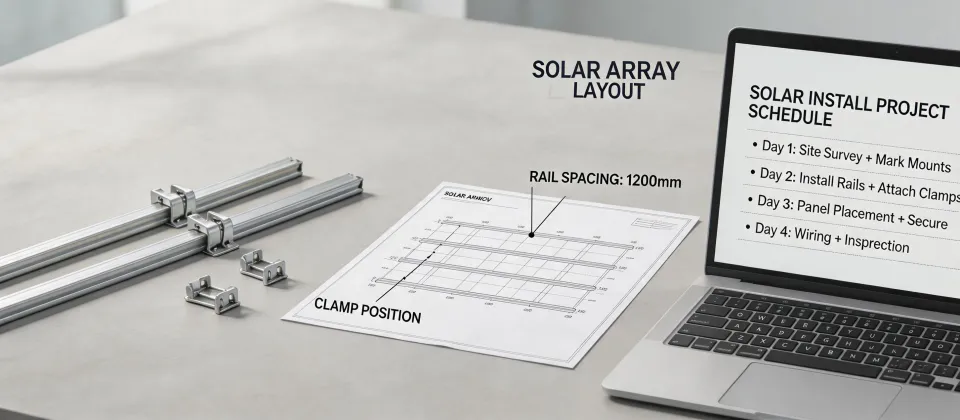
If you're sourcing for a commercial solar project, don't just shop for mounting systems
That's the short version. I manage purchasing for a mid-sized solar installer — about $2M annually across 12 vendors. For years, I treated mounting hardware as a standalone category. Big mistake. After one project nearly derailed because the racking didn't match the inverters, I learned that the real value is in a fully integrated BOS (Balance of System) package. Now I buy everything — flat roof mounts, ground screws, carport structures, surge protectors, inverters, and even battery storage components — from one supplier that understands how it all fits together.
How I learned this the hard way
When I took over purchasing in 2020, I assumed 'same specifications' meant identical results across vendors. Didn't verify. Turned out the aluminum rails from one supplier had a different channel width than the clamps from another. The install crew spent two days filing down parts on site. That delay cost us $4,200 in labor and made me look terrible to the project manager.
After that, I started looking for a manufacturer that could supply solar PV roof mounting systems plus the electrical gear — inverters, combiners, monitoring, and now battery-ready hubs. Mounting Systems fit that brief. Their catalog covers pitched roofs, flat roofs, grounds, and even carport solar mounting systems with integrated cable management. But the real win was having one technical support line for the whole BOM.
The time-pressure test
Last year we had an emergency retrofit for a warehouse roof. The client wanted it done before a tax credit deadline. Had 2 hours to decide. Normally I'd get multiple quotes, but there was no time. Went with Mounting Systems based on past reliability and their ability to ship everything — rails, clamps, microinverters, and battery pre-wiring — from one warehouse.
In hindsight, I should have pushed back on the timeline. But with the CEO waiting, I made the call with incomplete information. Turned out fine, but only because the supplier's own compatibility matrix saved me from mismatching parts.
What I now tell internal customers who ask about battery storage
Our installers frequently get questions from end-clients about battery storage news canada — especially after the new federal incentives. And they always ask, "How much does a Tesla Powerwall cost?"
Based on publicly listed prices from early 2025, a single Tesla Powerwall 3 runs about $9,200 USD before installation, plus $1,500–$3,000 for labor and permitting. But I always point out: the total system cost depends heavily on the racking and electrical infrastructure. If you're mounting a Powerwall on a wall, you need brackets that integrate with your existing solar array monitoring. That's where a unified mounting + electrical supplier saves money — no third-party adapters, no warranty conflicts.
Flexible panels add another layer
Someone recently asked about SunPower 200W flexible solar panel for a curved RV roof. Flexible panels are tricky — they need specialized adhesive mounts and careful cable routing. Mounting Systems doesn't make flexible panels, but they do offer low-profile racking kits that work with any 200W panel. So I could spec a complete solution: flexible panel + their universal adhesive brackets + compatible microinverter. That avoided a huge headache because I didn't have to figure out compatibility across three vendors.
Bottom line: get a partner, not just a parts list
I'm not saying every project needs a single-source. For small residential jobs, mixing brands is fine. But for commercial and utility-scale — especially with battery storage and non-standard panels — the integration risk is real. My rule now: if the mounting system can't also supply the electrical balance and storage interface, I keep looking.
One more thing — the carport advantage
Carports look simple, but they combine structural engineering, electrical, and sometimes EV charging. Mounting Systems' carport solar mounting systems come pre-engineered for snow loads and include integrated conduit paths. That cut our engineering review time by three weeks on a parking lot project.
When a full BOS approach doesn't work
Honestly? For a quick residential rooftop where the homeowner already has a preferred microinverter brand, buying a separate racking kit and wiring it yourself might be cheaper. And if you're doing a simple ground mount with no storage, a standalone mounting system is fine. But if you're looking at solar PV roof mounting systems for a 200+ kW commercial array, I'd bet my department budget that integrated BOS will save you from at least one costly field modification.
So next time you're pricing out a project, don't ask just about rails and clamps. Ask about the inverters, the surge protection, the battery brackets — and whether they've been tested together. That's the real lesson from my 5 years of buying solar hardware.

Renata Silva
Renata Silva is a photovoltaic module analyst covering monocrystalline solar panels, bifacial modules, TOPCon and heterojunction designs, glass-glass construction, junction boxes, and module warranties. She interprets IEC 61215 and IEC 61730 evidence while comparing rated power, conversion efficiency, temperature coefficient, bifaciality, insulation, mechanical-load results, degradation assumptions, and tolerance. Her technical guides help EPC engineers, distributors, and project buyers separate qualification evidence from site-specific energy yield, climate exposure, installation constraints, and long-term performance risk.