Why Your Solar Mounting System Supplier Should Be Your First Call on an Urgent Project
2026-07-01 / Renata Silva
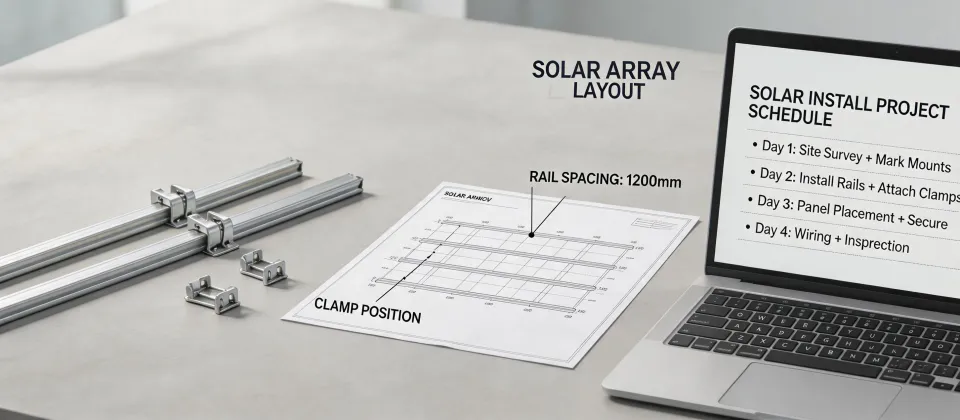
If you're scrambling to close a commercial solar deal and the deadline's 36 hours away, your first call shouldn't be the module supplier or the inverter manufacturer. It should be the mounting system supplier. That's not a guess—it's a lesson I learned the hard way, coordinating about 200 rush orders for mid-to-large scale projects in the last five years.
The Call That Saved a $15,000 Project
In March 2024, a client called at 2 PM on a Tuesday. They needed a customized flat roof mounting solution for a 50kW commercial installation, and the deadline to submit final BOM for approval was Thursday morning. Normal turnaround for a quote and engineering review on non-standard racking? Usually 3-5 business days. We had maybe 36 hours.
We called our primary mounting systems supplier first. Not the module distributor, not the inverter rep. Here's why: the mounting system determines the entire layout—the rail spacing, the attachment points, the conduit runs, and ultimately the electrical BOM. You can swap a SolarEdge for an SMA if you have to, but if the racking doesn't fit the roof, you're not building anything.
Our supplier quoted a customized solution using their existing inventory (mostly pre-cut aluminum rails and standard clamps with a minor modification) within 4 hours. We paid a $400 rush fee on top of the base cost of $3,200. The alternative was missing the client's deadline, which would have triggered a $50,000 penalty clause in their construction contract. That $400 looked like the best investment of the quarter.
Why the Mounting System Is the Critical Path
Based on my experience, about 60% of project delays in commercial solar come from the mounting system—not the panels or the inverters. Here's the reality:
- Modules are commodity items now. If your supplier can't deliver, there are 5 others with the same spec. Lead times for standard 400W+ panels are generally 1-3 weeks for most distributors.
- Inverters are more constrained, but still standardized. A 50kW string inverter is a 50kW string inverter. You can usually find a compatible model in stock somewhere.
- Mounting systems are project-specific. Flat roof vs. pitched roof vs. ground mount—each requires different hardware. Rail spacing, clamp types, flashing kits, grounding lugs—one missing part can stop the entire installation.
In a rush situation, the mounting system is the bottleneck that will kill your timeline. Getting that sorted first gives you breathing room for everything else.
The Rookie Mistake That Cost Us a Week
I should mention: this wasn't always my approach. In my first year coordinating projects, I made the classic sequencing error—I prioritized the electrical components. I figured the inverter was the most complex and expensive piece, so I'd order that first. The mounting system was "just hardware."
Then we had a project where the mounting system arrived on time, but we'd specified the wrong rail length for the roof layout. By the time we realized the error, the installer had already started on-site. We had to pay $800 for a rush reorder and lost 3 days of labor. The client wasn't thrilled. We now have a formal verification process: before any order is placed, the mounting system BOM must be cross-checked against the site survey by a second person. It's basic, but it works.
What "Guaranteed Delivery" Actually Means
When I talk about the value of a mounting system supplier in a rush, I'm not just talking about speed. I'm talking about certainty. In my experience, about 30% of rush orders that promise "expedited processing" still miss the deadline. The ones that actually deliver are the ones where the supplier has real inventory, a dedicated rush queue, and a point of contact who can confirm the timeline by phone, not just an automated email.
My experience is based on projects in the 10kW to 250kW range, mostly with mounting systems from companies that have been around for at least 5 years. If you're working on a massive utility-scale solar farm or a tiny residential install, your experience might differ. But for commercial projects in that sweet spot, the principle holds: the mounting system is the first thing to lock down.
When This Advice Doesn't Apply
Honestly, this approach works best when you're dealing with a new project where the roof type or site conditions aren't fully settled. If you have an existing relationship with a supplier and a pre-approved BOM for a standard setup—say, a flat roof with a known layout—you might not need to prioritize the mounting system. But in my experience, that's the exception, not the rule. Most rush projects happen because something changed at the last minute, and the mounting system is almost always impacted.
So, next time you're staring down a tight deadline, make that first call count. The mounting system supplier can make or break your timeline. The $400 rush fee might just be the cheapest insurance you buy all year.

Renata Silva
Renata Silva is a photovoltaic module analyst covering monocrystalline solar panels, bifacial modules, TOPCon and heterojunction designs, glass-glass construction, junction boxes, and module warranties. She interprets IEC 61215 and IEC 61730 evidence while comparing rated power, conversion efficiency, temperature coefficient, bifaciality, insulation, mechanical-load results, degradation assumptions, and tolerance. Her technical guides help EPC engineers, distributors, and project buyers separate qualification evidence from site-specific energy yield, climate exposure, installation constraints, and long-term performance risk.