Solar Mounting Systems: A 7-Point Buying Checklist for Procurement People
2026-08-14 / Renata Silva
-
Who Should Use This Checklist
-
The 7-Point Mounting Systems Buying Checklist
-
1. Match the mount to the actual installation site
-
2. Confirm module compatibility before you compare prices
-
3. Count the electrical accessories, not just the rails
-
4. Ask for engineering paperwork before you sign
-
5. Price the full bill of materials, not the per-watt racking rate
-
6. Lock down delivery timing and staging
-
7. Ask for references from similar installations
-
1. Match the mount to the actual installation site
- Common Mistakes to Avoid
-
So, What's the Bottom Line?
Type 'mounting systems' into a search engine and you get a weird mix: studio lighting modifier mounting systems, AR15 mounting systems, and shelf brackets for heavy crafts. None of that helps when you're trying to park a 550W solar panel bifacial module on a warehouse roof. This is about solar PV mounting systems.
I'm not an engineer. I'm the office administrator who does purchasing for a 15-person solar installation company. I process maybe 60-80 orders a year and manage about $1.2 million in annual hardware spend across 8 vendors. I report to operations and finance. My job is to make sure the right racks and clamps show up in time and don't turn into a call from my VP.
Since 2020, I've made enough ordering mistakes to build a checklist (in 2023, I ordered a rail that didn't match our clamp profile, and it cost two days on site). So this is the checklist I actually use. It's not engineering advice. It's the practical stuff that gets missed between the quote and the install.
Who Should Use This Checklist
Use this when you're buying mounting systems for flat roof, pitched roof, ground, or carport projects. It works for commercial and utility-scale solar arrays. If you're buying parts for a one-off DIY job, you can probably skip the engineering-stamp step, though you shouldn't.
The 7-Point Mounting Systems Buying Checklist
Seven points, no fluff. I keep this next to my mouse.
1. Match the mount to the actual installation site
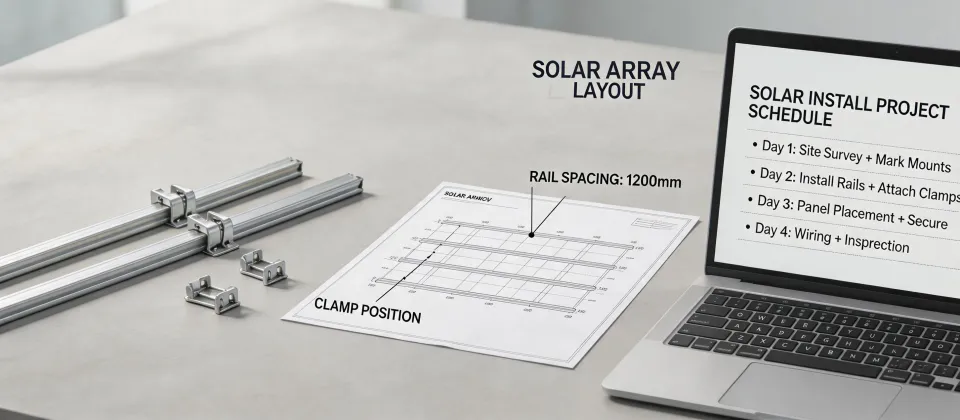
A mounting system is not universal. A flat roof system is designed around ballast and low-pitch wind behavior. A pitched roof system uses hooks and flashings that follow roof lines. A ground mount has to deal with soil and driven pile depths. A carport system needs structural steel and drainage planning. Get all four mixed up and you'll be buying adapter kits you didn't budget for.
- Flat roof: check waterproofing and ballast requirements
- Pitched roof: verify roofing material (shingle, tile, standing seam)
- Ground: assess soil conditions and frost depth
- Carport: confirm column spacing and head clearance
I once quoted a ground-mount system without checking the frost depth. The supplier asked for the geotech report before they would stamp the drawings. Good thing they did.
2. Confirm module compatibility before you compare prices
This is the step everyone skips because it seems obvious. It isn't. Large-format 550W solar panel bifacial modules are common now, and they're physically different from the 340W modules we installed regularly in 2020. The frames are taller, the widths differ, and bifacial modules need good rear-side exposure to deliver their extra energy.
Check three things:
- Clamp width and frame thickness ranges
- Number of required mid-clamps for the module length
- Rail configuration for bifacial rear-glass clearance
Ask for the supplier's current module compatibility list. If they say 'compatible with most modules,' ask for the specific list. A 'standard 30mm clamp' doesn't automatically fit a 550W solar panel bifacial frame.
This is also where the 'industry is evolving' thing matters. A mounting system designed for 2021-era panels may still be on the market, but the manufacturer may not have updated the clamp tooling. Confirm, don't assume.
3. Count the electrical accessories, not just the rails
Most mounting systems include grounding lugs, clamps, and cable management brackets. The problem is that some suppliers quote the rails and treat everything else as an add-on. Nothing is more frustrating than a full pallet of rails and no grounding hardware.
Line up your electrical BOM. For off-grid projects, a 30 amp PWM solar charge controller is common for small 12V/24V arrays, and it doesn't tell you anything about the racking. But it does tell you where the controller will be mounted, which means you need a wall or rail bracket. Include those accessories in the same order.
And since I get asked this weirdly specific question a lot: can you use LiFePO4 as starter battery? That's not a mounting system question, but the lesson is the same. Compatibility is not optional. A LiFePO4 starter battery needs a charging system designed for lithium chemistry. It might work in one truck and overheat in another. Same with clamps: the part might look right but be wrong for the module frame.
4. Ask for engineering paperwork before you sign
The mount quote should come with a structural review, not just a price. For commercial and utility projects, you want load calculations referencing current wind and snow standards, usually ASCE 7-22. If the local building official requires stamped drawings, verify the supplier can provide an engineer's stamp for your state.
Also ask about material certifications. If you're making environmental claims to your customers, be careful. Per FTC Green Guides (ftc.gov), a claim like 'recyclable' has to be substantiated. So if the mounting system is sold as recyclable, ask for the source that backs it up.
It's not the most exciting step, but it's the one that separates a real supplier from a parts reseller.
5. Price the full bill of materials, not the per-watt racking rate
Racking suppliers like to quote per panel or per watt. That number usually excludes end clamps, mid-clamps, grounding washers, flashing, bolts, and shipping. I've seen the extras add 15-25% to the quote.
When I took over purchasing in 2020, I bought a 'great deal' ground mount from a new vendor. It was $1,700 cheaper than our regular supplier, which felt amazing until I realized the BOM was missing end clamps. I spent $400 on expedited shipping and got an earful from the site lead. Now I ask for a complete line-item BOM before comparing prices.
Total cost = rails + clamps + grounding + flashings + shipping + any engineering fees + the cost of your time when it's wrong. The lowest quote is not the lowest cost.
6. Lock down delivery timing and staging
Mounting systems are long and awkward. A truckload of rails arriving three days late means installers stand around. In our 2024 vendor consolidation project, we moved to two principal suppliers because they could commit to delivery windows, not just 'estimated.'
Get the delivery date in writing. If the project has phases, ask for staged shipments. And don't accept a verbal 'should be fine.' I did that once with a carport order in 2022. The verbal confirmation got forgotten, and we ended up paying for an extra rental crane. Not fun.
If the supplier says 'six to eight weeks,' ask what the buffer is for. Sometimes that timeline is padded for production queue flexibility. That's fine, but you need to know which number is real.
7. Ask for references from similar installations
This is the one that feels awkward, so people skip it. Don't. A mounting system might look great in a brochure and have a terrible install experience on a specific roof type.
Ask for a reference from a commercial project with similar panel sizes and mounting scenarios. Better yet, ask if they can connect you with a previous customer who'll talk about how the wind calculations and delivery experience were. A supplier who has done a 550W solar panel bifacial ground mount before is much less likely to forget the mid-clamps.
Also, here's something vendors won't tell you: the first quote is rarely the final cost. There's usually room to negotiate once you've proven you're a reliable buyer. But don't ask for a discount before you've checked the engineering support. The support matters more.
Common Mistakes to Avoid
Assuming 'compatible' means the same across brands
It doesn't. In 2024, I assumed that a mid-clamp from one brand would fit another's rail. It didn't. The profile was off by less than 2mm, but that was enough. Lesson learned: verify stack-up dimensions before you place the order.
Skipping corrosion checks
Coastal and industrial environments need different materials and coatings. A mounting system with a standard anodized finish might fail earlier near saltwater. Ask about the corrosion class rating before buying, especially for carports in coastal states.
Ignoring bifacial rear side exposure
If you're buying 550W solar panel bifacial modules, you want a racking design that doesn't shadow the rear surface. Some mounting rails and crossbars are deep enough to block useful light. It might reduce the bifacial gain you paid for. Ask the supplier how the racking affects rear-side shading. Yes, that's a real spec.
Not planning for module cleaning or access
Ground mounts with bifacial panels need cleaning. If the rails are spaced too tightly, maintenance gets annoying. Leave enough clearance for a brush or a robot, whichever you plan to use.
So, What's the Bottom Line?
What was best practice in 2020 may not apply in 2025. Modules are bigger, bifacial is normal, and mounting systems have evolved to support them. But the fundamentals haven't changed: fit the mounting system to the site, verify compatibility, get the paperwork, and count the full BOM.
This checklist won't make you a PV engineer. It will help you avoid the dumb ordering mistakes that cost time and money. Print it, stick it next to your keyboard, and use it before you click 'place order.'

Renata Silva
Renata Silva is a photovoltaic module analyst covering monocrystalline solar panels, bifacial modules, TOPCon and heterojunction designs, glass-glass construction, junction boxes, and module warranties. She interprets IEC 61215 and IEC 61730 evidence while comparing rated power, conversion efficiency, temperature coefficient, bifaciality, insulation, mechanical-load results, degradation assumptions, and tolerance. Her technical guides help EPC engineers, distributors, and project buyers separate qualification evidence from site-specific energy yield, climate exposure, installation constraints, and long-term performance risk.