Bulletproof Mounting Systems: Why I Buy Racking Before Worrying About the Rest
2026-08-24 / Renata Silva
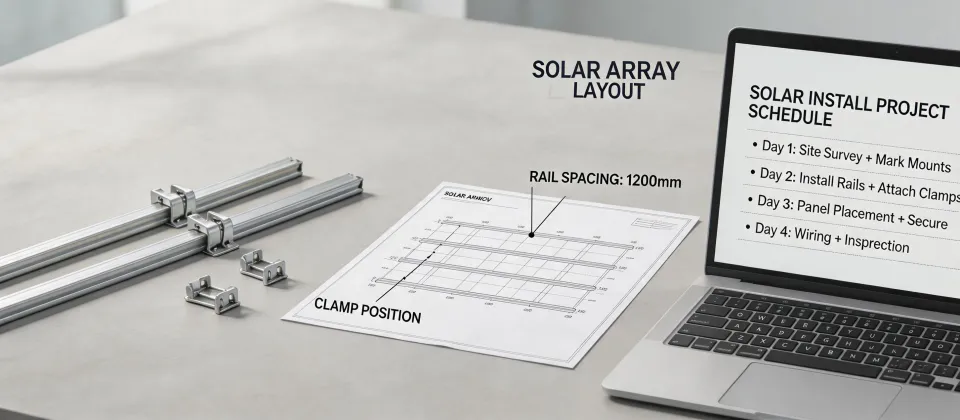
Officially, I'm the office administrator for a 45-person solar installation company. In practice, I manage procurement for everything that isn't a panel—racking, clamps, flashing, BOS electrical accessories, and the occasional surprise parts order. That's roughly $2.4 million a year across 9 vendors. I report to operations and finance, and I have one strong opinion: mounting systems are the most under-bought part of a solar project.
Search "mounting systems" and you'll get a mess. TV mounting systems. Medication event monitoring system results. A solar generator 600 watt roundup. None of that is what an EPC means when it specifies racking. I mean the rails, clamps, feet, bonding straps, and—most importantly—the stamped engineering that holds a solar array in place.
I'm not saying modules and inverters don't matter. They do. But a premium module on a flimsy mounting system is just expensive debris after a storm. If the mounting system fails, the module doesn't matter.
That's the core opinion. Now let me explain why I buy it this way.
What "Bulletproof" Actually Means
"Bulletproof" gets thrown around a lot. I stopped using it without quotes. In procurement, a bulletproof mounting system is one that comes with complete documentation, components that fit together without a call to tech support, and a supply chain that doesn't strand you at week nine of a twelve-week schedule.
What most people don't realize is that the aluminum rail is almost a commodity. The real product is the engineering behind it. The same profile from the same mill can have very different load ratings depending on the attachment detail, clamp spacing, and wind uplift calculation. I learned this the hard way.
I only believed the engineering report matters after skipping it. In 2022, I approved a "compatible" racking substitution to save $0.02 per watt. The quote had the right paperwork. It looked identical. But the seal plate didn't match our clamps. After the third-party inspection flagged it, we had to re-torque 1,100 clamps with a custom adapter. That cost us more than the original saving and delayed the project by almost two weeks.
If I remember correctly, the total rework cost was about $18,000—don't quote me on the exact number, but it was enough to make me a convert. Since then, I check the engineering before the price.
You are not buying aluminum. You are buying a system that can argue its own case in front of an inspector.
A truly bulletproof system also means the small things are solved: stainless steel hardware that doesn't gall, UV-stable caps that don't crack, and clamps that work with the specific module frame height. There's a difference between "compatible" and "listed for use with." In solar, that difference can be an inspection fail.
Cheap Racking Is Expensive Racking
Here's something vendors won't tell you: the first quote often assumes the most favorable conditions. If your roof has tall parapets, a high wind zone, or an existing membrane you don't want to penetrate, that changes both the design and the price. A system that's bulletproof on a warehouse roof in Texas isn't automatically right for a seventh-floor roof in Chicago. At least, that's been our experience with commercial flat-roof projects.
In our 2024 vendor consolidation project, we reduced racking suppliers from three to two. We didn't choose the cheapest. We chose the one that provided stamped shop drawings in under a week and had regional stock. That decision cut our average submittal time from 11 days to 4 days. That's not a speculative benefit—it's the difference between starting the job on time and paying a crew to wait.
Our company installs flat roof, pitched roof, ground, and carport systems, so we see a full range of racking problems. On flat roofs, ballast calculations are usually the headache. On ground mounts, it's driving depth and torque specs. On carports, it's wind uplift and corrosion. A mounting system that handles one of those well may not handle the others.
I do not make purchase decisions based on the lowest quote alone. What I look for is straightforward:
- Documentation: wind load calculations, structural notes, and UL 2703 compliance references.
- Compatibility: clamps and flashing explicitly listed, not "suitable for most modules."
- Lead time: a two-day versus two-week ship date can kill a project schedule.
Under UL 2703, the racking must provide a continuous grounding path. The difference is often in the bonding hardware. A cheap bonding washer can fail when the aluminum oxide layer isn't penetrated. The module may stay on the roof, but the system is no longer grounded. That's a safety issue, and it's invisible until a fault test.
Big Energy Questions Don't Answer Themselves
People love asking how many wind turbines to power the UK. I do too. It's a great conversation starter. But the renewable projects that fail usually fail at the component level, not the capacity question. A solar generator 600 watt on a shed roof still needs a mount that survives wind. A 50 MW ground mount needs thousands of connections that don't loosen after thermal cycling.
And if you searched "mounting systems" hoping for TV mounting systems or a medication event monitoring system, this article isn't for you. Those are completely different products. In solar, mounting systems are the physical foundation of every kilowatt-hour you plan to generate.
When I Don't Recommend a Premium Mounting System
The honest answer is: not every project needs the most bulletproof racking.
If you're installing a 10-panel array on a low, sheltered residential roof, a proven low-cost system is fine. Pick one mainstream brand, buy it consistently, and keep the installation details familiar. Don't switch to save a few hundred dollars on a small job.
But if the project has any of these, spend the extra money:
- Commercial roof with tall parapets or high wind uplift
- Ground mount in a snow region
- Carport where every row is under public view and liability
- Any roof where re-torquing after commissioning is difficult
This isn't a disclaimer. It's how we decide. The cost difference between a basic and a more robust mounting system is often less than one service call. If a cheap clamp fails, the truck roll alone will wipe out the savings.
"We've Used the Cheap System for Years"
I hear this from installers who are much more experienced than I am. I believe them. But what I also notice is that they didn't track the hidden labor: the extra minute per clamp, the call to engineering, the parts that didn't arrive with the rest of the order. A mounting system that works "fine" can still cost you in ways that don't show up on a line item.
I know it sounds defensive. Maybe I'm over-cautious because I'm the one who signs the PO and would have to explain the rework to finance. But I've sat through enough project reviews to know: if you can't explain why a mounting system is safe, you don't actually know it's a good deal.
The Bottom Line From Procurement
Mounting systems aren't sexy. But they're the part of the solar system that physically survives a storm. I'll pay a premium if it comes with a stamped engineering report and a vendor who answers the phone on the first ring. The last thing I want is to be on a roof after a callout, explaining why a $0.02-per-watt saving cost us the entire project margin.
Does this mean you should always buy the most expensive mounting system? No. It means you should choose racking with the same rigor you'd choose an inverter: documentation, reputation, and worst-case behavior in mind. When I do that, the rest of the BOS procurement is easy. When I don't, I get exactly what I deserve.
That's it. Simple.

Renata Silva
Renata Silva is a photovoltaic module analyst covering monocrystalline solar panels, bifacial modules, TOPCon and heterojunction designs, glass-glass construction, junction boxes, and module warranties. She interprets IEC 61215 and IEC 61730 evidence while comparing rated power, conversion efficiency, temperature coefficient, bifaciality, insulation, mechanical-load results, degradation assumptions, and tolerance. Her technical guides help EPC engineers, distributors, and project buyers separate qualification evidence from site-specific energy yield, climate exposure, installation constraints, and long-term performance risk.