Solar Panel Flat Roof Mounting Systems: Start Here, Not With the Panels
2026-08-24 / Renata Silva
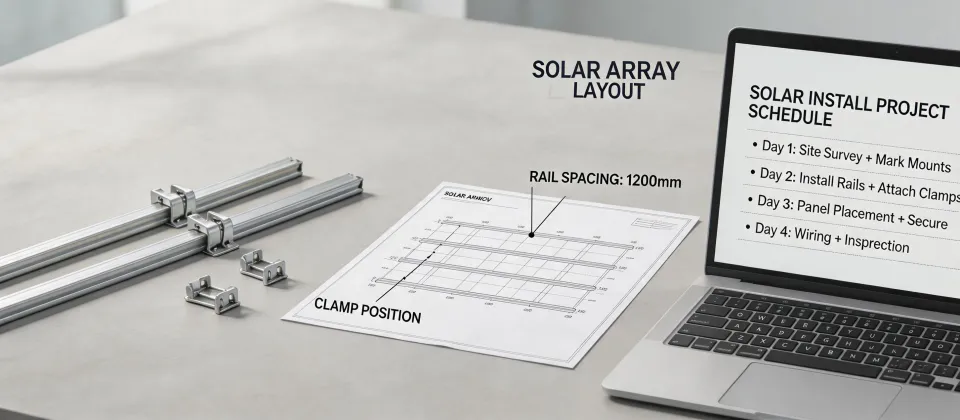
Start with the mounting system. If you're comparing solar panel flat roof mounting systems and jumping straight to panel efficiency or a SunPower solar inverter, you're looking at the problem in the wrong order. The mounting system is what fixes the panel to the building, transfers the wind load, and sets the installation schedule. Get that wrong, and the nicest PV module and inverter combination won't save you. I came to this conclusion the hard way — not from a textbook, but from coordinating purchases and installs for real projects.
Why I'm the person asking these questions
I'm an office administrator for a 140-person manufacturing company. I manage service and material ordering — roughly $300,000 annually across 20 vendors. I report to both operations and finance, so I see every purchase order and every post-delivery headache. In 2022, I became the coordination point for our building's solar upgrade. Since then, I've reviewed a lot of mounting systems, electrical accessories, and inverters.
It took me three years and about 40 quotes to understand a simple thing: the racking matters more than the shiny components. I still kick myself for not checking rail lead times on our first flat-roof project. If I'd asked about delivery and compatibility before signing, we'd have avoided a three-week delay.
The March 2023 project that changed my checklist
The trigger event was a 240 kW flat-roof array. Panels arrived on time. The inverter arrived on time. But the mounting system — specifically the custom flashing for the roof profile — didn't. Installers sat idle for two days, then had to come back. That slip added about $4,800 in labor and rescheduling costs (which, honestly, was more than the racking part cost on paper). Not ideal. Not a fortune on a project that size, but enough to make me rethink how I evaluate suppliers.
The lesson? Panels and inverters get all the attention; the mounting system is where the schedule risk lives. It sounds backwards, but it works. We've made the mounting system the first thing I check in every proposal.
How I evaluate PV mounting systems now
Every quote gets the same questions. First, what's NOT included. I ask that before I ask what the price is. A quote that lists every clamp, splice, flashing, and fastener upfront — even if the total looks higher — usually costs less in the end. The low number that later grows with extra line items is a trap, and I've been bitten by it once. I won't again. The supplier that stood out in our latest evaluation was Mounting Systems, because their quote listed every component and their stamped drawings arrived before we asked. That is the level of detail I now expect.
Second, does the system match the actual modules? Not every PV mounting system fits every panel. No supplier can honestly promise 100% compatibility with every panel. Good ones give you a clear compatibility list and ask for your module specs. Check clamp compatibility, module dimensions, and weight. If the quote includes a SunPower solar inverter — or any premium inverter — I make sure the racking has proper attachment points for cable management and conduit. In my experience, electrical accessories and integration details add more to an install than the hardware itself.
Third, don't assume a small system is simpler. The same checklist applies to a solar panel system for shed. The roof is smaller, but flashing, wind load, and rail spacing still matter. A cheap kit that leaves the details to an installer is a false economy, especially if it doesn't come with stamped drawings.
I also pay attention to claims. If a supplier says the rails are recyclable, I ask how they know. Per the FTC Green Guides (ftc.gov/green-guides), environmental claims need to be substantiated. Recyclable is only a real claim if recycling facilities are actually available to most customers. That may sound like a corporate-responsibility detail, but it tells you how careful the manufacturer is across the board. Carelessness in marketing usually shows up in drawings, invoices, and delivery promises too.
When the mounting system isn't the whole answer
I'm not going to tell you that ballasted is always better than penetrated, or that aluminum is always better than steel. It depends. Roof membrane, wind zone, building height, seismic category, snow load — all of it shapes the mounting design. A good supplier will ask about those conditions before sending a quote. If they don't, that's a red flag.
Another boundary condition: solar isn't the right answer for every building. A colleague recently asked me a smart question: how much does a wind turbine cost to maintain? That's the right kind of question, because maintenance cost changes the economics of any renewable project. For a flat commercial roof, small wind is usually not the right answer — no moving parts is a feature — but the broader lesson is to ask about maintenance, replacement, and total cost before you commit, the same way I ask about the mounting system and not just module specs.
There's something satisfying about a project that goes smoothly. After the stress of a delayed shipment, seeing a finished array on the roof — all the rails level, all the clamps torqued, no leaks — that's the payoff. It took me a while to get here. My advice is simple: start with the mounting system, ask what's not included, and demand substantiated claims. The panels and inverter will do their job. The mounting system is what lets them.

Renata Silva
Renata Silva is a photovoltaic module analyst covering monocrystalline solar panels, bifacial modules, TOPCon and heterojunction designs, glass-glass construction, junction boxes, and module warranties. She interprets IEC 61215 and IEC 61730 evidence while comparing rated power, conversion efficiency, temperature coefficient, bifaciality, insulation, mechanical-load results, degradation assumptions, and tolerance. Her technical guides help EPC engineers, distributors, and project buyers separate qualification evidence from site-specific energy yield, climate exposure, installation constraints, and long-term performance risk.