PV Mounting Systems vs. Portable Solar Kits: A Rush-Order Comparison for Solar Pros
2026-09-16 / Renata Silva
-
What I'm comparing—and why it matters when the clock is ticking
-
Dimension 1: Speed—who actually delivers when you're late?
-
Dimension 2: Total cost—sticker price vs. actual cost
-
Dimension 3: Scalability and compliance—where DIY hits a wall
-
Dimension 4: Integration—electrical accessories matter more than the rack
-
Dimension 5: Risk—what happens when the deadline slips
-
Which should you choose?
What I'm comparing—and why it matters when the clock is ticking
I work as a rush logistics coordinator at a renewable energy equipment supplier. I've handled 120+ rush orders in 9 years, including same-day turnarounds for EPC clients. Normal turnaround for commercial PV mounting systems is 8–12 days. When the deadline is 36 hours, that's the difference between a signed project and a penalty clause.
This article compares two paths: engineered PV mounting systems for flat roof, pitched roof, ground, and carport projects plus electrical accessories, versus small portable solar setups—5W/10W panels, portable power stations, and DIY integration. If you searched for ar 15 mounting systems, this is a different category. That's firearm hardware. Here, mounting-systems means solar racking.
I'll compare on five dimensions: speed, total cost, scalability and compliance, device integration, and risk. At least one result surprised me. (It usually does.)
Dimension 1: Speed—who actually delivers when you're late?
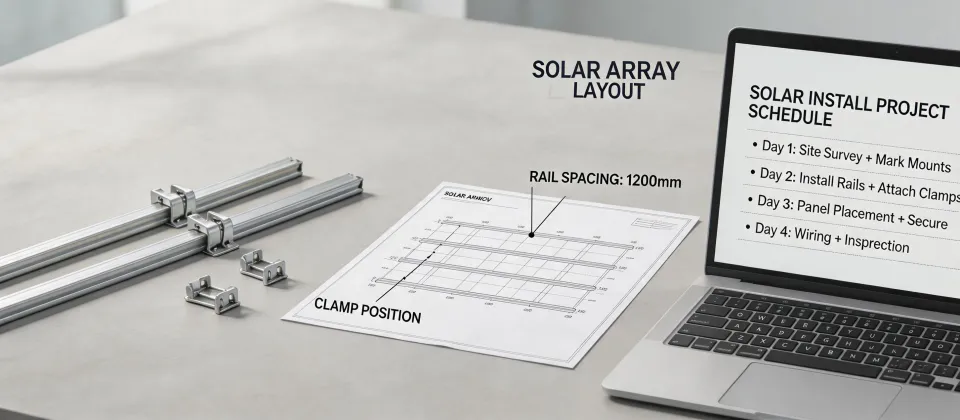
A: engineered PV mounting systems. If you need a commercial flat roof or ground mount, speed depends on inventory, freight, and engineering review. Not the website checkout. In March 2024, a client called at 6:30 a.m. needing ballasted flat roof mounts for a 480 kW commercial project 36 hours later. Normal lead time: 10 days. We found a regional warehouse with compatible rails and clamps, paid $1,200 extra in freight on top of the $18,400 base order, and delivered with 4 hours to spare. Missing that deadline would have triggered a $50,000 penalty clause.
B: small panel and portable power setups. This is where DIY wins—sometimes. A 5W or 10W panel with a controller can ship next-day from a general retailer. A bluetti ac200p l portable power station can arrive in 2–4 days. For a tiny off-grid sensor or emergency phone charging, that beats waiting on a commercial racking order. The surprise wasn't the speed. It was how often people buy the wrong portable gear and then pay twice.
Verdict: For small, temporary loads, portable wins on raw speed. For anything structural, permitted, or above a few panels, engineered PV mounting systems win because speed without compatibility is just a faster failure.
Dimension 2: Total cost—sticker price vs. actual cost
A: PV mounting systems. Public 2024–2025 cost benchmarks put commercial flat roof racking around $0.12–$0.35 per watt, depending on ballast vs. penetration, wind uplift, code, and material. Ground mount utility-scale can be lower; pitched roof residential is often higher. That's before electrical accessories, inverters, surge protectors, and battery storage components. Setup and engineering can add $0.02–$0.08/W on small or rushed projects. (Verify current rates with your supplier.)
B: small solar and portable power. A 5W–10W panel often lists at $12–$35. A 100W folding panel can be $80–$200. A Bluetti AC200P L portable power station has listed around $1,300–$1,700 depending on bundle and promotions (as of January 2025, at least). Add cables, adapters, and a controller, and a small setup can hit $1,500–$2,200 fast.
How much does it cost for a wind turbine? Short answer: more than most people expect. According to NREL and DOE public cost data, small wind installed costs often run $10,000–$50,000 for 5–15 kW before incentives, site work, and interconnection. Utility-scale wind has averaged roughly $1,300–$1,800 per kW in recent U.S. benchmarks. That's a different scale from a 10W panel. (Note to self: stop comparing apples to wind farms.)
Verdict: Portable wins for tiny loads. Engineered mounting systems win on cost per watt once you need more than a few hundred watts or any real reliability. The cheapest DIY setup I've seen failed once and cost more than the mid-range option.
Dimension 3: Scalability and compliance—where DIY hits a wall
A: engineered PV mounting systems are designed for wind uplift, snow load, seismic zones, roof warranties, and electrical code. You get stamped engineering letters, load calculations, and listed components. That matters when an AHJ asks for documentation. For EPCs and commercial developers, this isn't optional.
B: small solar panel 5w 10w device integration is great for sensors, gate openers, cameras, and camping. But it doesn't scale to a 500 kW array. You can't ballast a 10W panel and call it a commercial roof. You also can't ignore rapid shutdown, grounding, or surge protection once you add batteries and inverters.
Verdict: If you're integrating a 5W panel with a remote device, portable is fine. If you're building anything that needs permits, engineered mounting systems are the only sane path.
Dimension 4: Integration—electrical accessories matter more than the rack
A: integrated electrical accessories. Mounting is only half the system. Inverters, surge protectors, rapid shutdown, and battery storage components need to work together. A mismatched clamp or rail is annoying. A mismatched surge protector can take down a project.
B: portable power stations. The bluetti ac200p l portable power station is popular because it's plug-and-play. But plug-and-play has limits. It pairs well with 200W–400W folding panels. It does not pair well with a 5W trickle panel if you expect fast recharge. The frustration: people buy a 5W panel, connect it to a 2,000Wh station, and wonder why it takes weeks to charge. That's not a product flaw. That's math.
Verdict: Match the gear to the load. For portable, size the panel to the battery. For commercial, use listed BOS components and don't mix brands blindly.
Dimension 5: Risk—what happens when the deadline slips
A: engineered systems. Risk is concentrated in logistics and engineering. Miss a freight window, and you can lose a crew day. That crew day can cost $4,000–$12,000 depending on size. I've seen a $9,000 rush fee save a $120,000 install schedule. That's an easy yes.
B: portable systems. Risk is lower dollar-wise, but higher annoyance-wise. A failed controller or wrong connector can strand a remote site. The fix is usually another order, another wait. After the third time a discount portable vendor missed a delivery window, I stopped using them for anything deadline-critical. Now we keep one tested portable kit in the warehouse. Simple. Done.
Legacy myth: local is always faster. That was true 10 years ago when digital options were limited and local shops had everything in stock. Today, a well-organized remote vendor with real-time inventory can beat a disorganized local one. The catch is you have to verify stock before you promise a date.
Which should you choose?
Choose engineered PV mounting systems when:
- You need commercial or utility-scale solar.
- Permits, wind uplift, and engineering letters are required.
- You need integrated electrical accessories and battery storage components.
- The deadline has a penalty clause attached.
Choose small portable solar and power stations when:
- You're powering a 5W–10W remote device, camera, or sensor.
- You need emergency backup for phones, lights, or tools.
- You can tolerate slower recharge and limited scalability.
- You don't need permits or structural engineering.
And if you're searching how much does it cost for a wind turbine, get site data first. Wind is a different beast. For most rush solar needs, the decision is simpler: portable for tiny loads, PV mounting systems for anything that has to pass inspection and still be there after a storm.
Bottom line: Efficiency isn't just about speed. It's about total cost, compatibility, and risk. The fastest option that fails isn't fast. It's just expensive.

Renata Silva
Renata Silva is a photovoltaic module analyst covering monocrystalline solar panels, bifacial modules, TOPCon and heterojunction designs, glass-glass construction, junction boxes, and module warranties. She interprets IEC 61215 and IEC 61730 evidence while comparing rated power, conversion efficiency, temperature coefficient, bifaciality, insulation, mechanical-load results, degradation assumptions, and tolerance. Her technical guides help EPC engineers, distributors, and project buyers separate qualification evidence from site-specific energy yield, climate exposure, installation constraints, and long-term performance risk.