Solar Mounting Systems and Electrical BOS: A Scenario-Based Procurement Guide
2026-09-16 / Renata Silva
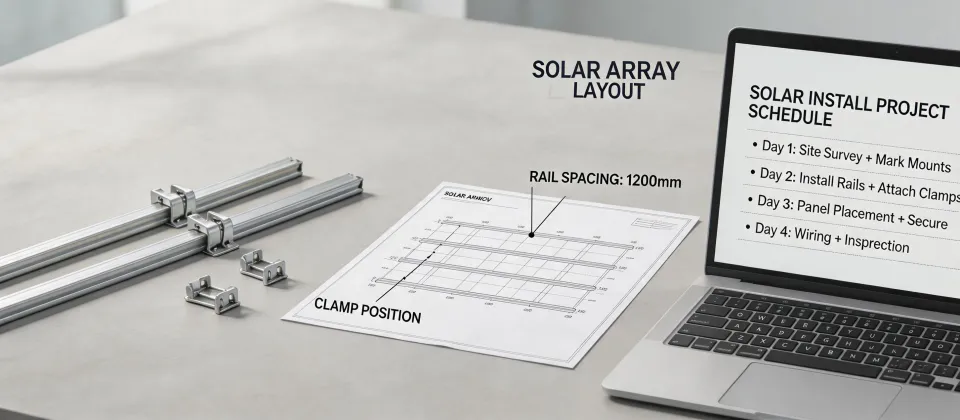
There is no single right answer for mounting-systems procurement. I have managed solar EPC budgets for about 7 years—maybe 6, I would have to check the system—and the biggest mistake I see is treating every project as if it needs the same racking and electrical BOS package. The right choice depends on your roof, site, electrical scope, and risk tolerance. Here is how I break it into three scenarios.
The Three Scenarios That Matter
- Scenario A: Commercial flat roof with solar ballast mounting systems.
- Scenario B: Pitched roof with solar panel roof mounting systems.
- Scenario C: Ground mount, carport, or remote O&M site with electrical accessories and backup power.
If you have ever had a ballast delivery show up two weeks late, you know that the cheapest line item on the quote is rarely the cheapest project. Trust me on this one.
Scenario A: Commercial Flat Roof and Ballasted Mounting
On a large flat roof where you cannot or do not want to penetrate the membrane, solar ballast mounting systems are usually the right starting point. But the cost conversation has to be about total cost of ownership, not the per-panel rail price.
Most buyers focus on the rail or clamp price and completely miss the ballast blocks, membrane protection pads, wind uplift engineering, structural review, and wire management. Those line items can add 25-40% to the first cost. In Q2 2024, we compared five vendors for a 1.2 MW ballasted roof. One quoted the rail at $12.80 per panel. Another quoted $14.10. The lower one excluded ballast pads, engineering stamps, and wire management. Total cost of ownership was 18% higher—roughly a $42,000 swing. That is not a rounding error.
According to UL (ul.com), UL 2703 covers mounting systems, clamping devices, and bonding for PV modules. If a clamp is not listed with your module, you are relying on opinion, not certification.
I am not 100% sure why some vendors include engineering in the base quote and others treat it as an add-on. My best guess is that they are passing risk to you. Ask for a line-item TCO sheet. If they will not provide one, that tells you something.
For a ballasted roof with no moving parts, a machine condition monitoring system is usually overkill. But if the same site has rooftop HVAC units or tracker drives, it can catch vibration and temperature issues before they become emergency service calls. The math only works if avoided downtime is more expensive than the monitoring subscription. Seriously, run that number before you buy.
Scenario B: Pitched Roof and Penetrated Mounting
Solar panel roof mounting systems on a pitched roof are a different animal. Here, the hidden costs are flashing, tile replacement, snow guards, roof age, and wire management. If the roof is more than 10-12 years old, re-roof before you install. Removing and reinstalling an array later can cost 2-3 times more than doing it right the first time.
Do not accept a blanket promise that a mount is 100% compatible with every panel. Check the UL 2703 listing and the manufacturer's engineering for your specific module. Compatibility is a test result, not a sales claim.
On the electrical side, surge protection matters. A surge protective device at the inverter and at the AC panel is cheap insurance. UL 1449 covers surge protective devices, so look for that listing. And for the question I get from installers all the time—can you plug a power strip into a surge protector—the short answer is usually no. A surge protector is a protective device, not an outlet multiplier. Daisy-chaining a power strip into a surge protector can overload the protector and may void its listing. If you need more outlets, use a UL 1363 listed power strip directly into a wall receptacle or a portable power station outlet rated for the load.
For commissioning, a VTOMAN 600X portable power station can run a laptop, a meter, and a small charger. I have used one on a residential job to avoid running an extension cord across a finished lawn. I am not 100% sure on every variant's continuous output, so check the label. Do not chain a power strip into a surge protector into the station. Plug one device or one listed power strip directly into the station if the load is within spec. That is the safe way to do it.
Scenario C: Ground Mount, Carport, and Remote O&M
Ground mounting systems and carport structures have their own cost drivers: soil tests, corrosion protection, pile versus concrete foundations, trenching, and access roads. Terrain can swing cost per watt by 30% or more. You cannot compare a flat, sandy site to a rocky slope on price alone.
This is where a machine condition monitoring system starts to make financial sense. Tracker drives, motors, pumps, and central inverter fans are rotating equipment. A condition monitoring system can watch vibration, temperature, and current. If a single truck roll costs $1,200 and monitoring avoids two per year, the math works. If you have no rotating equipment and no remote site, put that budget into surge protection and proper grounding instead.
On remote pads, a portable power station like the VTOMAN 600X portable power station is genuinely useful. It can power a laptop, a crimping tool, or a small test load. But size it correctly. People think premium mounting costs more. Actually, cheap mounting often costs more because you pay for rework, leaks, and O&M. The causation runs the other way: vendors who deliver quality can charge more because they are not funding your future repairs.
How to Tell Which Scenario You Are In
Here is the checklist I use before I request quotes:
- Roof or ground? If you cannot penetrate, you are in Scenario A. If you can penetrate and the roof is sound, you are in Scenario B. If it is ground or carport, you are in Scenario C.
- Structural capacity: Wind uplift, snow load, and ballast weight can kill a design. Get a structural review early.
- Electrical scope: Inverters, surge protective devices, monitoring, and backup power. If you need more outlets, do not daisy-chain power strips and surge protectors. Use listed devices correctly.
- Downtime cost: If a failure costs more than a condition monitoring system, consider it. If not, skip it.
- Budget cycle: First cost versus TCO. The lowest quote is often not the lowest total cost.
If you are still unsure, ask your supplier what they do not do. The vendor who says 'this is not our strength—here is who does it better' earns my trust for everything else. I would rather work with a specialist who knows their limits than a generalist who overpromises. That is the expertise boundary I look for, and it has saved me way more than any discount.
No universal answer. But if you match your project to the right scenario, you avoid the two most expensive mistakes in solar procurement: buying features you do not need and missing the hidden costs you do need.

Renata Silva
Renata Silva is a photovoltaic module analyst covering monocrystalline solar panels, bifacial modules, TOPCon and heterojunction designs, glass-glass construction, junction boxes, and module warranties. She interprets IEC 61215 and IEC 61730 evidence while comparing rated power, conversion efficiency, temperature coefficient, bifaciality, insulation, mechanical-load results, degradation assumptions, and tolerance. Her technical guides help EPC engineers, distributors, and project buyers separate qualification evidence from site-specific energy yield, climate exposure, installation constraints, and long-term performance risk.