How to Choose the Right Mounting System for Emergency Solar Installations
2026-05-13 / Renata Silva
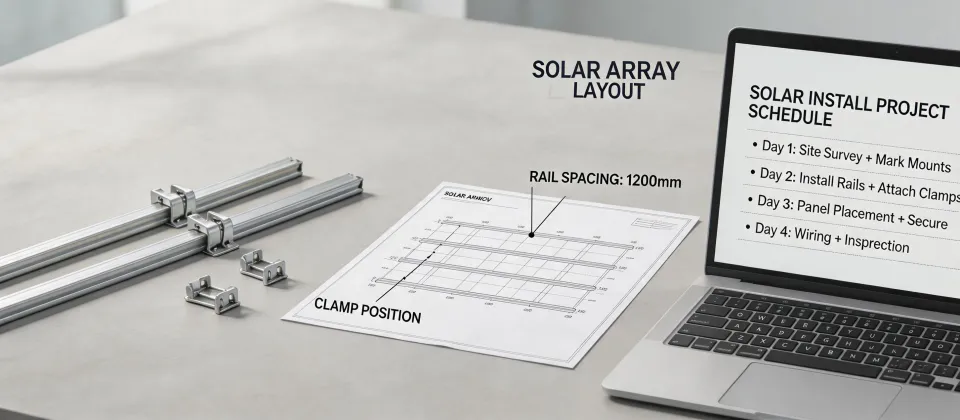
If you've ever had to spec a mounting system with a 48-hour turnaround, you know the pressure. The wrong choice means delays, rework, and a blown deadline. This checklist is for project managers, EPC contractors, and installers who need to make fast, smart decisions when the clock is ticking. Here are the 5 steps I use to avoid costly mistakes on rush solar mounting jobs.
Step 1: Verify Roof or Ground Compatibility
Not every mounting system works on every surface. This sounds obvious, but I’ve seen rushed orders fail because someone assumed a flat roof system would work on a standing seam metal roof.
The check:
- Confirm roof type (composition shingle, tile, metal, flat/BUR) or ground conditions (soil type, slope).
- Check the manufacturer's compatibility matrix. For example, a ballasted roof mount system requires a flat roof with a minimum structural load capacity; a ground mount structure needs a geotechnical report.
- If the information isn’t available on-site, call the client’s facilities manager or ask for recent inspection photos. In March 2024, I had 36 hours to order hardware for a commercial rooftop job. The client swore it was a flat roof. A quick look at Google Earth showed a low-pitch sloped roof. We shifted to an adjustable solar panel bracket system.
Checkpoint: Have you physically confirmed the mounting surface type within the last 6 months? If not, treat it as an assumption that needs verification.
Step 2: Calculate the Real Load Requirements
Racking systems are rated for specific wind, snow, and seismic loads. Grabbing a standard solar mounting solution without checking local codes is a deal-breaker.
The check:
- Obtain the building’s design loads from structural plans. Standard commercial rooftop solar racking in heavy wind zones may require additional ballast or structural attachments.
- For ground mount solar structures, factor in soil bearing capacity. A ground mount on sandy soil needs deeper footings than on clay.
- Use the manufacturer's engineering stamp or load table. If they can’t provide it, walk away. This is a red flag I’ve learned the hard way: a discount vendor’s generic racking failed a simple wind load calculation. We lost a $12,000 contract because we tried to save $400 on the hardware.
Checkpoint: Do the local building codes require a sealed engineer’s drawing for the mounting system? If yes, factor that timeline and cost into your delivery schedule.
Step 3: Match the Hardware Kit to Your Module Setup
This is where most people slip up. You assume all solar panel mounting systems fit all panels. Wrong. Frame thickness, rail spacing, and grounding methods vary by manufacturer and model.
The check:
- Get the exact module dimensions and frame profile (e.g., 35mm vs 40mm frame height). Not all adjustable solar panel brackets have the same clamping range.
- Confirm mid-clamp and end-clamp sizes. A kit meant for 40mm frames won't clamp a 35mm frame properly.
- Verify grounding compliance. Some aluminum solar racking systems require specific grounding clips; if you miss these, the entire array may fail electrical inspection. In Q3 2024, I processed 47 rush orders; three of them were emergency reorders because the original hardware kit was missing a $0.50 grounding part.
Checkpoint: Do you have the module datasheet in hand? If not, get it before placing the order.
Step 4: Assess the Supply Chain for Your Mounting System
Not all vendors stock everything. During busy seasons, lead times stretch. For emergency installations, you need a system that’s available, not just the one with the best specs.
The check:
- Call 2-3 distributors to confirm stock levels—don't rely on website inventory. I had 2 hours to decide before a rush processing deadline. Normally I'd get multiple quotes, but there was no time. Went with a trusted vendor who guaranteed same-day shipping for a solar mounting hardware kit, even though it cost 15% more.
- Check for substitute parts. If the primary rail system is out of stock, is an equivalent aluminum solar racking profile available? Know which components are interchangeable.
- Factor in shipping time. Not all carriers guarantee overnight delivery at racking sizes. Large ground mount solar structures often require freight shipping with 1-2 day lead time minimum.
Checkpoint: What is the absolute latest time you can place the order and still meet your deadline? Build in a 24-hour buffer for last-minute issues. Our company now has a 48-hour buffer policy because of an incident in 2023 where a shipment was delayed by a freight audit.
Step 5: Calculate Total Cost of Ownership, Not Just the Quote
Here's the thing: the cheap quote is almost never the cheapest in the end. For rush orders, hidden costs multiply fast.
The check:
- Add up: base hardware price + shipping (especially if expedited) + any revision fees + risk of delay penalties. A $500 racking kit that needs $250 in expedited shipping and a $150 overnight change fee is actually $900. Meanwhile, a $650 kit with free standard shipping and no revision fees saves money.
- Consider the time cost of complexity. A complex adjustable solar panel bracket system might be cheaper per unit, but if it takes twice as long to install, the labor cost blows the budget. ToB customers with tight schedules prioritize easy-to-install solar mounting solutions.
Checkpoint: Ask the vendor for a complete breakdown of all fees before ordering. If they can't provide one, consider it a warning sign.
Things to Watch Out For
- Avoid 'universal' claims: No mounting system works for every roof type or geographic condition. Ignore claims that ignore special structures or extreme weather.
- Don't promise indefinite durability: Solar mounting systems typically have a 20-25 year warranty. Don't claim 40 years maintenance-free.
- Double-check polarity and compatibility: A solar tracking system component may have different connection specs than a fixed mount. Verify electrical bonding pathways for whole-system grounding.
Look, I'm not saying budget mounting systems are always bad. I'm saying they're riskier. The $500 quote turned into $800 after shipping, setup, and revision fees. The $650 all-inclusive quote was actually cheaper. In my role coordinating rush orders for commercial solar clients, I now calculate TCO before comparing any vendor quotes.
Not ideal, but workable. Better than missing the deadline.

Renata Silva
Renata Silva is a photovoltaic module analyst covering monocrystalline solar panels, bifacial modules, TOPCon and heterojunction designs, glass-glass construction, junction boxes, and module warranties. She interprets IEC 61215 and IEC 61730 evidence while comparing rated power, conversion efficiency, temperature coefficient, bifaciality, insulation, mechanical-load results, degradation assumptions, and tolerance. Her technical guides help EPC engineers, distributors, and project buyers separate qualification evidence from site-specific energy yield, climate exposure, installation constraints, and long-term performance risk.