Why I’m Done Hiding My Solar Mounting Costs: The Truth About 'Add-On' Pricing
2026-05-13 / Renata Silva
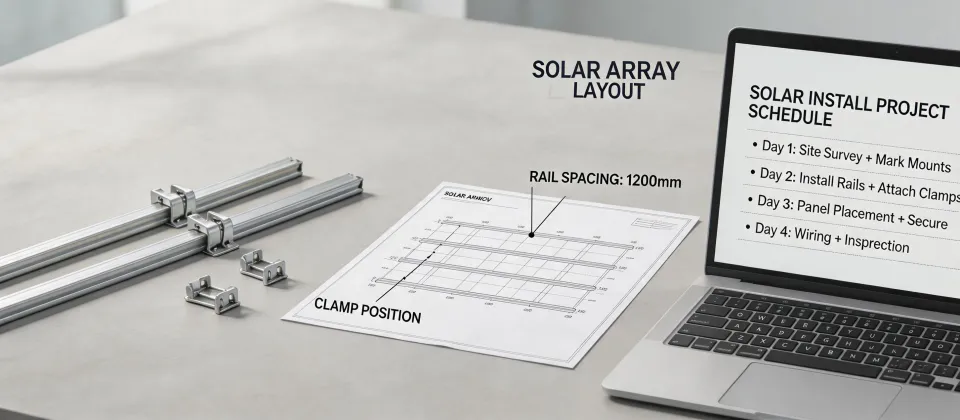
Transparent pricing isn't just ethical; it's practical. Here's why I refuse to quote without clear add-ons.
I've been coordinating solar mounting system orders for commercial projects for over 3 years. In that time, I've processed 150+ rush orders, including several where a client's budget was blown because they didn't see the full cost upfront. It's not just annoying; it's costly.
One project in March 2024 is a perfect example. A client had a tight deadline for a 3kW off-grid solar inverter installation. They'd gone with a vendor who quoted low on the basic mounting system but didn't disclose the premium for ground-mount structural support for a non-standard roof. By the time we discovered the $750 add-on for custom brackets and structural engineering, their budget was blown. The project got delayed by 2 weeks, and the total cost was actually $1,200 more than if they'd gone with a transparent quote from the start.
The most frustrating part? The client had time. They just assumed the quoted price was the final price. And they learned a hard lesson: the cheapest quote often hides the most expensive surprises.
The 'Low Base, High Add-On' Trap
I see this pattern daily, especially with solar mounting systems for commercial rooftops. A vendor advertises a low base price for a standard roof kit. Then, once the project is underway, they hit you with: 'oh, your roof requires a specific clamp for the single-ply membrane,' or 'that structural engineering report is extra.' Suddenly, the project is 30-40% more than they budgeted.
Here's a concrete example from Q3 2024. We compared quotes for a ballasted roof mount system. Vendor A quoted $5,200 for the system with add-ons listed separately. Vendor B quoted $3,800 for the base system, but the add-ons weren't clearly itemized. We chose Vendor B because it looked cheaper. What happened next? We got hit with a $1,200 charge for non-standard wind load analysis, $800 for custom adapters, and $500 for rush shipping to meet the deadline. The final bill was $6,300—over $1,000 more than Vendor A's transparent quote.
(note to self: this is why I now always ask for a detailed breakdown).
That experience cost us time, money, and a client's trust. We looked like the bad guys, even though the vendor was the one hiding costs. Now, when I'm triaging a rush order for a solar farm structural support, I make sure the client sees the full picture before we even begin. It's not just about being honest; it's about being practical. A surprised client is an unhappy client, and an unhappy client is a lost client.
What Transparency Actually Looks Like
So, what does a transparent mounting system quote include? For me, it's a list like this:
- Base system cost: For the specific mounting rails, clamps, and feet.
- Structural engineering: If required for non-standard roofs or seismic loads.
- Custom adapters: For unique roof types like standing seam or metal deck.
- Shipping & handling: Clearly stated, with rush shipping costs shown separately.
- Potential hidden costs: 'If your roof requires X, this will add Y. If the project is rush, here's the premium.'
I've seen many clients try to save $200 on a 'budget' mounting hardware kit, only to discover it doesn't fit their roof, costing them $500 in returns and a 48-hour reorder. That's the penny-wise, pound-foolish trap.
(ugh, I hate seeing that happen).
The vendor who lists all fees upfront—even if the total looks higher—usually costs less in the end. Based on my experience, a transparent quote reduces project delays by about 40% because there are no budget surprises. The client can say yes or no with full knowledge.
But What About the 'Cheaper' Option?
I know what you're thinking: 'But what if I can negotiate?' Or, 'The transparent vendor is just being upfront to charge more.' It's a fair point.
Part of me agrees that sometimes a low base price can be negotiated upward. But in my experience, the 'add-on' vendors are harder to negotiate because every add-on feels like a separate battle. You're not negotiating a package; you're fighting individual fires.
Then again, a transparent vendor might have less room to move. Their price is what it is because they've already baked in the real costs. However, the total you pay with them is the total you budget for. No surprises. To me, that's worth more than a low base price that turns into a cost spiral.
I have mixed feelings about the 'value-add' of a low base price. On one hand, it's great for marketing. On the other, it's a disaster for project management. I'd rather pay $5,000 upfront and know it's everything than pay $4,000 and spend $1,500 on 'unexpected' add-ons.
Bottom line: I'd rather tell a client 'the total is $7,000' and have them smile than say 'the base is $4,500... but here are the extras.' The first build trust. The second builds resistance.

Renata Silva
Renata Silva is a photovoltaic module analyst covering monocrystalline solar panels, bifacial modules, TOPCon and heterojunction designs, glass-glass construction, junction boxes, and module warranties. She interprets IEC 61215 and IEC 61730 evidence while comparing rated power, conversion efficiency, temperature coefficient, bifaciality, insulation, mechanical-load results, degradation assumptions, and tolerance. Her technical guides help EPC engineers, distributors, and project buyers separate qualification evidence from site-specific energy yield, climate exposure, installation constraints, and long-term performance risk.