I Sold the Wrong Mounting System: A €27,000 Mistake That Built Our Best Checklist
2026-09-16 / Renata Silva
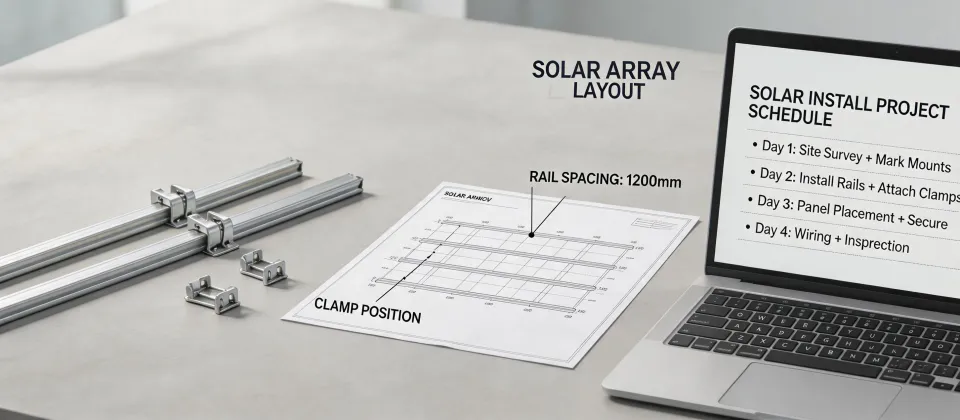
I Sold the Wrong Mounting System: A €27,000 Mistake That Built Our Best Checklist
September 2022. I'll just say it—I was in a hurry.
The European energy crisis had pushed solar demand through the roof. Literally. Our team doubled its commercial installation volume between 2021 and 2022. I was personally handling about 50 orders. And this one… this one taught me why speed is sometimes your worst enemy.
Let me walk you through it in order. Because if you're in solar installation or project development, you might see yourself in this.
Background: A 400 kWp Roof in the Netherlands
An EPC we'd worked with before reached out about a logistics warehouse near Rotterdam. Flat roof. 400 kWp. Ballasted. No penetrations allowed because of the roof warranty.
They specified Baird mounting systems. That's common in the region—not the biggest name, but reliable for flat roof solar PV mounting systems, and our pricing was decent.
I received the site plan. Roof load calculations. Panel specs. The usual package.
By this point, I'd done roughly 50 rooftop jobs. I reviewed the numbers. Looked fine. But something felt off.
What My Gut Was Saying
That roof had a weird load distribution. Not the shape—the load paths. There was a large skylight on the north side and a maintenance walkway cutting through the main array zone. The generic load map we used said the ballast was fine. My gut said wait.
I showed it to our structural engineer. Good guy. Experienced.
"Follow the calculations," he said. "It works."
But it nagged at me.
I placed the order anyway. 2,500 ballast blocks. Rails. Connectors. Hit send and moved on.
The First Zone Installed Fine
Three weeks later, the shipment arrived on site. The installers craned it up to the roof. The first zone went together perfectly.
Then they started the section near the skylight.
That's when it went sideways. The ballast weights were locally overloaded. The structural calculations weren't wrong—they just used an average across the entire roof.
The actual load-bearing capacity near the skylight was about 25% lower than assumed. Nobody's math was wrong. The assumption was.
The Phone Call
The lead installer called me. You know that tone—the one that says bad news before the words come.
"We have to tear out the whole zone and redo it."
I didn't cry. But I did walk outside and stand in the parking lot for maybe five minutes. September in the Netherlands. Cold enough to feel it.
Breaking Down the €27,000
I want to say the total was around €24,500. Maybe €27,000 with everything. I'd have to check the final update, but that range feels right.
Removed steel and labor: about €6,800. Replacement ballast: around €4,200. Redesign: roughly €1,500. And three weeks of delay triggered a €12,000 penalty clause.
Plus the "we won't call you again" feeling. That one doesn't have a number.
So glad I caught the next project's issue during the pre-check. Almost shipped 40% more ballast than needed—would have been another €6,000 down the drain.
The Coffee-Stained Checklist
After that disaster, I did what any pitfall documenter should do: I wrote it down.
A checklist. Handwritten. Coffee-stained. Taped to the wall next to my desk. Now it's several pages. Still stained.
Here's what made the list:
- Are load calculations done per-project, not from a template?
- Is there any "this looks fine to me" assumption?
- Has the structural assumption been verified on site?
- Have we produced this exact configuration before?
Simple stuff. We've caught about 47 potential errors using this checklist in the past 18 months. Last year alone, it saved us roughly €65,000 in rework.
And here's the thing: the same logic applies to how you monitor any system. The Dutch battery storage news today is full of companies tracking cell health in real time. Vibration sensors for wind turbines work the same way—they watch for anomalies, not just whether things are running. A tyre pressure monitoring system does exactly that: alerts you when something is off, not when everything is fine.
What Actually Went Wrong
Look, the mistake wasn't technical. At least, not entirely. The problem was "I've done this before" turning into "I know exactly what this is."
Call it a false-positive pattern match. The roof looked familiar. The numbers looked familiar. But the load context wasn't familiar at all.
One More Thing
I don't blame the engineer. I blame myself. I'm the one who hit "order."
And on the flip side: that error also made me rethink how we treat customers of different sizes. The 400 kWp job almost lost us a client. But I've also seen how vendors who treated my €200 test orders seriously are the ones I still use for €20,000 orders.
Small doesn't mean unimportant—it means potential.
So the checklist still hangs on the wall. I keep adding to it. Last week I added another line. Three minutes of checking. Six figures of peace.
Take it from someone who learned the hard way: if something feels off, stop. Ask one more question. The cost of ignoring your gut is never zero.

Renata Silva
Renata Silva is a photovoltaic module analyst covering monocrystalline solar panels, bifacial modules, TOPCon and heterojunction designs, glass-glass construction, junction boxes, and module warranties. She interprets IEC 61215 and IEC 61730 evidence while comparing rated power, conversion efficiency, temperature coefficient, bifaciality, insulation, mechanical-load results, degradation assumptions, and tolerance. Her technical guides help EPC engineers, distributors, and project buyers separate qualification evidence from site-specific energy yield, climate exposure, installation constraints, and long-term performance risk.