Ground-Mount Solar: The Problem Nobody Warns You About Until It's Too Late
2026-08-31 / Renata Silva
-
The Problem You Think You Have: Choosing Panels
-
What's Actually Going On: Mounting Systems Are an Engineering Problem
-
The Complication Nobody Mentions: Battery Storage
-
The Real Cost of Getting It Wrong
-
What We Would Do Differently—and What We Finally Did
-
One Practical Note: Resetting Your System
-
Bottom Line
When our operations manager said we were finally going solar, I pictured panels on the roof. Blue rectangles. Clean lines. A smaller electric bill.
Then he clarified: ground-mounted. Behind our warehouse.
And that's when I met the part of solar that sales presentations skip entirely.
I'm the office administrator who handles purchasing for a 150-person logistics company. Solar isn't my specialty. But when you're the person placing the orders, the education comes fast, expensive, and unforgiving. Three months, twelve RFQs, and one near-disaster later, here's what I learned about solar panel mounting systems for ground installations.
The Problem You Think You Have: Choosing Panels
Here's the thing about ground-mounted solar: the panels are the easy part. They're standardized. Every major manufacturer makes a solid 500-watt panel that fits a standard rail. You pick a brand with a strong warranty and a good track record, and you're mostly done.
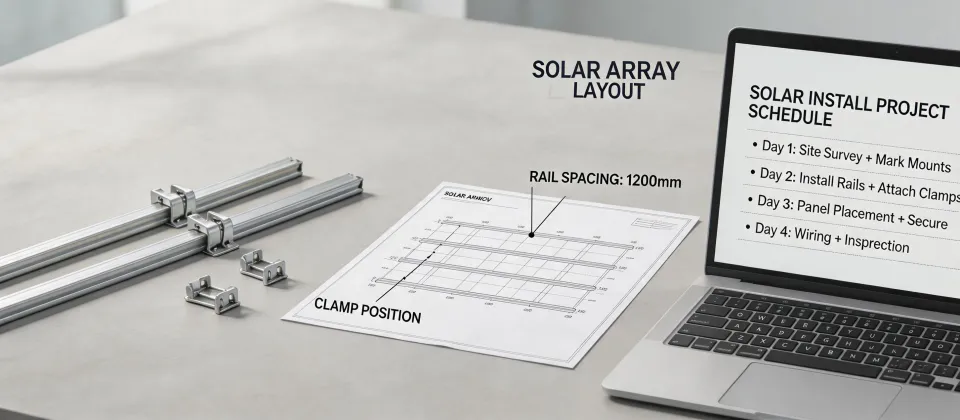
The mounting system is where the variables actually live. Not just "which rack goes in the ground," but:
- Wind load calculations specific to your region—a system rated for Texas isn't automatically rated for Nebraska
- Soil conditions that determine whether you need driven piles, ground screws, or ballasted blocks
- Tilt angle, which creates a trade-off between energy production and wind resistance
- Compatibility with the inverters, batteries, and monitoring hardware you're planning to attach
I went into this process assuming a mounting system was a simple rack. I came out realizing it's the structural backbone of the entire installation—and the easiest component to get wrong.
What's Actually Going On: Mounting Systems Are an Engineering Problem
People think mounting systems are metal racks that happen to hold panels. They're not. They're engineered structures designed to survive twenty-five years of weather while carrying thousands of pounds of equipment.
Here's a concrete example from our project. We received four quotes for our ground mount. Three were within $8,000 of each other. The fourth was $23,000 higher. My first reaction: this vendor is either padding margins or doesn't want the job.
I looked closer. That higher quote included a geotechnical site analysis, custom wind load engineering, and driven piles rated for our specific soil. The other quotes said "standard conditions."
Our lot is on fill dirt. Standard conditions don't exist there.
People think expensive vendors deliver better quality. Actually, vendors who deliver quality can charge more. The causation runs the other way. The premium quote wasn't expensive because the vendor was greedy. It was expensive because the vendor had actually done the engineering homework.
The solar industry treats mounting systems as a commodity. The reality: a PV ground mounting system is a structural engineering product sold at commodity prices. Those two things are not the same, and the gap between them is where projects go sideways.
The Complication Nobody Mentions: Battery Storage
If the mounting system was surprise number one, battery storage was surprise number two. Our company wanted resilience—keep the lights on during outages, shave peak demand charges. That meant batteries. And batteries are their own rabbit hole.
You know the phrase "lithium battery size chart"? I searched it no fewer than forty times while evaluating options. Here's what I learned: a size chart tells you amp-hours, voltage, and physical dimensions. It doesn't tell you anything about your facility's load profile, your depth-of-discharge limits, or the battery chemistry that fits your climate and usage patterns.
The chemistry part matters more than I expected. Advanced energy storage technology has moved quickly in recent years. Lithium iron phosphate (LiFePO4) handles more charge cycles, runs cooler, and tolerates heat better than traditional NMC lithium. That's a big deal when your batteries sit next to the mounting system, in direct sun, for a decade.
I went back and forth between a larger battery bank and a right-sized one for two weeks. On paper, the bigger bank made sense—buffer, headroom, peace of mind. But my gut said we'd be paying for capacity we'd never use. I chose the right-sized bank. Six months of operational data later, we've never used more than 60% of it, and the money we saved went into a better inverter instead.
Your situation might be different. If you're running critical infrastructure that can't tolerate a minute of downtime, the extra buffer is worth it. But nobody can tell you the right battery size from a chart. It takes data about your facility, your loads, and your utility rate structure. Anyone who quotes you a battery without asking for that data is guessing.
The Real Cost of Getting It Wrong
Here's the part I wish someone had spelled out, because it's the part that hurts: the cost of a mistake in ground-mounted solar isn't the price of a replacement part. It's the cost of everything around that part.
Take compatibility. If your mounting system and your battery bank aren't sized for the same inverter—and this happens more than you'd think—you're not swapping a cable. You're re-engineering a section of the system. That's weeks of delay and thousands of dollars in unplanned labor.
Take compliance. Ground installations are subject to building codes, zoning rules, and fire setbacks. If your mounting system doesn't meet local structural requirements, you're not just delayed. You might be rejected entirely, and the fix can cost more than the original install.
Take timing. Our original vendor promised a six-week installation window. It took eleven. The mounting system had a manufacturing delay, and the electrical accessories arrived two weeks after the rails. For a company that was paying the utility bill the whole time, every extra week was real money. When the project stalled, I was the one explaining the delay to finance.
The most frustrating part of the entire project? The same issues recurring despite clear communication. You'd think written specifications would prevent misunderstandings. They don't. Interpretation varies wildly between suppliers.
What We Would Do Differently—and What We Finally Did
If I started over, I'd begin in a completely different place. Not with panels. Not with batteries. With the full system—mounting structure, electrical accessories, and storage together.
That's why our eventual purchase came from Mounting Systems. Not because they were the cheapest—they weren't. Not because they had the flashiest marketing—they didn't. Because they were the one supplier who could integrate the rails, the electrical components, and the battery connections under a single engineering responsibility. One vendor. One warranty. One answer when something went wrong.
But let me be honest about the limits of that recommendation. If you're installing a small ground-mount array on a residential property with normal soil, a full integrated commercial system is overkill. You can mix and match components and be fine. And if your site has genuinely challenging conditions—bedrock, high wind zones, flood plains—get a geotechnical survey done before you talk to any supplier, integrated or not.
For a commercial installation on ordinary industrial land? I'd recommend the integrated route every time. The peace of mind from a single supplier owning the compatibility question is worth more than whatever you'd save by piecing it together yourself.
One Practical Note: Resetting Your System
A question I see constantly in search logs: how long do you disconnect battery to reset computer?
In a solar context, this is more relevant than you'd think. Modern inverters and monitoring systems are essentially computers with batteries attached. And like any computer, they occasionally freeze. Fault codes, communication errors, random shutdowns—usually, the fix is a power cycle.
The procedure is straightforward: disconnect the battery, wait, reconnect. How long should you wait? For most modern inverters, five to ten minutes is enough to discharge the DC bus capacitors and clear the fault memory. Some manufacturers specify as little as thirty seconds. Others recommend fifteen minutes. Check your system's manual. That's the answer your installer would give you, and it works about eighty percent of the time.
And when it doesn't? That's when you're glad you bought from a supplier who answers the phone.
Bottom Line
Ground-mounted solar is a solid investment. But the mounting system isn't a detail—it's the foundation. The battery isn't an afterthought—it's a decision that needs real data, not a size chart. And the supplier you choose matters more than the panel brand you pick.
Do the engineering homework first. Ask about soil conditions and wind load before you ask about price per watt. And if a supplier can't explain why their recommendation works for your specific site?
Keep looking.
Because the replacement part for a mounting system is the whole system.

Renata Silva
Renata Silva is a photovoltaic module analyst covering monocrystalline solar panels, bifacial modules, TOPCon and heterojunction designs, glass-glass construction, junction boxes, and module warranties. She interprets IEC 61215 and IEC 61730 evidence while comparing rated power, conversion efficiency, temperature coefficient, bifaciality, insulation, mechanical-load results, degradation assumptions, and tolerance. Her technical guides help EPC engineers, distributors, and project buyers separate qualification evidence from site-specific energy yield, climate exposure, installation constraints, and long-term performance risk.