Mounting Systems: A Buyer's Comparison Guide (And Why Verification Beats Assumptions)
2026-08-31 / Renata Silva
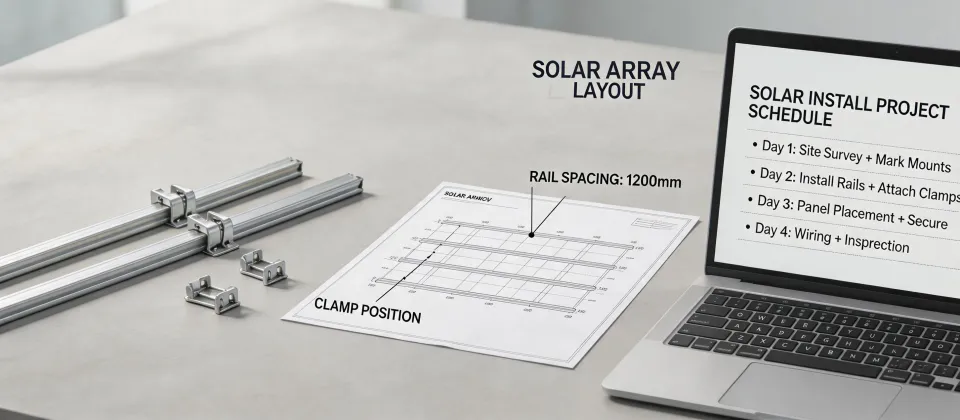
When I first started handling purchases for our company, a quick search for "mounting-systems" or "mounting systems"—with or without the hyphen—returned an odd pile of results. There were TV bracket ads, solar racking suppliers, wind turbine foundation guides, and some Linky smart meter news that felt energy-related but not actually useful. It's easy to get lost when you're just trying to buy hardware and make your team happy.
This article comes from my experience as the office administrator who places the orders and lives with the consequences. I process 60 to 80 purchase orders a year and manage relationships with about eight different vendors, so I've learned to compare things before I commit. I've made mistakes—the kind that cost real money and a couple of awkward conversations with my VP. So now I think of any mounting system purchase as a comparison between two approaches: Option A is trusting what the sales rep puts in front of you. Option B is verifying the technical stuff in advance, even though it takes a little longer. Here's how those two approaches stack up on the dimensions that actually matter.
Why I Compare These Two Paths
My job involves ordering solar PV mounting systems for our facilities team. I don't buy TV mounts or wind turbine anchors, but the phrase "mounting systems" mixes all of those together online. People looking for a space saver TV mounting system land on the same search results as someone trying to spec a commercial roof rack. And "wind turbines on land" shows up for teams researching renewable energy hardware, just like we did when we were comparing solar to other options. The same is true for "Linky smart meter news"—it's relevant to solar because grid rules affect installs, but it's not something I'd rely on for a purchasing decision.
So the comparison that matters is simple: Do you take the fast path and trust the brochure, or do you do the slower, preventive work of checking the details? In my experience, the second approach saves more money than it costs.
Dimension 1: Specs and Compatibility
Option A: "This mounting system fits all standard panels."
That sounds great until you realize "standard panel" can mean different widths, thicknesses, and clamping zones depending on the manufacturer. Last year, I made the classic rookie mistake of assuming "standard" meant "our existing inventory." It didn't. The clamp positions were off by 2.5 centimeters, and we had to order new mid-clamps. That mistake cost us around $600 in extra parts and shipping.
Option B: "Check the compatibility list, the module dimensions, and the authorized clamping zones."
If you've ever bought a space saver TV mounting system, you already know how this works. A bracket might say "fits up to 65 inches," but the VESA pattern, weight limit, and stud spacing are what actually decide whether it fits. Solar PV mounting systems are the same. You need to verify the range of module widths, the torque specs, and the tested wind classes. Most reputable suppliers provide this data in a technical sheet. I've learned to ask for it before any purchase order goes out.
The conclusion here surprised me: the pricier system wasn't necessarily the better one. The one with the clearest spec sheet won, because it saved us from guesswork.
Dimension 2: Wind Load and Site Conditions
Option A: "It's wind-rated, no problem."
That sentence is a red flag for me now. "Wind-rated" doesn't mean anything unless you know the reference wind speed, exposure category, and whether the ground mount is on soil, gravel, or concrete. We once skipped a site check because it was "basically the same as the neighboring project." That was the one time it wasn't. The soil was looser, the wind exposure was higher, and the installation team had to pour extra concrete. The delay was about two weeks and the cost was above budget.
Option B: "Verify the wind load calculation against your local structural standard."
For example, wind load calculations in Europe often follow EN 1991-1-4; in the U.S., it's ASCE 7-22. A good supplier will share these numbers or tell you which standard they used. If they don't, I'd rather walk away.
I also think about wind turbines on land here. They deal with serious dynamic loads, but the principle is the same for solar ground mounts: local conditions matter. A system that works on a sheltered industrial rooftop might not work on an open field. That's not a knock on any specific product—it's just physics.
Dimension 3: Regulations and Grid Updates
Option A: "You don't need a permit for this."
In my first year of doing this, I trusted a sales rep who said the local building department wouldn't require a permit. They were wrong. The inspector required stamped drawings, and we had to pause the whole project. I ate the rush fee for the engineer, and it made me look careless in front of the operations director.
Option B: "Check with the local authority and your utility before you order."
Regulations change, sometimes because of things like smart meter rollouts. As of 2025, Linky smart meter news in France is still a topic for solar owners—connection rules, remote disconnects, and tariff changes can affect when a system can be tied to the grid. The same applies in other markets. Even if you're not in France, the lesson is universal: a 10-minute check on the local rule saves days of rework.
This dimension had an unexpected result for me. I used to think checking rules was optional for small projects. Now I check first, because the cost of being wrong is far higher than the cost of asking.
Dimension 4: Real-World Physics and Ground Truth
Option A: "It works anywhere you put it."
No. Just no. There are limits to every mounting system. Soil bearing capacity, drainage, seismic zone, even the way snow slides off a roof all matter.
Option B: "Confirm the basics with your own eyes or a site survey."
Here's a fun example: Are there black holes in our solar system? As far as we know, no. But the question is a reminder that verifying assumptions is always better than assuming you know. You don't need to be an astrophysicist to check whether a site has enough clearance for a carport or whether the ground is suitable for the mount type you chose. You just need a tape measure and a couple of phone calls. I've started using a checklist that includes "basic assumptions"—and it's the cheapest insurance I've ever bought.
I remember after ordering the first big batch from a verified supplier, I kept second-guessing myself: What if the wind calculations were off? What if the clamps didn't actually fit? The stress ended when the first rack went together without issue. Since then, I trust the process more than the promises.
So Which One Should You Choose?
If you're ordering a low-cost mounting system for a small, sheltered installation and the vendor gives you clear specs, Option A might be fine. I've done it more than once. But for anything that will be up for 20 years, on an exposed roof or in the ground, Option B is the right call.
My rule of thumb: 5 minutes of verification beats 5 days of correction. That's not a slogan I read anywhere—it's from my own spreadsheet of mistakes and rework. A preventive attitude costs a little time, but it's almost always worth it.
If I had to leave you with one practical step, it's this: before you buy any mounting system, write down three things—compatibility, load, and permit status. Ask the vendor to confirm each one in writing. If they can't, that's your answer.
I know from experience that a 10-minute email asking for engineering data feels awkward when you're rushing. But I've never once regretted sending it. I have regretted not sending it.

Renata Silva
Renata Silva is a photovoltaic module analyst covering monocrystalline solar panels, bifacial modules, TOPCon and heterojunction designs, glass-glass construction, junction boxes, and module warranties. She interprets IEC 61215 and IEC 61730 evidence while comparing rated power, conversion efficiency, temperature coefficient, bifaciality, insulation, mechanical-load results, degradation assumptions, and tolerance. Her technical guides help EPC engineers, distributors, and project buyers separate qualification evidence from site-specific energy yield, climate exposure, installation constraints, and long-term performance risk.