Mounting Systems: Snowboards, Guns, or Solar? A Practical Comparison for Buyers Who Need It Fast
2026-08-31 / Renata Silva
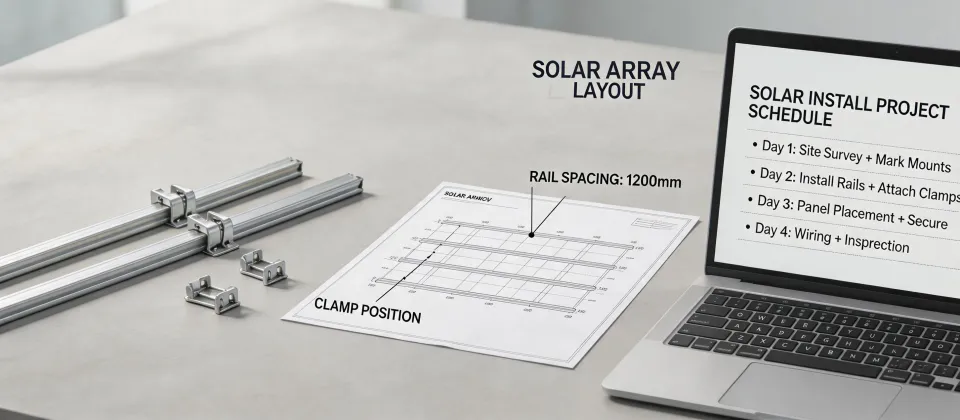
If you searched 'mounting systems' and landed here, let me save you a minute. Snowboard mounting systems, gun mounting systems, and solar PV mounting systems all share the same two-word phrase. They are not the same product. I design and supply the third one—solar mounting systems for commercial and utility-scale projects.
So before we get into the comparison, here is the short answer to 'what is solar system short answer': A solar system in the PV industry is solar panels + an inverter + a mounting system + electrical accessories. That's it.
Why those search terms confuse real orders
In my role coordinating rush PV projects, I've seen more than one inquiry start with 'mounting systems' and end with a question about snowboard bindings. 'Power inverter 100 watt' is another mismatch—it is an electrical component, not a mounting component, and for commercial solar you are usually configuring inverters in kilowatts, not watts. 'TV channel monitoring system' belongs more to broadcast headend monitoring than to solar string monitoring. And 'gun mounting systems' is definitely not something I can help with.
I'm not making fun of search terms. I'm pointing out that 'mounting systems' is a high-level keyword, not a specification. What you actually need depends on load, roof type, product compatibility, and deadline.
The real comparison: Option A vs Option B
After a lot of rush orders, the most useful comparison isn't flat roof vs sloped roof, or aluminum vs steel. It's two ways to buy the same capability:
Option A: a single-source, integrated mounting package, with racking, clamps, grounding, electrical accessories, and perhaps inverters or monitoring, all specified together.
Option B: assembling the parts yourself—rails from one vendor, clamps from another, inverter from a third, monitoring from a fourth—and hoping the pieces line up.
I'll compare them on three dimensions: time, engineering risk, and total cost.
Time: single-source wins when the deadline is real
For a fast project, Option A wins. Period. When I get a call on Tuesday for a 1.2-megawatt order that needs to ship Friday, I need one engineering review, one submittal, and one purchase order. I can validate the complete system against the panel dimensions and roof layout without waiting for three vendors to stop blaming each other.
In March 2024, I had a client call 36 hours before construction deadline because the tile roof anchor specified by another vendor was a no-go. We swapped the anchor and clamp combination, paid $600 in expedited freight, and delivered. The alternative was a $50,000 penalty for missing the utility interconnection window. That's the real timeline risk with multiple vendors: each handoff adds hours, and hours become days.
Option B can be fine when you have six weeks. But if you're moving on a deadline, the extra coordination cost is a risk, not a virtue.
Engineering risk: one throat to choke
A mounting system isn't just a rail. In North America, UL 2703 covers mounting systems, clamping devices, and grounding lugs. The standard is part of a compliant installation. If a clamp hasn't been tested with the module frame, the assembly may look fine and still fail the structural review.
Option A makes it easier to answer the compatibility question because the same supplier has already tested the pair. Does that mean every supplier can guarantee 100% compatibility with every panel model? No. I can only speak to the panels we have actually tested and specified. The important thing is that testing happens before ordering, not after.
Option B gives you more choice, and I'll concede that. If you're installing an unusual module or a complex roof, a specialist component supplier might have the exact oddball bracket. But the engineering review burden moves to you or your structural engineer. For structural loads, I use local building codes and ASCE 7-22 input criteria. The person who signs off is the building official, not a blog post.
I've seen buyers focus on per-watt pricing and completely miss that an engineering stamp, custom rail lengths, and grounding details can add 20-30% on top of the quote. I've also nearly been that buyer. One week before a shipment, I was about to approve a clamp that wasn't listed for the module we'd chosen. A second review caught it. That would have been a costly retrofit.
Total cost: the quote vs the final invoice
On paper, Option B often looks cheaper. I get why people piece together parts—it feels like you're cutting out a middleman. To be fair, some experienced EPCs do this successfully. They have their own structural engineer, established vendor relationships, and a warehouse full of spare parts.
But in my experience, the cheaper piecemeal quote is rarely the final total. The surprise isn't always the rail price. It's the unplanned extras: double freight, a special clamp you didn't know you needed, a power inverter 100 watt accessory that doesn't match the system output, and hours your team spends coordinating returns. A bundled BOS package solves that because the inverter and electrical accessories are selected together with the mounting system.
I've only worked with mid-size commercial installers. If you're a utility-scale developer with a dedicated supply chain team, Option B might make sense for you. The calculus is different when you have people whose only job is managing vendors.
What to check before you choose
If the phrase 'mounting systems' brought you here, ask yourself what type of project you're really solving for. If it's solar, the short version is: panels, inverter, mounting, electrical BOS. Then decide based on your constraints.
- If you have three weeks or less, or if the project has several interdependent products, choose Option A. You need one response, one submittal, one responsible party.
- If you have six weeks or more and in-house engineering, Option B is worth exploring. You'll have time to resolve mismatches.
- If you're searching for snowboard mounting systems, gun mounting systems, or TV channel monitoring system, this page probably isn't what you need. If you're sizing a solar array, know the four core components: panels, inverter, mounting system, and electrical accessories.
Is a single-source mounting system more expensive? Sometimes. Is it worth it on a short deadline? Usually, yes. The last thing you want is to stand at the job site with panels staged, racks on the truck, and one bracket that doesn't exist in the quantities you need. I would rather spend twenty minutes explaining the system up front than make an emergency phone call the night before a deadline. An informed customer asks better questions and makes faster decisions—and faster decisions are what keep projects alive.

Renata Silva
Renata Silva is a photovoltaic module analyst covering monocrystalline solar panels, bifacial modules, TOPCon and heterojunction designs, glass-glass construction, junction boxes, and module warranties. She interprets IEC 61215 and IEC 61730 evidence while comparing rated power, conversion efficiency, temperature coefficient, bifaciality, insulation, mechanical-load results, degradation assumptions, and tolerance. Her technical guides help EPC engineers, distributors, and project buyers separate qualification evidence from site-specific energy yield, climate exposure, installation constraints, and long-term performance risk.