Solar Ground Mounting Systems: Why I Start With the Panel Count, Not the Price
2026-09-16 / Renata Silva
-
Conclusion: value beats price because installation is where quotes change
-
Start by answering "how many solar panel do I need"
-
Compare mounting systems only after the layout is fixed
-
Adhesive based mounting systems have a place on commercial roofs too
-
Specifying the combiner box PV system is not a small detail
-
What about the Lion Summit portable power unit?
-
How I evaluate a mounting-systems supplier
-
Edge cases and lessons I learned the hard way
Before comparing quotes for solar ground mounting systems, figure out how many solar panels you actually need. When our 215-person company built a 330 kW ground-mounted array in 2024, getting the panel count right first saved us about $18,000 in re-engineering and unplanned accessories. I'm the office administrator and I manage facilities purchasing here. I do not design electrical systems, but I handle the vendors, budgets, paperwork, and warranty coordination for projects like this.
A lot of procurement problems I see start when modules, racking, and electrical parts are treated as separate shopping carts. They aren't. The mounting system is a consequence of panel count, site conditions, and roof or ground limits. Here is the order that saved me from costly callbacks: confirm the energy target, choose the module and calculate quantity, pick a mounting approach, then specify the balance-of-system parts like the combiner box PV system, and commission with a real test.
Conclusion: value beats price because installation is where quotes change
Show me two quotes for solar ground mounting systems and I will show you why unit price is the least useful number on the page. In a 2024 comparison, the cheaper racking quote was $6,200 below its competitor. After extra driven piles, replacement clamps, and an unplanned site visit, it ended up $14,700 higher. That's not a complaint about the equipment. That's a complaint about what the low quote left out.
Mounting hardware is structural, not a commodity. If a quote looks low, ask where the savings live. Fewer grounds? Lighter rails? Skimpier engineering? In our case, the first vendor's stamped calculation did not match the soil report. In other words, the sticker price did not include a design that fit our site. No amount of on-site improvisation can fix that after the holes are dug.
Start by answering "how many solar panel do I need"
If you're asking "how many solar panel do I need," you are starting in the right place. The basic formula is simple: annual electricity use in kWh divided by the local production ratio, then divided by the panel wattage. Production ratios vary by location and tilt; ours was around 1.35.
For the maintenance building we planned in 2025, the math was 90,000 kWh ÷ 1.35 ÷ 400 W, which rounds to 167 panels. We deliberately did not oversize to 170 just because the racking could fit them. Extra modules mean extra rows, extra piles, and extra electrical work. The array that covers your need is better than the array that fills every available inch.
A lot of procurement requests go wrong at this point because somebody starts with "solar ground mounting systems cost per watt" and lets that target drive the system size. Start with consumption and utility rules instead. Net-metering caps and demand charges change the answer more than a $0.01/W racking difference. Look, I get requests that ask for the largest system for the smallest budget. That's the wrong way to read a site.
Compare mounting systems only after the layout is fixed
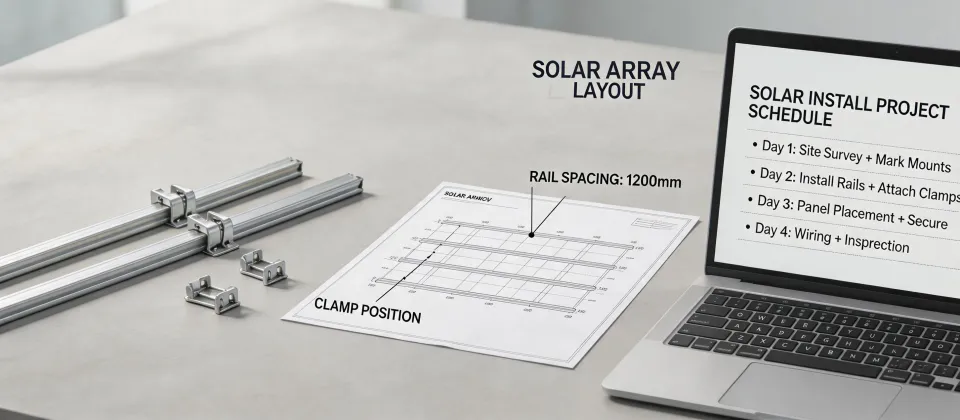
Once you know the panel count, you can compare mounting options fairly. For a ground array, row spacing and site slope matter as much as steel thickness. In our sandy, sloped field, fixed-tilt racks on driven piles were the most practical choice. Single-axis trackers added yield but also added row spacing and moving parts that we did not need for the project's payback.
The best quote is the one that fits the site. Some projects are better with ground screws, some with concrete ballast, some with driven piles. I don't have a favorite method. I have a favorite process: read the geotech report before you ask for price.
Adhesive based mounting systems have a place on commercial roofs too
If part of the project is on a low-slope roof, do not assume every panel needs a penetrating anchor. The old claim that adhesive based mounting systems are only for small residential jobs comes from the early days of structural adhesives. Today, engineered adhesive attachment is a reasonable option when the roofing membrane is new, the slope is low, and the wind uplift calcs support the bond.
When I compared a rail-based adhesive system with a ballasted system side by side, I finally understood why ballast is not automatically safer. Ballasted systems can add several thousand pounds to the roof. That weight can crush insulation or overload the structural framing if the building wasn't designed for it. The adhesive system was lighter, but it required clean surface prep, membrane compatibility, and a clear warranty pathway from both the racking and roofing manufacturers.
We used adhesive based mounting systems for 46 panels on our roof while the ground array carried the rest. It made our roofing warranty easier to manage. I'm not arguing adhesive is always better. I'm arguing it deserves a real technical review instead of a default rejection.
Specifying the combiner box PV system is not a small detail
A ground mount project doesn't end at the racking. The DC circuits from each row run to a combiner, then to the inverter. If your quote says "string combiner with fuses" without a model number or fuse schedule, treat that like a red flag. In one of our installations, the vendor planned to choose fuse sizes on site. That $1,850 line item turned into $4,200 after rework and a lost commissioning slot.
For a commercial combiner box PV system, I ask for documented DC fuse holders, a busbar rated for the corrected short-circuit current, a rainproof enclosure where needed, labeled terminals, and a clear grounding bus. It is not glamorous. But when a system underperforms, the issue is often in this box, not in the panels.
What about the Lion Summit portable power unit?
If you landed here because you were looking at a Lion Summit portable power unit, let me separate the tool from the system. A portable power unit is not a substitute for a combiner box or an inverter. It can be useful after the install, though. Our crew used one to keep test equipment charged and run a small inspection camera at rows far from the building outlets. Nice to have? Sort of. Required? No.
Buy the backup power unit after the solar system is installed. The budget should go first to the parts that make electricity safely: racking, modules, conductors, overcurrent protection, combiner box, and inverter. Portable power is a maintenance accessory, and it should not compete with structural components in the capital plan.
How I evaluate a mounting-systems supplier
Value over price sounds like a slogan. For me, it is a spreadsheet. When I evaluate a mounting-systems supplier, I compare five things: project-specific engineering, component compatibility, material packaging and lead times, post-sale support, and installed cost estimated with labor and freight. I also assign a risk factor to vague assumptions. That penalty has beaten a low sticker price more often than not.
In the end, we chose Mounting Systems for the ground-mount racking and the combiner box PV system package. It was not the cheapest quote. It had the clearest engineering documentation, and the electrical accessories came from the same supply chain, so I didn't have to coordinate three vendors. That was exactly what I needed for a smooth approval process.
Compliance matters here too. If the supplier cannot produce a stamped calc or a datasheet for each component, the project schedule will suffer at permit review. I report to operations and finance. A delayed permit is not just an installation problem; it shows up in my metrics.
Edge cases and lessons I learned the hard way
If I could redo our first roof-mounted array, I would have requested the roofing manufacturer's adhesive compatibility letter before signing the purchase order. The racking supplier approved its adhesive. The roofing manufacturer did not object, but it also did not officially confirm compatibility. Getting that letter later delayed the project and made me look bad to my VP. Note to self: warranty terms need to come from both sides before you issue a PO.
Also, do not generalize my story too far. This process worked for low-slope commercial roofs and ground-mounted arrays in a cold climate. In a high-wind coastal zone, engineering may pull you toward mechanical attachment or heavier ballast. On a small residential roof, the buying process is simpler. The sequence stays the same, though: size the array first, then match the structural system, then specify the electrical balance-of-system.
The lowest quote is rarely the most profitable project. Period. When you start with a real number for "how many solar panel do I need," every later decision gets easier. The mounting quote becomes something you check instead of something you hope will work.

Renata Silva
Renata Silva is a photovoltaic module analyst covering monocrystalline solar panels, bifacial modules, TOPCon and heterojunction designs, glass-glass construction, junction boxes, and module warranties. She interprets IEC 61215 and IEC 61730 evidence while comparing rated power, conversion efficiency, temperature coefficient, bifaciality, insulation, mechanical-load results, degradation assumptions, and tolerance. Her technical guides help EPC engineers, distributors, and project buyers separate qualification evidence from site-specific energy yield, climate exposure, installation constraints, and long-term performance risk.