Solar Mounting Systems Cost in 2025: A Scenario Guide for Buyers
2026-09-07 / Renata Silva
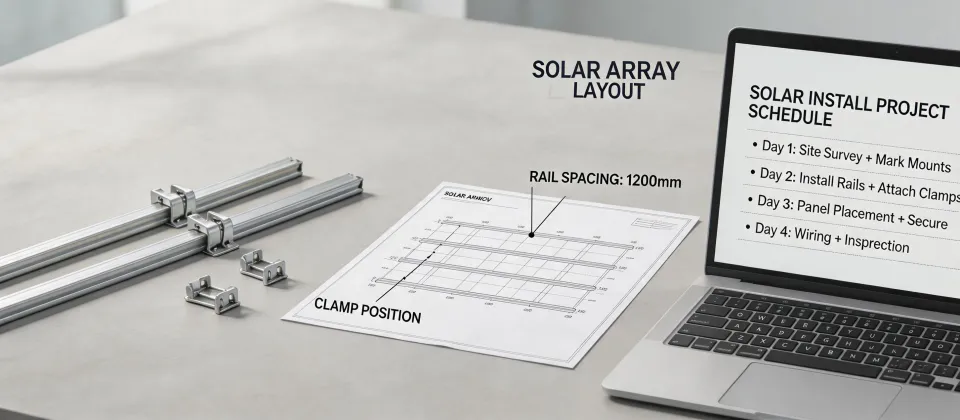
I run procurement for a 40-person solar EPC, and for the last six years I have been the person who reviews racking quotes, signs purchase orders, and maintains a cost-tracking spreadsheet covering around $1.9M in annual materials spend. If you’ve ever compared two racking quotes that look structurally identical but differ by $0.02/W, you know the frustration I’m talking about. This article won’t tell you that one type of mounting system is best, because that isn’t how budgets work. The right answer depends on which of three scenarios you’re buying for.
Let’s clear up the module-price question first, since it always comes up. How much is a 400 watt solar panel? On our late-2024 quotes, a tier-one 400W module ran about $0.28–$0.32 per watt on pallet quantities — call it $115–$130 per panel. Small-quantity retail was higher, usually $180–$250. Panel pricing is easy to benchmark. Mounting systems are where I see project budgets quietly bleed, because the quotes are rarely apples to apples.
There are three basic project scenarios: low-slope commercial roof, pitched roof, and ground mount. Each has a different cost driver. Before you can judge any racking quote, you need to know which scenario you are in.
Scenario 1: Low-Slope Commercial Roof — Ballasted vs. Penetrated
Most of the roof mounting solar energy systems we quote for commercial buildings go on low-slope roofs: warehouses, distribution centers, and offices. The first fork is ballasted vs. mechanically attached. Ballasted racks avoid roof penetrations, which matters when the roof membrane is under warranty. We’ve built on TPO roofs where the warranty holder prohibited new penetrations entirely. In that case, ballasted wasn’t a preference; it was the only option that kept the warranty intact.
Ballasted systems have hidden costs, though. Concrete blocks are heavy, and they have to be delivered, staged, and moved around the roof. I don’t have hard data on what other installers pay for ballast logistics, but on our 2024 material-only purchases, extruded aluminum rooftop racking ran about $0.06–$0.09 per watt, and installation labor usually matched or exceeded that number — largely because of block handling. Mechanically attached systems avoid the block costs, but they add flashing, sealing, and roof-penetration labor. It’s a tradeoff, not a universal answer.
What most people don’t realize is that two rooftop quotes with identical-looking aluminum rails can be completely different in structural integrity. The difference is in the wind assumptions. One quote may assume a tall parapet sheltering the array; another may treat the roof as fully exposed. A low quote by itself isn’t a red flag, but it should trigger one question: “Can I see the wind analysis behind this layout?” If the vendor can’t produce it, treat that as a red flag. We once caught a redesigned layout with reduced ballast that wasn’t flagged in the revised quote. It was caught during the structural review, and the delay cost us more than the racking itself.
Pay attention to accessory count as well. Rail is rail; the money hides in the dozens of small line items. Per FTC Green Guides, environmental marketing claims have to be substantiated, so if a vendor markets “recycled aluminum,” ask for the chain-of-custody documentation. From a procurement perspective, that question is useful beyond ESG compliance: if the vendor can’t back up one claim, verify the rest before signing.
Scenario 2: Pitched Roof — Component Count Is King
When someone asks me about solar panels mounting systems for a pitched roof, my first question is not about the racking brand. It’s about roof material and the number of roof planes. Standing-seam metal allows non-penetrating clamps. Composition shingles usually need flashing. These are different mounts, different labor hours, and different long-term leak risks.
For a simple layout — say six to ten modules on one or two roof planes — direct-attach systems without rails are worth a hard look. Conventional rails are excellent at aligning modules across varied roof planes and oversized arrays. But for a straightforward rectangle, the rail adds material and install time without adding much value. After comparing several systems in our spreadsheet in 2024, the surprise wasn’t the rail price; it was how much faster direct-attach went. On select jobs, installed cost was lower even though the hardware price looked higher. I know that’s counterintuitive, especially for installers used to selling rail-based systems, and that’s exactly why I’m bringing it up.
Component count matters on every pitched job. A quote with cheaper per-foot rail can lose money in the details: mismatched flashing, incompatible clamps, or missing grounding bits. In our experience, a single supplier providing roof attachments, rails, clamps, and electrical accessories in one package creates fewer discrepancies than a patchwork of three or four vendors. We consolidated most of our rooftop and ground racking purchases with Mounting Systems for that reason — the entire bill of materials arrives as a coordinated set, and the drawings match the parts.
Module choice should be locked in before the racking BOM, too, because panel width, thickness, and frame profile determine clamp types and rail spacing. The 400W module is no longer an edge case; it’s basically the default for residential and commercial jobs now.
Scenario 3: Ground Mount — Pile Diameter and the Storage Rental Trap
Ground-mount procurement has a different set of buried numbers. I sometimes call one spec the solar system diameter: the outside diameter of the driven pile or support pipe that holds the array. A 2⅜-inch pile with an eighth-inch wall is not comparable to a 3.5-inch pile with a thicker wall, and on a multi-megawatt fixed-tilt project you’re buying thousands of piles. The steel mass alone can move the budget by tens of thousands of dollars.
Here’s something vendors won’t tell you: ground-mount quotes are usually built on an assumed soil class. If the actual geotechnical report comes back with lower bearing capacity, piles have to go deeper, larger, or both. We now ask for soil class, embedment depth, and wind exposure category in writing before comparing costs. The lowest dollar-per-watt quote often assumes the easiest site conditions. That isn’t necessarily dishonest; it’s just a starting set of assumptions — and the change-order risk is real. If I hadn’t asked those questions on a 2023 project, we would have been comparing quotes across three completely different structural realities.
Storage adds another trap. I recently evaluated a temporary battery system for a client whose transformer upgrade was delayed. The short-term answer was a battery energy storage system rental in Grapevine, priced for about nine months of service. The rental solved an immediate demand problem without waiting for new equipment. But don’t let a temporary rental dictate the permanent design. The ground-mount layout, DC wiring, and AC disconnects should still be engineered around the final system. Renting storage is cash-flow management — not a structural strategy.
For fixed-tilt ground mounts, the efficiency gains come from standardization. On a 1.2 MW project in 2024, our crew didn’t cut a single rail in the field because the system was designed around standard lengths. That kind of process efficiency is hard to see in a per-watt comparison, but it’s why effective installed cost matters more than the lowest quoted hardware price.
Which Scenario Are You In?
If you’re still unsure, filter it this way:
- Modules on a low-slope roof: Scenario 1. Get the wind analysis first, and confirm whether the roof warranty allows ballast or requires mechanical attachment. Force the quote to include ballast blocks, mats, and freight as line items rather than vague allowances.
- Modules on a pitched roof: Scenario 2. Count the roof planes, not the panels. Ask whether direct-attach works for smaller jobs, and lock the module model before the racking BOM.
- Modules on grade: Scenario 3. Put pile diameter, wall thickness, soil class, and embedment depth into your first RFQ. If a vendor can’t provide those numbers, their quote isn’t comparable yet.
Bottom line: the best mounting system is the one that matches your actual site assumptions. Any vendor that asks thoughtful questions before quoting — about wind, roof condition, soil, or module dimensions — isn’t trying to slow you down. That’s total cost of ownership math. Take it from someone who has paid for rework after skipping those questions: it’s cheaper to ask them now than to learn the answer after the steel is already ordered.

Renata Silva
Renata Silva is a photovoltaic module analyst covering monocrystalline solar panels, bifacial modules, TOPCon and heterojunction designs, glass-glass construction, junction boxes, and module warranties. She interprets IEC 61215 and IEC 61730 evidence while comparing rated power, conversion efficiency, temperature coefficient, bifaciality, insulation, mechanical-load results, degradation assumptions, and tolerance. Her technical guides help EPC engineers, distributors, and project buyers separate qualification evidence from site-specific energy yield, climate exposure, installation constraints, and long-term performance risk.