A Mounting Systems Warning: Don’t Order the Racking Before You Understand the EBoS
2026-09-07 / Renata Silva
-
The surface problem: “Just quote the mounting system”
-
Deep cause #1: “System” often means “structure”
-
Deep cause #2: EBOS for solar mounting systems is treated as an afterthought
-
The cost: not just dollars, but momentum
-
The fix: a short checklist, instead of another 20-page spec
-
Answer the right question
Ask someone which is the smallest planet in the solar system, and you’ll hear “Mercury” before the sentence ends. Ask an installer what delays a commercial solar project, and you’ll usually hear “mounting systems.” After eight years of reviewing solar mounting system specifications, I’d point somewhere else: the gap between the racking specification and the electrical balance of system.
I should explain. I’m an applications engineer for a mounting systems manufacturer. I’ve been in this role since 2017, and in my first four years I documented six significant mistakes that cost roughly $17,000 in wasted time and materials. Now I maintain our internal checklist. Consider this an attempt to warn mounting systems buyers before they make the same mistake.
The surface problem: “Just quote the mounting system”
In September 2022, a contractor asked us to quote a ground-mount system for a 118-module commercial array. “Electrical is already handled,” he said. “Give me the racks, the clamps, the anchors.” That sentence should have been a red flag.
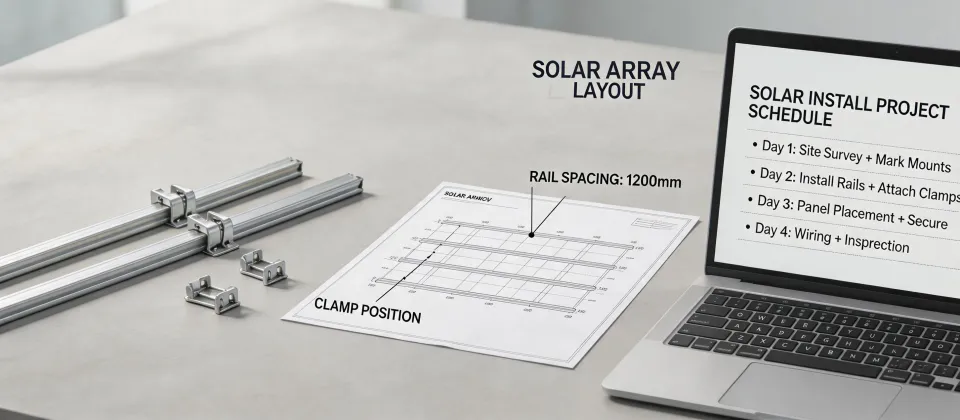
We supplied the racking on schedule. Mechanically, everything fit. The trouble started when the electricians tried to run DC conduit along the array. Their wire routing crossed a maintenance access path, and the rail profile didn’t have a clean way to attach cable management without extra standoffs and splice brackets. None of those components appeared in the mounting systems quote because I hadn’t asked to see the electrical layout. The mechanical order was around $9,800. The extra electrical BOS parts and rework came to another $3,200. The project lost nine days over a problem that had nothing to do with the strength of the racking.
That mistake stayed with me because it looked like a mounting system failure. It wasn’t. It was a coordination failure that cost real money.
Deep cause #1: “System” often means “structure”
Most buyers treat a solar mounting system as a collection of physical parts: rails, clamps, feet, screws. But the system also has to support every cable, optimizer, inverter, monitor, and junction box attached to it. Once you attach an electrical component to a rail, you’ve changed the mechanical specification. The electrical system and the mounting system are no longer separate.
I understand why people miss this. A foldable solar panel with charge controller is an all-in-one product: unfold it, plug in the battery, and it works. Commercial mounting systems are not like that. They are platforms for dozens of decisions, and often those decisions are made after the racking is ordered. That’s the wrong order, and it’s a hard habit to break.
Deep cause #2: EBOS for solar mounting systems is treated as an afterthought
Let’s define the acronym I hear too late: EBOS, or electrical balance of system. It covers inverters, combiners, disconnects, cable trays, rapid shutdown electronics, and monitoring. EBOS for solar mounting systems is not an optional accessory kit. It is the set of electrical and mechanical interfaces that turn racking into an array.
The usual assumption is that racking should adapt to any electrical plan. In my experience, the opposite gets closer to the truth: the electrical plan has to be developed in parallel with the mounting layout, or it ends up adapting on site—at field-labor prices. This is a common causation reversal. People think poor interface planning comes from missing parts. In reality, it comes from missing the design link between mechanical structure and electrical topology. At least, that’s been my experience on commercial ground-mount and carport projects.
There’s also a training dimension. If your team is new to electric vehicle infrastructure, don’t assume you can separate the carport from the charger. I once spent half a day in EV charging station installation training—not to become an EV installer, but to understand how charging cables, conduits, and mounting frames interact. It felt like a detour at the time. It saved us a $4,900 rework on a later carport project because I knew to ask where the charging cables would enter the column before the steel was ordered. You don’t need to install EV chargers yourself, but you need enough awareness to ask the right questions in the same meeting.
The cost: not just dollars, but momentum
These interface gaps show up as change orders, but the real damage is schedule momentum. When ground-mount racking is delivered on time and then waits for an electrical redesign, the whole project slows down. The mounting system itself is fine; the surrounding assumptions are not.
A related example from March 2023: we delivered a carport structure with provision for EV charger pedestals. The charger equipment was supplied by another vendor, and no one checked the charger’s mounting hole pattern against the columns we had planned. We caught the mismatch during a pre-install review, before production started. That single change order was $2,400 in additional steel, plus a one-week delay. The parts weren’t complicated. The interface wasn’t coordinated.
(Should mention: in both stories, the installers were experienced and the mounting gear was not the weak link. The weak link was the design process around it.)
The fix: a short checklist, instead of another 20-page spec
After the September 2022 incident, I started asking four questions before every major order. These four now save us a lot of pain:
- Show me the single-line diagram and DC layout before you quote racking. Even a rough sketch helps me spot physical clashes.
- Which electrical components attach to the racking? Optimizers, rapid-shutdown boxes, monitoring antennas, cable trays—all of them need a mechanical home.
- Where will conduit and cable runs travel? The easiest path often crosses rails, posts, or access lanes. It’s better to know before the order.
- Who is doing the installation, and what have they trained on? First-time EV charging or carport installations deserve a coordination call, not a guess.
The last item keeps surprising me. In Q1 2024, I added a formal “interface review” to our internal handoff process. It was just two columns on a spreadsheet: mechanical assumptions and electrical assumptions. Since then, it has caught 47 potential conflicts, many of them before they became change orders. That sounds obvious now. It wasn’t obvious to me until a mounting system order turned into a $3,200 lesson.
Answer the right question
I still get asked which is the smallest planet in the solar system, and the answer is easy: Mercury. But the question that keeps me up at night is not about planets. It’s about the small interfaces we ignore between the mounting system and the EBOS. The rails won’t bend, the clamps won’t break, and the modules will fit. The failures hide in the connections—the cable clips, conduit paths, charger stud locations, and the quiet assumptions we made on separate spreadsheets.
If you’re ordering a mounting system in 2025, ask for the electrical drawings first. Not because you need to design the inverter layout, but because the mounting system isn’t a pile of aluminum. It’s a platform where electrical decisions live. Coordinate the interfaces before you order, and the worst of these problems disappear.

Renata Silva
Renata Silva is a photovoltaic module analyst covering monocrystalline solar panels, bifacial modules, TOPCon and heterojunction designs, glass-glass construction, junction boxes, and module warranties. She interprets IEC 61215 and IEC 61730 evidence while comparing rated power, conversion efficiency, temperature coefficient, bifaciality, insulation, mechanical-load results, degradation assumptions, and tolerance. Her technical guides help EPC engineers, distributors, and project buyers separate qualification evidence from site-specific energy yield, climate exposure, installation constraints, and long-term performance risk.