Solar Mounting Systems: What a Quality Manager Checks Before Rooftop or Ground Installation
2026-09-04 / Renata Silva
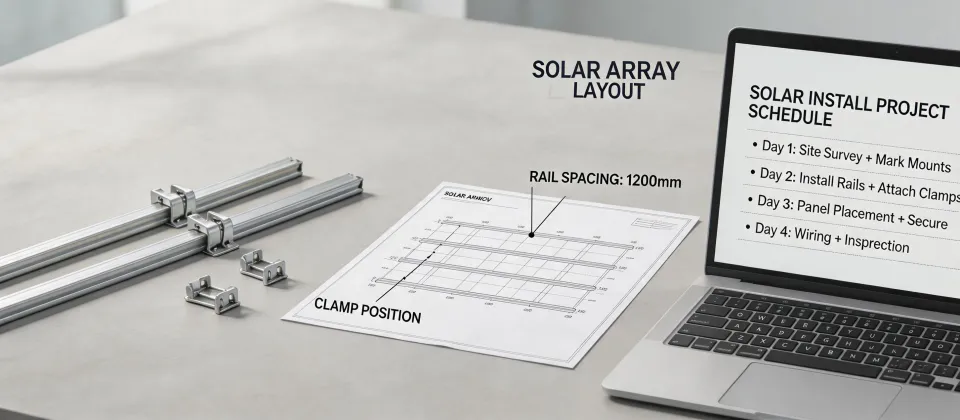
When a solar project goes sideways, the module and the inverter usually get the blame. In the projects I review, the real culprit is more often underneath both: the mounting system.
I'm a quality and brand compliance manager at Mounting Systems. I review structural calculations, technical documentation, and project submittals for PV mounting solutions on flat roofs, pitched roofs, ground arrays, and carports—roughly 200+ project reviews a year. In our Q1 2024 quality audit, 9% of first-round submittals were rejected for correction. Most shared the same pattern: components that had to work together—rails, clamps, flashings, fasteners—were not specified as a verified set.
Racking typically is a single-digit percentage of a PV project's cost and 100% of what keeps the array attached for 25 years. You can replace an inverter in an afternoon. Modules can be swapped one at a time. A mounting failure, by contrast, forces a rework that touches everything above it.
Why does this matter right now? Because the photovoltaic mounting systems market is growing as fast as solar itself. According to IRENA (irena.org), solar PV made up roughly 346 GW of the 473 GW of renewable capacity added worldwide in 2023.
Honestly, I'm not sure why published estimates of the photovoltaic mounting systems market swing so widely. I have seen figures from $12 billion to over $25 billion for the same year. My best guess is that every mounting-systems supplier and analyst counts a different product set: some include trackers and ground screws, others count only rails and clamps. The disagreement itself is a useful reminder: in mounting, definitions are everything.
Rooftop Solar Mounting Systems: What I Inspect First
Two details predict the most rework that reaches my desk on rooftop solar mounting systems: clamp compatibility and flashing choice. Rail spans, torque specs, structural calculations—those are engineering, and usually they get done properly. Clamps and flashings are where assumptions sneak in.
Here is a specific example. A clamp designed for a 30–35 mm module frame can sometimes be forced over a 40 mm frame, but it won't grip correctly under wind uplift or snow load. The mismatch is invisible on installation day and expensive in year three. That is why we maintain a module compatibility list for every profile, and why I ask any supplier for one. If a module is not on the list, the phrase 'should work' does not belong in your project file.
In 2022, we rejected a batch of 8,000 clamps from one of our suppliers because the gripping surface measured 1.2 mm off the drawing. The supplier argued it was 'within industry standard.' Our tolerance is ±0.5 mm. We rejected the batch and the supplier redid it at their cost. The risk we weighed was simple: ship them and look good for a quarter, or stop the line and explain a delay to customers. I kept asking myself whether a 1.2 mm deviation was worth loose clamps on a commercial roof five years later. It wasn't. Now every contract with that supplier includes the exact gripping-surface spec.
The second issue is flashing. A roof that was watertight before solar stays watertight after—only if the mount's flashing matches the actual roof profile. Corrugated metal, standing seam, clay tile, and torch-down membrane all need different details. In North America, the racking and its grounding/bonding path should be listed to UL 2703 (ul.com); in Europe, structural calculations typically follow the Eurocodes. That documentation isn't paperwork. It is independent proof that someone checked.
One more thing: I don't have a fixed opinion that ballasted is better than penetrated, or aluminum better than steel. Both methods work. The correct one depends on the building's spare load capacity, wind region, and roof membrane. What I object to is choosing a method because that's what the vendor stocks rather than because the roof required it.
Ground Mounts Are Not Oversized Basketball Goal Poles
If you search for 'basketball goal ground mount', you'll see what many people picture when they hear 'ground mount': a steel pipe sunk in concrete with a backboard on top. A customer once asked whether a small solar array could be mounted that way, 'like a basketball goal and a slab.'
The short answer is no. A basketball goal has to hold a few hundred pounds of pole and backboard against tipping. A solar ground mount has to hold hundreds of pounds of glass at an angle that catches wind from underneath, in open terrain with no shelter. Same noun, different universe. Soil conditions, wind exposure, row length, and module tilt all change the foundation math.
I would not want any ground-mount supplier—including us—to quote a pile layout without site-specific soil and wind data. That is why ground-mount projects usually include stamped engineering. For a 12-module array it can feel like overhead, but ground mounts sit in the open, where worst-case wind is not a question of 'if' but 'when.'
Inverters and Batteries: Answering the Price Questions
Everyone asks 'how much is a power inverter?' The timestamped, honest answer for a residential grid-tied string inverter is roughly $1,000 to $2,500, based on distributor quotes from early 2025; for a commercial three-phase inverter, the per-watt price drops but the absolute number climbs. Verify current rates before budgeting—inverter pricing moves quickly.
But the number that matters is the list of line items around the inverter. Does the quote include the DC disconnects? The surge protection device? The monitoring gateway? The mounting brackets for the inverter itself? No? Then you don't know the price yet. I've learned to ask 'what's NOT included' before 'what's the price.' A vendor who lists all fees upfront—even if the total looks higher at first—usually costs less in the end. Transparent pricing is simply easier to compare; hidden line items are where surprises hide.
The same 'similar-sounding product' problem shows up with batteries. Search 'lifepo4 battery car audio' and you will find lithium iron phosphate packs designed for car stereos—chemistry siblings to solar storage, but different tools. A car-audio LiFePO4 battery is engineered for short, massive current bursts. A stationary PV battery is engineered for daily cycling over years. They are the same chemistry family, but rarely good substitutes for each other. When a storage quote just says 'LiFePO4', ask for cycle life at your planned depth of discharge, and for the continuous charge and discharge ratings—not only the capacity.
The Caveats Nobody Puts in a Brochure
Now the boundaries, because there are always boundaries. If you're assembling an unpermitted, off-grid 1 kW array for a shed, a simple universal mounting kit may be perfectly fine. The scrutiny I'm describing applies to arrays where people, roofs, and warranties are at stake.
If your roof has an unusual structure—say, an older substrate that hasn't been inspected—mounting hardware will not fix it. No racking system compensates for rotten framing or an overloaded building. In that situation, a structural review comes before any mount selection, and many local codes already require it.
No honest manufacturer will promise that every clamp works with every module ever made. Frame heights vary, coatings vary, and frameless or shingled modules behave differently from standard framed ones. The compatibility list is the truth; the word 'probably' is not a specification.
If you ask me, the best array is not the one with the most impressive-looking clamps or the longest warranty sticker. It is the one where the mounting system received the same attention as the module and the inverter. After four years of reviewing 200+ projects a year, that's the conclusion I keep landing on—and the missing detail I keep finding when rework happens.

Renata Silva
Renata Silva is a photovoltaic module analyst covering monocrystalline solar panels, bifacial modules, TOPCon and heterojunction designs, glass-glass construction, junction boxes, and module warranties. She interprets IEC 61215 and IEC 61730 evidence while comparing rated power, conversion efficiency, temperature coefficient, bifaciality, insulation, mechanical-load results, degradation assumptions, and tolerance. Her technical guides help EPC engineers, distributors, and project buyers separate qualification evidence from site-specific energy yield, climate exposure, installation constraints, and long-term performance risk.