Commercial Mounting Systems: The Procurement Checklist I Use After $38,000 in Racking Mistakes
2026-09-03 / Renata Silva
-
Check #1: Start with the site details, not just module count
-
Check #2: Send the exact module drawing, especially for TOPCon bifacial solar panels
-
Check #3: Ask for the “what’s not included” list in writing
-
Check #4: Count the small parts before comparing total cost
-
Check #5: Solar panel wall mounting systems get a separate review
-
Check #6: Plan freight, staging, and spare parts before delivery
In September 2022, I signed what looked like a well-priced commercial mounting system order. By the time the material actually reached the roof, that “competitive” price was $16,800 higher than the purchase order. Not because the rails were bad—they were fine. The problem was the pieces that no one put in writing: wall mount brackets, grounding lugs, splice plates, cable clips, and three freight invoices instead of one.
I’ve now spent six years buying racking for commercial solar projects. I’ve also kept a list of my own procurement mistakes—ten so far, costing roughly $38,000 in extra freight and rework. The list below is the one I walk through before every quote. It has six checks, and check #3 is the one I’d beg you not to skip.
Check #1: Start with the site details, not just module count
When an EPC sends a message that says “we need mounting systems for a 1.2 MW commercial project,” that could mean a roof, a carport, or a vertical wall. It can even mean different foundation approaches for the same ground site, depending on soil and wind.
Before you ask for quotes, put together a one-page site brief. Include:
- Region and wind speed or wind zone
- Roof type, slope, and deck construction if roof mounted
- Soil report or structural report for ground or wall mounts
- Module orientation and tilt, if known
- Dimensions of available areas: parapet offsets, wall height, row spacing
A racking company that has to guess will build its quote around its default assumption. If that assumption doesn’t match the site, you’ll pay for the rework and delay later, not in the quote.
Check #2: Send the exact module drawing, especially for TOPCon bifacial solar panels
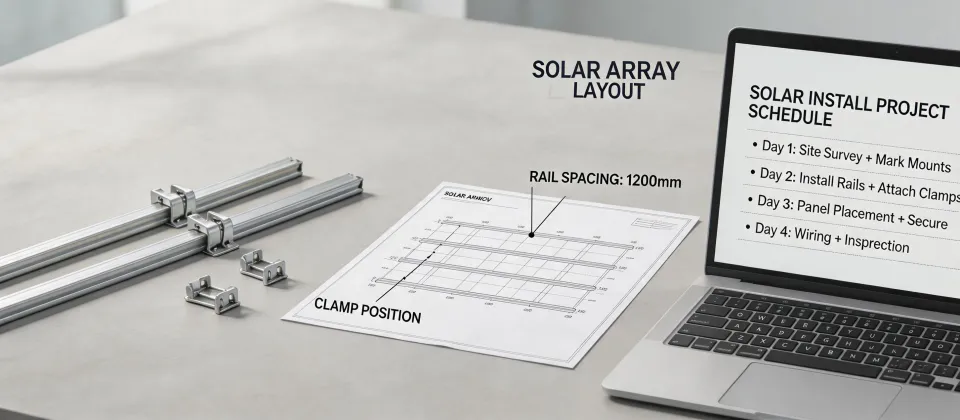
It sounds simple, but I still get RFQs that say “450 W bifacial.” There are TOPCon bifacial solar panels in that power class with very different frame heights and clamping zones. If the supplier quotes based on an older 450 W module drawing, the rail spacing can be perfectly correct for the wrong panel.
I learned this the hard way on a ground-mount order. The drawing we sent showed a 35 mm frame. The panels that arrived had a 30 mm frame. The standard clamps didn’t fit. No need to describe the rest.
So include the module data sheet and the installation drawing. If you are evaluating TOPCon bifacial solar panels, call out “bifacial” as well—the racking needs room for the rear cable path and junction box, especially if you’re also mounting rapid shutdown devices on the rail.
Check #3: Ask for the “what’s not included” list in writing
I used to ask three suppliers for their best price and compare totals. The problem is not the totals; it is what those totals include.
A commercial mounting system price should be transparent. That means a line-item BOM and a list of exclusions. When a quote says “includes standard accessories,” I reply with one question: “What is not included?”
I’ve learned to ask “what’s NOT included” before I ask “what’s the price?” The supplier who lists exclusions clearly, even if the total looks higher, usually costs less by the time the project is done.
Look for ballast blocks, flashing, ground screws, anchor bolts for wall mounts, rail splices, grounding lugs, and cable trays. Some vendors sell those separately because quantities vary. That’s fine—as long as the separation shows up on the quote before you sign.
Check #4: Count the small parts before comparing total cost
Our worst shortage wasn’t a rail problem. We had enough rail. We were 22 splice plates short because the takeoff software assumed shorter rail runs. Splice plates are cheap. The overnight freight was not.
Now I build a row-by-row takeoff before approving any commercial mounting system order. For every row of modules, I count rail splices, mid-clamps, end clamps, grounding hardware, flashing or penetrations, wire clips, and clips for module-level power electronics. Then I add about 2% spare for small parts.
Don’t trust a single “complete system” part number. A complete system for one site can be a partial system for another. If doing the count by hand feels impossible, ask the manufacturer for a compatibility report. But don’t sign the order until someone has checked the clamp count against the actual number of modules.
Check #5: Solar panel wall mounting systems get a separate review
If your job includes a wall-mounted array, don’t quietly fold it into the roof-mount scope. Solar panel wall mounting systems use a different attachment method: brackets bolted to concrete, structural steel, or masonry. In my experience, that’s where some of the biggest hidden engineering gaps show up.
Ask whether the quote includes anchor bolts and an anchor schedule for the exact wall substrate. A universal wall-mount bracket designed for poured concrete won’t necessarily work on a metal stud wall. Ask for the wall-mount installation detail and, if local code requires it, a structural review. It’s much easier to get that before steel is ordered than after the anchor bolts are set.
Check #6: Plan freight, staging, and spare parts before delivery
Another boring but expensive area is logistics. Mounting rails come in long bundles. If the site has a narrow entrance or no crane access, a standard delivery truck can be a problem. We discovered this on a Friday afternoon once, and the cost of the second truck plus an off-site crane was painful. (Yes, I’ve done that. It was as bad as it sounds.)
Ask the supplier how the material will be packed: bundle weights, bundle lengths, pallet counts, and whether the truck has a liftgate. If the order is large, ask whether partial deliveries are possible and whether there is an extra fee for them.
Also keep a small spare-parts buffer on every PO. A missing clamp or damaged end cap is not a big deal if you can pull one from the job box. It becomes a project delay if you have to order a $60 part with $400 freight.
That’s the checklist. It doesn’t make racking design heroic; it prevents expensive surprises. The most transparent quote isn’t always the lowest one on the first page, but it’s usually the cheapest one on the final invoice. These days I don’t open with “What’s your best price?” I ask one thing first: “Can you show me what’s missing?”

Renata Silva
Renata Silva is a photovoltaic module analyst covering monocrystalline solar panels, bifacial modules, TOPCon and heterojunction designs, glass-glass construction, junction boxes, and module warranties. She interprets IEC 61215 and IEC 61730 evidence while comparing rated power, conversion efficiency, temperature coefficient, bifaciality, insulation, mechanical-load results, degradation assumptions, and tolerance. Her technical guides help EPC engineers, distributors, and project buyers separate qualification evidence from site-specific energy yield, climate exposure, installation constraints, and long-term performance risk.