The Cheapest Solar Mounting System Costs More. A Procurement Manager's TCO Guide
2026-08-25 / Renata Silva
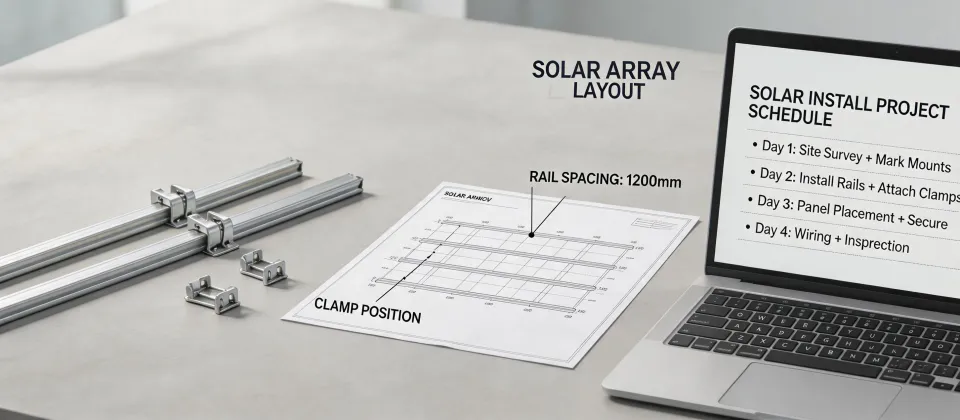
Here's what six years of buying solar power mounting systems taught me: the lowest-priced quote is rarely the cheapest system once it's installed. I've tracked every invoice, every change order, and every compatibility fix across 45+ commercial projects, and the pattern is consistent. Low-bid mounting hardware adds 12-20% in hidden cost compared to a mid-priced option with lower installed cost. If you're evaluating racking by price per watt, you're optimizing the wrong number.
I'm the procurement manager at a solar EPC in the Pacific Northwest. We do flat roof and ground-mount systems on warehouses, retail centers, and light industrial buildings. I manage a purchasing budget of roughly $450,000 a year, and I've negotiated with 15+ mounting system vendors since 2019. I track every order in our procurement system—not because I'm naturally organized, but because I got burned twice on "budget" racking and built a cost spreadsheet out of spite. Our policy now requires a minimum of three quotes on any system above 100 kW, a rule born from one of those burns. I've also been uninvited from two vendors' "preferred customer" lists for pushing back on pricing. I'm okay with that.
Why price per watt is a trap
A mounting system quote doesn't include the cost of installing the mounting system. Installation labor is usually 30-40% of total project cost, so the question that matters isn't "what does the hardware cost?" It's "what does this system cost per fully-installed, commissioned watt?"
It's tempting to think you can just compare price per watt and be done. That's the oversimplification I see every time a developer forwards me a cheaper quote they found online. A quote that's 10% cheaper on components can easily be 15% more expensive in total installed cost because of part count, installation time, and compatibility rework.
Integrated grounding is a perfect example. Some rail systems include grounding in the splice connections. Others need separate lugs, wire runs, and an extra hour of crew time per row. At $85/hour for a two-person crew, that's a real number—usually $0.01 to $0.02/W that never appears on the quote. Multiply that across 500 kW and you're not talking about pocket change.
The most frustrating part is that the same surprises keep repeating. You'd think a written spec sheet would prevent it, but two vendors can say "compatible with standard modules" and mean completely different things. One has a tested module list. The other has a hunch.
The "all aluminum rail is the same" myth
This was mostly true a decade ago, when modules were heavier, frames were thicker, and wind load wasn't the design driver it is today. Modern modules are bigger and thinner-framed, and mounting deflection matters. Rail spacing, clamp width, and torque specs actually affect module warranty coverage. The "standard profile" that "should fit" can void the module manufacturer's warranty. I've seen the claim letter. It wasn't fun.
There's a marketing layer to cut through here, too. Every aluminum racking vendor calls their product "recyclable." Per the FTC's Green Guides (16 CFR Part 260), environmental claims like that have to be substantiated—but standard structural aluminum is recyclable regardless of who extrudes it. It's like bragging that your product is made of metal. A green label isn't a substitute for load test data and a compatibility report.
A 480 kW warehouse example
Spring 2024, warehouse rooftop outside Portland. 480 kW DC—478.4 kW, if we're being precise; the final string layout changed it. Two final quotes:
Vendor A: $0.064/W, all-in. Vendor B: $0.055/W on components—plus a fuel surcharge they "forgot" on the first call, $1,800 for the engineering stamp we'd explicitly requested, and separate grounding parts we'd have to source and install. We almost took B at face value. The spreadsheet said otherwise:
- Engineering and PE stamp: included in A. B charged $1,800 as a change order.
- Freight: A included delivery to the site. B added a $640 fuel surcharge.
- Grounding: A integrated it into the rail splices. B required additional lugs and wire, which we estimated at 18% more install labor.
- Warranty: B's warranty excluded coastal installations. Our site was 14 miles from the coast. That's a risk transfer, not a feature.
Fully loaded, Vendor B's "cheaper" system came out about $9,400 more expensive. We went with A, the install finished two days ahead of schedule, and we didn't have to explain a coastal exclusion to a client in year two. (Should mention: we now build a schedule buffer into every project. That's a 2022 lesson, back when we didn't.)
Wind turbines, caravan panels, and the same logic
"Are wind turbines worth the cost?" is a question we get more often than you'd expect. My procurement answer: for a commercial rooftop, almost never. Small wind turbines come with moving parts, vibration, maintenance schedules, and permitting complexity that PV mounting systems don't. At commercial electricity rates, distributed solar typically pays back faster and with more predictable output. I've priced both; solar won on ROI in every site evaluation we ran, except truly windy locations with poor sun exposure. That's the only context where wind math can make sense.
The same logic applies at caravan scale, by the way. A flexible solar panel for a caravan looks cheaper than a rigid panel with proper mounting brackets—until you account for lifespan, heat-related degradation, and how it handles stones on the road. Same TCO mistake, smaller dollar amount. It's a pattern, not a coincidence.
The checklist I actually use
Before I approve any mounting system order, I run through this:
- Tested module compatibility list. Not "standard modules." The actual report with model numbers, in writing.
- PE stamp and engineering docs included? If it's a change order, that's real money.
- Integrated grounding? If not, add $0.01-$0.02/W in labor and parts.
- Delivered price. Freight, fuel surcharges, and pallet fees all included.
- Warranty exclusions. Coastal, chemical, snow-load, and finish conditions. Read them before ordering, not after a claim.
- Part count per kW. Fewer SKUs usually means fewer surprises on the roof.
Where I could be wrong
The caveats matter. There are projects where a budget mounting system is the right call: small rooftops under 50 kW, low wind zones, simple layouts, and an in-house crew that's installed the same system before. In those cases, paying a premium for speed and support is overkill. I've approved budget systems on exactly those projects.
The spreadsheet also isn't a crystal ball. We had a mid-priced vendor's clamps fail coating adhesion tests eight months after a 2023 install. They replaced the hardware, but only after several uncomfortable calls. I don't have a formula for avoiding every bad vendor—what I have is a system for catching the predictable surprises.
If you're mid-evaluation right now, that's what I'd challenge you to do: stop comparing price lists and start comparing fully-installed system cost. The cheapest hardware is never the whole story.

Renata Silva
Renata Silva is a photovoltaic module analyst covering monocrystalline solar panels, bifacial modules, TOPCon and heterojunction designs, glass-glass construction, junction boxes, and module warranties. She interprets IEC 61215 and IEC 61730 evidence while comparing rated power, conversion efficiency, temperature coefficient, bifaciality, insulation, mechanical-load results, degradation assumptions, and tolerance. Her technical guides help EPC engineers, distributors, and project buyers separate qualification evidence from site-specific energy yield, climate exposure, installation constraints, and long-term performance risk.