The Best Solar Generator Won’t Save You if the Mounting System Is Wrong
2026-08-25 / Renata Silva
-
Buyers Focus on the Panels, Not the Rack
-
Standardization Reduces Installation Mistakes
-
The Electrical Side Has to Fit the Mount
-
Efficient Engineering Reviews Save Weeks
-
What About Kayak Mounting Systems?
-
Every Roof Is Different—and Still Standardizable
-
Bottom Line: The Mount Holds Everything Together
Here’s a provocative take: what is the best solar generator for off grid living isn’t the solar generator. It’s the mounting system.
I’m a quality and brand compliance manager at Mounting Systems. Basically, I review project designs before they reach customers—roughly 200 unique items every year. In our Q1 2024 audit, 14% of first drawings failed because of mounting details: missing torque specs, wrong clamp counts, cable routings that would chafe against a rail edge. Not one of those failures was caused by a faulty solar panel.
That’s why I believe efficiency is a quality feature. A mounting system that is quick to design and predictable to install prevents errors. Fewer errors mean a better outcome for the installer and the building owner.
Buyers Focus on the Panels, Not the Rack
Most customers compare module efficiency, price per watt, and brand names. They ask about ABB energy storage compatibility. They compare inverters. Then the mounting system becomes an afterthought.
The question everyone asks is “which panel should I buy?” The question they should ask is “how will this array behave when the wind blows?” That’s an outsider blind spot. Mounting hardware is less glamorous than a new solar generator, but it matters more.
If you’re searching for PV mounting systems UK, start with the load documentation. A panel that isn’t clamped properly will move, squeak, or lift off in a storm. The best solar generator won’t help if the rack fails.
Standardization Reduces Installation Mistakes
About four years ago, I started tracking a pattern. Installers were using generic fasteners in place of specified clamps on commercial flat-roof projects. The generic hardware was cheaper and easier to source, but it didn’t have the same pull-out resistance. We kept rejecting the same thing.
We changed our design templates, added part numbers, and made clamps part of the kit. We also added torque marks on some rail connections. It sounds small, but the rejection rate on those designs dropped by roughly 30% in the next two quarters. That’s the kind of improvement that doesn’t show up in a spec sheet—but it shows up in fewer callbacks.
This is why I get annoyed when people reduce mounting systems to a price game. Saving $0.02 per clamp is a loss if it creates rework. Installers who choose a standardized system finish faster and with fewer headaches.
The Electrical Side Has to Fit the Mount
I’m not an electrician, so I can’t tell you how to size a battery. What I can tell you from a quality perspective is that the mount must leave room for the electrical balance of system.
For example, if the project includes ABB energy storage or a similar DC-coupled battery, the mounting system needs space for cabling and service clearance. I’ve seen designs where the battery was positioned so close to a rail that an installer had to remove the module to access the breaker. Technically it worked. Practically it was a maintenance nightmare.
A good mounting system includes cable trays, clamp compatibility, and enough space for conduit. That reduces the chance of an electrician improvising with zip ties on a sharp rail edge. Mechanical and electrical have to be designed together.
Efficient Engineering Reviews Save Weeks
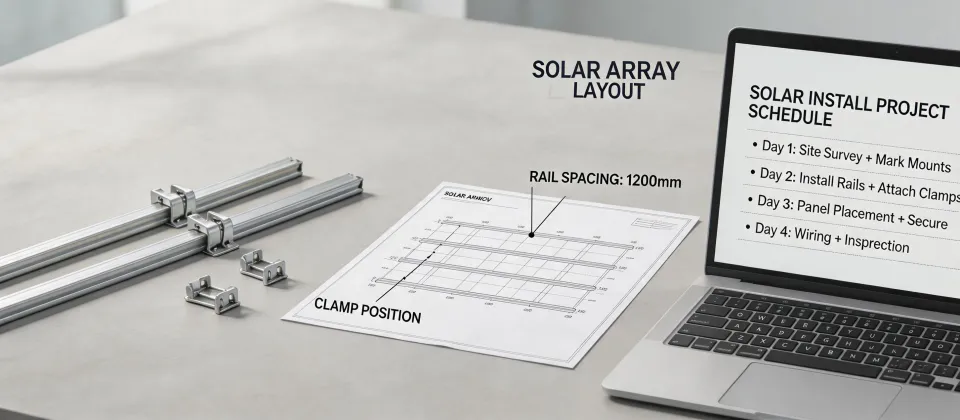
At Mounting Systems, our engineering team checks wind loads against BS EN 1991-1-4. For flat-roof projects, this used to mean two to three days per design because every drawing was a unique snowflake. After we standardized the rail spacing and clamp selection, the same check takes a few hours for a typical layout.
I’m not a structural engineer, so I won’t pretend to calculate an uplift coefficient. But I can see the business effect: faster reviews get installers on site sooner. On a 200kW project, a three-day saving can be the difference between a good month and a bad month.
That’s the efficiency edge. It doesn’t require cutting corners. It requires removing boring decisions so people can focus on the parts that actually vary.
What About Kayak Mounting Systems?
Our marketing team occasionally sees search terms like kayak mounting systems and coverr wind turbine video in the data. Those aren’t our products. I don’t know much about kayak racks, and I don’t need to. But the principle is the same: a mount is something you notice only when it fails. It shouldn’t be an afterthought.
If you came here looking for a kayak rack, I’m sorry to disappoint. If you came here looking for solar mounting systems, you’re in the right place.
Every Roof Is Different—and Still Standardizable
I hear this from experienced installers: every roof has its own slope, membrane, parapets, and surprises. They’re right. But the surprise should be handled in the layout, not by inventing a new bracket on site. You can adapt a proven clamp and rail system to an unusual roof without abandoning tested components.
I used to think standardized mounting was just a sales strategy. Then I watched the same custom bracket fail in the same spot on three consecutive projects. The cost of that flexible approach was rebuilds, delays, and a very unhappy building owner. So now I’m a believer in engineering flexibility, not component improvisation. Choosing a reviewed mount over an improvised one should be a no-brainer.
Bottom Line: The Mount Holds Everything Together
The solar industry spends too long discussing panels and inverters and not enough time on mechanical connections. The best listicle answering what is the best solar generator for off grid living probably won’t mention wind uplift or clamp torsion limits. That’s a mistake.
Take this with a grain of salt: I work for a mounting systems supplier, so my bias should be obvious. But the quality data supports it. When the mount is standardized, installation is smoother. When the electrical accessories are planned into the design, service access is easier. When load calculations are documented, approvals are faster.
I’m not 100% sure every manufacturer reviews every drawing, but we do. As of March 2025, our custom reviews are still manual. That might not sound efficient, but it is. The people who skip that step are saving time in the wrong place.
So, what is the best solar generator for off grid living? Pick a good one, obviously. But spend more time on the mounting system—that’s what will keep your panels working when the weather turns.

Renata Silva
Renata Silva is a photovoltaic module analyst covering monocrystalline solar panels, bifacial modules, TOPCon and heterojunction designs, glass-glass construction, junction boxes, and module warranties. She interprets IEC 61215 and IEC 61730 evidence while comparing rated power, conversion efficiency, temperature coefficient, bifaciality, insulation, mechanical-load results, degradation assumptions, and tolerance. Her technical guides help EPC engineers, distributors, and project buyers separate qualification evidence from site-specific energy yield, climate exposure, installation constraints, and long-term performance risk.