Solar Mounting Systems in Georgetown KY: A Procurement Manager's TCO Story
2026-08-26 / Renata Silva
The First Call
It was February 2024, and the first call I took from Georgetown, KY, did not follow the usual script.
Dana introduced herself as the property manager for a small commercial building. She wanted solar panels on a flat roof, but she wasn't sure where to start. She had her lunch break to figure it out.
'I have been searching all morning,' she said. 'First Google showed me TV mounting systems. Then it gave me Grid Doctor 3300 solar generator system reviews. I also asked how much power does a wind turbine generate, because I thought maybe that was simpler. And now I'm reading about a solar micro inverter circuit diagram. I'm even more confused than when I started.'
I laughed. Then I realized she was serious.
Why I Stopped Selling and Started Explaining
My name is Jordan. I'm a procurement manager at Mounting Systems, where I've spent six years tracking every invoice, comparing vendor quotes, and managing an annual budget for our own operations. I've analyzed over $180,000 in cumulative spending and built enough cost spreadsheets to know one thing: the lowest sticker price almost never means the lowest total cost.
I also believe that educating a customer isn't a distraction. It's part of the job. An informed customer asks better questions and makes faster decisions. So I did not start with a pitch.
'Before I quote anything,' I said, 'tell me what you actually want on that roof.'
The Confusion Was Real
On paper, Dana's project wasn't complicated. A 72 kW DC array on a 20-year-old TPO roof. Good solar orientation, no shade, and enough space for around 180 modules.
But the questions she asked were the kind that come from Googling general terms. She wanted to know whether a solar generator box could replace the whole system. She wanted to understand what a micro inverter does. And she still had a tab open for TV mounting systems, because the search engine thought she meant a wall mount for a television.
I told her: 'TV mounting systems are for TVs. If you search for solar mounting systems in georgetown ky, that's how you get to us.'
Then she asked about wind. 'How much power does a wind turbine generate?' I pulled up the Department of Energy's wind energy page. According to energy.gov, utility-scale wind turbines typically have capacity factors around 30-40 percent. A rough example: a 2.5 MW turbine at a 35 percent capacity factor would produce roughly 7.7 million kWh per year. But that assumes a good site, a tall tower, and lots of open land. It wasn't going to happen on a commercial flat roof in central Kentucky.
'A wind turbine is a great renewable energy project,' I said. 'It's just not this project.'
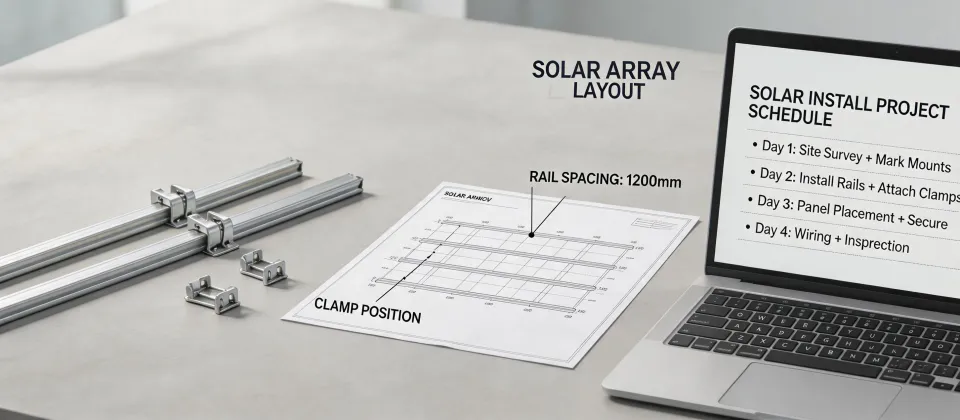
Dana also asked if I could send a solar micro inverter circuit diagram. I'm not an electrical engineer, so I described it the way I think about it: each solar module gets its own small inverter, and that inverter converts DC from that one module into AC. A solar micro inverter circuit diagram usually shows the PV module, the inverter board, and an AC cable running to the next one. The mounting system doesn't care which inverter you choose. It cares that the module is clamped correctly and that you have a clean path for the cable.
The TCO Talk
Here's where I have to admit something. My first instinct was to quote our standard flat roof ballasted system. It works for a lot of projects, and it avoids roof penetrations. But ballasted isn't inherently better or worse than a penetrated system. It's a tradeoff. What I mean is the roof's structural capacity and the local wind speed decide which one is safe, not the marketing brochure.
I asked Dana to send me the roof's structural report. She had one. It showed the existing insulation board could take a certain amount of additional load, but not unlimited concrete ballast. That changed things.
Her other quote was 12% lower per panel. It was a ballasted system with a generic weight estimate. If we had installed it, the roof might have needed reinforcement. In the worst case, the wind uplift calculation could fail. The risk was an expensive repair call after the first real storm.
I kept asking myself: is a quick yes worth creating a nightmare for a customer I just met?
She wanted a number before her 1:00 meeting. Normally I'd take 48 hours to run a proper layout. I made a judgment call. I gave her a range, not a quote. The range included line items for freight and electrical accessories. I said: 'Don't compare the racking price alone. Compare the whole bill of materials.'
Here's what I put in the email, because I think too many buyers skip this step.
- Rails, clamps, and splices
- Ballast blocks or roof penetrations and flashing
- Grounding clips and bonding components
- Wire management, electrical boxes, and microinverters or DC/AC cabling
- Freight to Georgetown, KY
- Installation labor, including crane time for ballasted systems
- Structural review stamps and permit support, if required
The question everyone asks is 'what's the price per watt?' The question everyone should ask is 'what is included in that list?'
Most buyers focus on per-unit pricing and completely miss setup fees, revision costs, and shipping that can add 30% to the total. That's a pattern I've documented in our cost tracking system more than once.
The surprise wasn't that her cheaper quote was missing items. It was that the 'cheap' option would have been more expensive once I added the missing ballast blocks, freight, and electrical grounding hardware. I want to say the freight alone was around $1,800, but don't quote me on that number. Freight rates change. The point was the total difference was far more than 12%.
What Actually Happened
Here's the ending you might not expect. Dana didn't buy from us.
She went with a local distributor that carried a different brand. Her installer had used that brand for years and could get technical support in person. For her timeline, that was the lower-risk choice. It wasn't about which rail was stronger. It was about the support system around the hardware.
That's not a sales problem. It's a good decision for her. I sent a follow-up note with a simple checklist. I also told her to ask the local distributor to confirm the wind uplift calculation and the exact ballast count. If the quote doesn't include that, the mounting system isn't a system yet.
What I'd Tell Another Buyer
First, customers are not confused by accident. The search results for solar racking are cluttered with TV mounting systems, solar generator reviews, wind turbine questions, and circuit diagrams. Without a good guide, that's information overload.
Second, education is not filler. If I had not explained the difference between a 3.3 kWh backup box and a 72 kW array, Dana might have ordered a Grid Doctor 3300 and thought she was done. If I had not explained TCO, she might have signed the cheaper quote and paid twice.
Third, there is no 'best' mounting system for every roof. There is only the best choice for a specific roof, a specific budget, and a specific installer. At least, that's been my experience after six years of comparing hardware and invoices.
If you're planning a commercial solar project in Georgetown, KY, or anywhere else, find a partner who educates before quoting. Ask for a line-item bill of materials. And when someone asks you whether a wind turbine is simpler than solar, show them the math.

Renata Silva
Renata Silva is a photovoltaic module analyst covering monocrystalline solar panels, bifacial modules, TOPCon and heterojunction designs, glass-glass construction, junction boxes, and module warranties. She interprets IEC 61215 and IEC 61730 evidence while comparing rated power, conversion efficiency, temperature coefficient, bifaciality, insulation, mechanical-load results, degradation assumptions, and tolerance. Her technical guides help EPC engineers, distributors, and project buyers separate qualification evidence from site-specific energy yield, climate exposure, installation constraints, and long-term performance risk.