Fixed vs. Tracking Solar Mounting Systems: What a Quality Inspector Actually Checks
2026-08-26 / Renata Silva
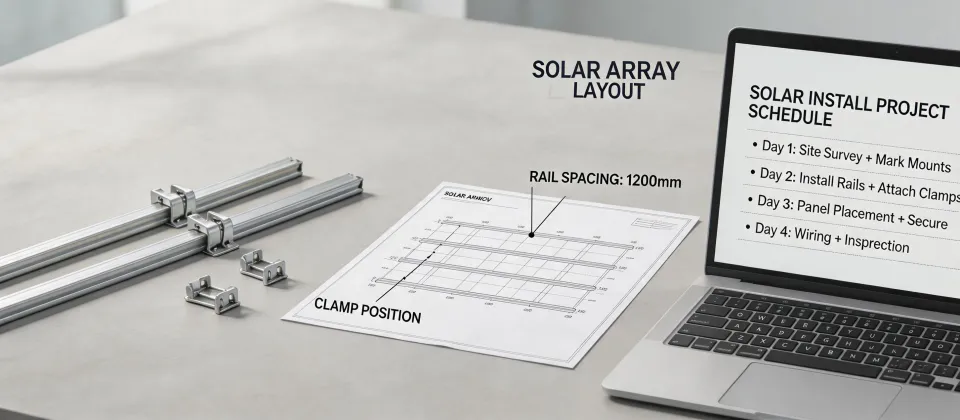
I review solar mounting systems before they reach customers—roughly 200 unique configurations a year, spanning flat roof, pitched roof, ground, and carport projects. In our Q1 2025 quality audit, I rejected 6% of first deliveries. Not because our suppliers are bad. Because inspecting beats assuming.
The question I get most often from installers and EPCs isn't about rail spacing or clamp torque. It's this: fixed-tilt or solar panel tracking mounting systems?
I'll give you my honest answer—but first, let me set up the comparison properly. This is one of those decisions where sales brochures won't help you. Trackers look impressive; fixed mounts look boring. But “impressive” doesn't equal “right for your site.”
What We're Actually Comparing
I'm comparing fixed-tilt and tracking mounting systems across four dimensions that I've seen cause real project problems:
- Structural integrity and failure modes—what breaks, and how often
- Real-world energy yield—the gap between brochure numbers and actual output
- Total cost of ownership—not just the purchase price, but 25 years of upkeep
- Installation and quality control complexity—what you're really signing up for during construction
The goal isn't to crown a winner. It's to match the right system to the right project.
Dimension 1: Structural Simplicity vs. Moving Parts
A fixed-tilt mounting system is, fundamentally, a sophisticated bracket. Once it's anchored and torqued correctly (which, honestly, is a bigger “if” than people expect), there's not much that can go wrong. The loads are static. Wind uplift, snow load, thermal expansion—all well-understood problems with well-established engineering solutions. If the material gauge is right and the surface treatment is done properly, a fixed mount will sit on a roof for 30 years without complaining.
A tracking system changes the equation. You're introducing motors, slew drives, actuators, sensors, and control electronics. Every moving joint is a potential failure point. Every sensor feed is a potential source of garbage data. I've seen a single-axis tracker stow itself in the wrong position at 2 AM because a limit switch had a cold solder joint. That's not exotic failure—that's just electronics living outdoors for a decade.
Let me rephrase that. It's not that trackers are bad. It's that they're demanding. What I mean is: they require a level of verification that a fixed mount simply doesn't. When I audit a tracker supplier, I'm checking slew ring tolerances, encoder calibration, and wind alarm programming. When I audit a fixed mount supplier, I'm mostly checking material thickness, weld quality, and whether the anodizing actually meets spec.
I learned never to assume “same specifications” meant identical results across vendors. A few years back, we received a batch of fixed-tilt clamps where the aluminum measured 0.2 mm thinner than the approved sample. The vendor insisted it was within industry tolerance. It technically was. But over 25 years of thermal cycling, that thinner clamp translates to reduced clamping force and more micro-movement. We rejected the batch, they redid it at their cost, and our contract now explicitly states material thickness tolerance with random sample verification. That decision cost a $22,000 redo and delayed a commercial rooftop project by two weeks (ugh). Worth it, though—since then, we've had zero unexplained fastener issues on that product line.
Dimension 2: Energy Yield Gains vs. Reliability
Here's where tracking systems make their case. Reported gains for single-axis tracking over fixed-tilt typically land somewhere in the 20–35% range, depending on latitude, climate, and site conditions. NREL's PVWatts tool will give you a site-specific estimate, and I’d recommend running it before you commit to any hardware.
But here's what I've observed from quality audits on actual projects: the gain is highly situational. On a site with frequent cloud cover, the advantage shrank to maybe 10%. On a site with regular storm events, tracker uptime became a real factor. The numbers at one of our test sites said tracking would deliver 28% more energy. My gut said the added complexity wasn't worth it given the wind exposure. We went with the data.
Eighteen months later, the customer had logged three tracker fault events totaling 11 days of downtime. The 28% gain became closer to 20% after accounting for lost production. Still meaningful—but not the slam dunk the spreadsheet suggested. The surprise wasn't the yield gain itself. It was how much maintenance downtime quietly ate into it. Every tracker on that site needed sensor calibration visits that weren't in the original O&M budget.
To be fair: at the right site, trackers are absolutely the right call. Open, flat ground, high solar resource, minimal shading—trackers can be the best investment in the entire project. But the site evaluation matters more than the tracker spec sheet. At least, that's been my experience across roughly 50 ground-mount projects over the past four years.
Dimension 3: Total Cost of Ownership Over 25 Years
Let's talk numbers. A tracking system typically costs 20–40% more upfront per installed watt than a comparable fixed-tilt ground mount. That's the headline number everyone sees. But the total cost of ownership story is more interesting:
- Trackers require preventive maintenance: lubrication of slew drives, sensor cleaning, firmware updates. Budget for annual site visits.
- Motors and gearboxes have finite lifespans. Expect at least one actuator replacement in a 25-year period. That's a part plus a truck roll.
- Moving cables need higher-quality connectors and more frequent inspections, because a cable that flexes for a decade will fail sooner than one that sits static.
- Fixed mounts, by contrast, typically just need a structural inspection after severe weather events. That's a much cheaper and easier-to-schedule activity.
The gap narrows but doesn't disappear. Tracking still wins on cost-per-kilowatt-hour at utility scale. But for small systems, the economics flip completely.
Here’s a real example. A customer asked me to review a small off-grid setup using a SunPower 110W flexible solar panel paired with a Green Fuel power inverter 1000W. They wanted to mount the 110-watt panel on a tracking arm. The tracking arm cost more than the panel and the inverter combined. For a panel that size, the yield gain from tracking might be 25–35 watts. That's not nothing, but it's not worth adding a motorized mechanism that can fail in a remote location with no one around to fix it.
I told them: mount it fixed, and adjust the tilt seasonally if that's practical. Save the tracking budget for a proper battery bank—that’s where their real bottleneck was. And speaking of batteries: if you're doing a self-install and you need to disconnect a lead-acid battery—say, a car battery or a deep-cycle bank—always disconnect the negative terminal first. That way, if your wrench accidentally touches the frame while loosening, you don't complete a circuit near potentially explosive hydrogen gas. Disconnect the positive terminal first and you're creating a spark source right next to the battery vent. I watched a guy learn this the hard way on a solar shed install back in 2023. Nobody got hurt, but it left a scorch mark and a very memorable lesson.
Dimension 4: Installation & Quality Control Complexity
Here's where the two systems diverge most in my daily work. A fixed mounting system is forgiving. If an installation crew torques a clamp to 80% of spec, it'll probably hold anyway. If they skip a bolt, you might see it during a thermal inspection. The failure modes are gradual and usually detectable before catastrophic.
Tracking systems don't offer that luxury. Quality verification for trackers requires:
- Calibrated torque verification on every pivot joint
- Sensor alignment checks before commissioning
- Software verification of tracking algorithms and wind-alarm behavior
- Stow-mode simulation to confirm the system parks itself safely during a storm
For fixed systems, the quality issues I flag are much more basic: wrong gauge steel, skipped surface treatment, undersized welds, or fasteners that cause galvanic corrosion. The same quality principles that apply to a computer wall mounting system—check the anchor rating, verify the load capacity, inspect the hardware—apply to a ground mount. But the stakes are higher. A wall mount that fails drops a monitor. A tracking system that fails with 200 modules attached at a 60-degree angle in a windstorm damages property and risks lives.
I ran a blind test with our engineering team a couple of years ago: same mounting system spec, two different manufacturers, neither identified by name. Everyone picked the same product as “more professional” when they could see and feel the weld quality, the surface finish, and the packaging. The cost difference was roughly $0.04 per watt. On a 2 MW project, that's $80,000 for measurably better quality. On a 50 kW commercial roof, it's $2,000. Either way, the customer notice was immediate. Details signal professionalism—customers notice the difference even when they can't articulate what it is.
Which Mounting System Should You Choose?
Here's my practical, scenario-based guidance (and yes, I fully expect some tracker manufacturers to disagree with parts of this):
Choose fixed-tilt when:
- Your site has variable weather or significant cloud cover
- You're mounting on a commercial rooftop. (I've never worked on a rooftop where tracking made economic sense—wind exposure and structural load issues compound the cost.)
- Your system size is under 100 kW
- You don't have on-site maintenance staff or reliable local service partners
- You want maximum predictability in your production model
Choose tracking when:
- You're building a large ground-mount system in a high-insolation region
- Your site is flat, open, and free of shading obstructions—irrigation pivots and low crops are fine, trees and buildings are not
- You can commit to a real O&M program. Trackers need annual inspections, period.
- You're optimizing for maximum energy output under a PPA or feed-in tariff where the extra yield directly improves project IRR
- Your project size justifies the engineering and maintenance overhead. In my experience, that's typically 2 MW or larger for single-axis trackers to be truly worthwhile.
One more thing, and this is probably the most honest advice I can give: the brand of the system matters less than the quality culture of the manufacturer. I've rejected premium-brand products because the batch quality was inconsistent. I've approved less-known brands because their quality documentation was transparent and their production tolerances were real. Ask for third-party test reports. Ask for material certificates. Ask what happens when a batch fails their own inspection.
At the end of the day, the mounting system is the physical foundation of your entire solar investment. Skimping on quality here costs you in performance, safety, and customer trust. I've seen what a structural failure does to a client relationship—it doesn't matter that the failure was technically “within industry standard.” The perception of quality is the reality of your brand. That's true whether you're buying a $50 wall mount for an office TV or a $500,000 tracker array for a solar farm.
If you're weighing options for a specific project, the team at Mounting Systems reviews system layouts and project requirements every day. We won't tell you tracking is always worth it, and we won't tell you fixed-tilt is always safer. We'll tell you what actually makes sense for your site—with the documentation to back it up.

Renata Silva
Renata Silva is a photovoltaic module analyst covering monocrystalline solar panels, bifacial modules, TOPCon and heterojunction designs, glass-glass construction, junction boxes, and module warranties. She interprets IEC 61215 and IEC 61730 evidence while comparing rated power, conversion efficiency, temperature coefficient, bifaciality, insulation, mechanical-load results, degradation assumptions, and tolerance. Her technical guides help EPC engineers, distributors, and project buyers separate qualification evidence from site-specific energy yield, climate exposure, installation constraints, and long-term performance risk.