Solar Mounting Systems, Small-Wind Standards, and Energy Monitors: Lessons from a Rush-Order Specialist
2026-08-27 / Renata Silva
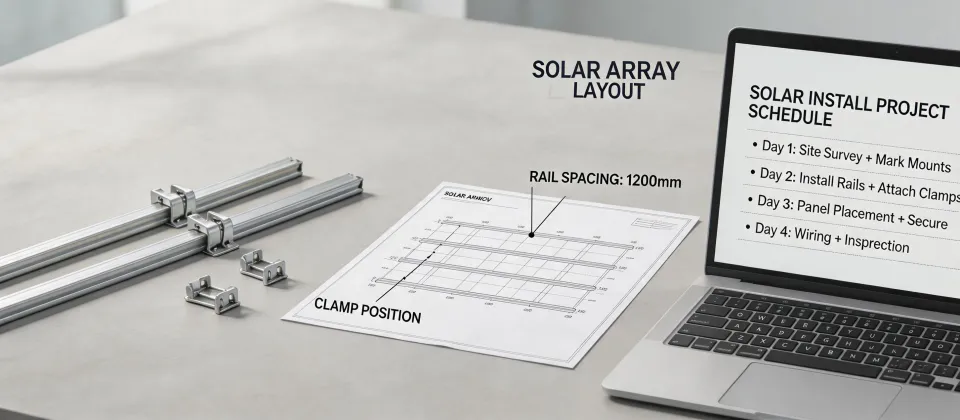
Short version: when a solar project has a hard deadline, the cheapest mounting system is rarely the cheapest project. I've watched a $600 delay on flat roof PV mounting systems turn into a $12,000 schedule loss because a crew stood idle waiting for one part. In my role coordinating rush orders for Mounting Systems, the deciding factor is not the product price, it's whether the supplier can confirm inventory, commit to a date, and defend that date. That certainty is worth paying for.
Why I stopped trusting 'probably on time'
When I first started coordinating rush orders at Mounting Systems, I assumed the emergency fee was mostly margin. Then I saw what it costs to pull a picker off another line, double-check US stock, and rearrange freight. It isn't pure profit. But the buyer isn't paying for speed; they're paying for a confirmed yes. 'Probably Friday' and 'Friday, with a tracking number' are two different products.
Last quarter, our team processed 47 rush orders—47, maybe 49, I'd need to check the CRM—and 95% delivered on time. The misses all started with a vendor who could only say 'should be okay.' That phrase is the most expensive phrase in this industry.
Flat Roof PV Mounting Systems Are the Silent Schedule-Killers
Conventional wisdom says racking is a commodity: any rail works, any clamp works. My experience from 200+ order triages says otherwise. The part that kills a rooftop schedule is almost never the module. It's an incompatible clamp, a missing bolt pack, or a ballast shield ordered at the wrong height. On a flat roof, the array geometry and wind uplift calculation depend on the exact components. Substituting a 'similar' bracket on site is how a stamped structural letter falls apart.
What I check first
- Confirmed inventory in the US, not 'from the factory in six weeks.'
- Compatibility data for flat roof PV mounting systems with the module make and clamp range. 'It probably works' is not a drawing.
- Ballast shields—the aerodynamic deflectors that reduce concrete blocks. If the quote says 'ballistic shield mounting systems,' that's a different product, and I'll come back to it.
In March 2024, a client called at 3 p.m. needing 30 sets of ballast shields for a Friday installation. Normal lead time was five days. We had the parts in our US warehouse, paid $400 extra for a split-load truck, and delivered Thursday night. The client's alternative was a $15,000 penalty for delaying an entire rooftop crew. The extra $400 wasn't the cost of the product; it was the cost of certainty.
The IEC 61400-2 Small Wind Turbines Standard Overview Everyone Misses
I also get calls from project managers who think small wind can be rushed the same way as a PV array. It can't. The IEC 61400-2 small wind turbines standard overview that I give every installer is simple: this standard sets design loads, safety factors, and structural testing requirements for turbines with a rotor-swept area of 200 m² or less—basically, most turbines under 50 kW.
A client once asked if we could manufacture and certify a tower in two weeks. The answer was no. Compliance evidence under IEC 61400-2 is required by many incentive programs and local inspectors, and that evidence cannot be generated overnight. If your schedule assumes otherwise, the schedule is wrong. No amount of expedite fees fixes that.
How to Install an Energy Monitor Without Losing a Week
One of the most frequent emergency calls I get is from an installer who is stuck on how to install an energy monitor before a PTO deadline. The sequence is straightforward, but the details cause re-works.
First, disconnect power before opening the panel. Then confirm the monitor's power input has a dedicated double-pole breaker and that the breaker size matches the monitor's rating. The current transformers—CTs—snap around the main conductors from the utility, not around conductors from an inverter or subpanel. CTs are directional; the arrow on the CT has to point the way the manufacturer specifies, so follow the manual.
Route the low-voltage CT leads separately from line voltage. The most common re-work I see is skipped wire separation, followed by chasing noise spikes in the readings. After power-up, verify voltage and current phase on the display. If a phase shows negative, reverse that CT and reboot.
A Note for CT Solar Panel Companies
When I say CT here, I mean Connecticut, not current transformer. It's an easy collision of acronyms.
If you're at one of the CT solar panel companies comparing suppliers, ask three things before you commit a date: Does the energy monitor meet the utility or incentive program's revenue-grade requirement? Is the CT size matched to the service, or is it a generic 100 A clamp in a 400 A panel? Can the manufacturer show a recent Northeast reference, not a rendering?
Same goes for mounting claims. Per the FTC's Green Guides (16 CFR Part 260), if a supplier markets a mounting system as 'recyclable,' they need substantiation. 'Recyclable' is not a marketing label. And if a salesperson says 'zero maintenance,' ask for the corrosion-test data. In a deadline-driven project, you don't want to discover the problem after the 30-year warranty is the only thing you actually received.
Where This Advice Stops Applying
This advice works when the part exists, the supplier has real inventory visibility, and the schedule is measured in days. It doesn't apply to custom fabrications or products that haven't been certified yet. No amount of guaranteed delivery turns an unproven component into a code-compliant one.
Also, if you truly need ballistic shield mounting systems for a security application, stop reading and call a company that specializes in rated security hardware. If you typed 'ballistic shield mounting systems' while trying to spec PV wind deflectors, the term you probably want is 'ballast shield.' I've seen the mix-up more than once.
For most flat-roof commercial solar projects, though, the formula is the same: confirm the bill of materials, confirm the shipping date, and pay for a confirmed date instead of a hopeful one. That isn't an upsell. It's the cheapest insurance you'll buy all year.

Renata Silva
Renata Silva is a photovoltaic module analyst covering monocrystalline solar panels, bifacial modules, TOPCon and heterojunction designs, glass-glass construction, junction boxes, and module warranties. She interprets IEC 61215 and IEC 61730 evidence while comparing rated power, conversion efficiency, temperature coefficient, bifaciality, insulation, mechanical-load results, degradation assumptions, and tolerance. Her technical guides help EPC engineers, distributors, and project buyers separate qualification evidence from site-specific energy yield, climate exposure, installation constraints, and long-term performance risk.