Solar Panel Mounting Systems: Which Configuration Actually Makes Sense for Your Project?
2026-08-27 / Renata Silva
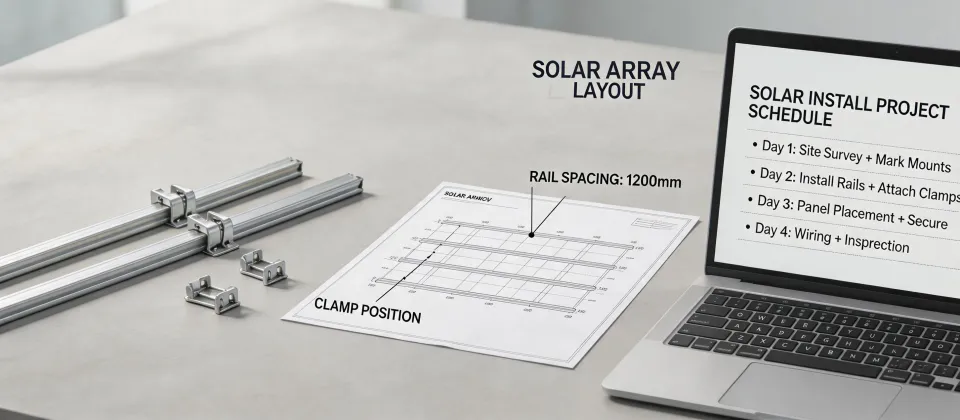
Ask five solar installers to name the single best mounting system and you'll get five different answers—none of them wrong. That's because there isn't one. A warehouse with 40,000 square feet of low-slope roof needs something completely different from a building with zero usable roof space. And neither solution tells you anything about the electrical balance-of-system components you'll also be purchasing.
I've been managing purchasing for a mid-sized commercial solar installer since 2020. That's roughly 60-80 orders a year across 8 vendors for mounting hardware, inverters, surge protectors, and associated electrical accessories. In that time, I've learned that every project falls into one of three categories—and once you identify your category, the product selection gets a lot easier.
Three Scenarios, Three Different System Types
The way I see it, the "what mounting system should I buy" question actually breaks down into three distinct scenarios. Knowing which one you're in determines everything from racking type to which electrical components you'll need:
- Scenario 1: Wall-mounted systems—when roof space is unavailable or undersized
- Scenario 2: Ground-mounted systems—when land is available and grading works
- Scenario 3: Electrical balance-of-system—inverters, surge protection, and backup power components that make any mounting configuration actually functional
The category labels sound obvious, but in practice plenty of projects try to stretch a rooftop solution into a wall situation, or ignore the electrical side until weeks after the racking is specified. That gets expensive, and I've watched it happen more than once.
Scenario One: Solar Panel Wall Mounting Systems
Solar panel wall mounting systems are the answer when roof space isn't available or isn't structurally suitable. This comes up more than you'd expect—urban commercial buildings, multi-story facilities, and properties where the roof is crowded with HVAC equipment and setbacks that eat into the available array area.
I assumed "same specifications" meant identical performance across vendors when I first started buying wall-mount hardware. Didn't verify thoroughly. Turned out rail spacing, wind load calculations, and even the fastener specs varied significantly between manufacturers. The first wall-mount system we quoted for a city building had to be redesigned because the original spec assumed a lower wind load than the local code required. That redesign cost a week and a half and a not-insignificant expedite fee on replacement parts.
Here's what I'd verify before committing to a wall-mounted layout:
- Wind load ratings. Not optional. Your structural engineer needs to sign off, and the local authority having jurisdiction might require stamped calculations even for projects below the threshold where you'd normally expect it.
- Wall substrate compatibility. Concrete, masonry, steel stud, and structural steel each require different anchors and mounting brackets. We carry three different attachment kits in inventory because of this.
- Module width and frame compatibility. Rail widths and clamp ranges vary with panel frame thickness. It sounds basic, but I've processed return orders on clamps that didn't fit the specified module.
One counterintuitive thing worth noting: wall-mounted arrays can perform better in winter than ground or roof mounts because the vertical angle sheds snow more effectively and captures low-angle sunlight. That's not true in every climate, but it's a legitimate consideration in snowy regions.
My experience here is based on roughly 15 wall-mount projects in the 20-80 kW range. If you're working on a small residential vertical array, the engineering and procurement process may be simpler than what I'm describing.
Scenario Two: Solar Panel Ground Mounting Systems
Solar panel ground mounting systems become the right call when land is available and the roof isn't viable—or when the customer wants maximum capacity without structural penetration. We've specified ground mounts for commercial facilities with large parking lots (carports, typically) and for one industrial client with about four acres of unused field behind their warehouse.
The industry has evolved considerably here. What was best practice in 2020 may not apply in 2025. Pile-driven foundations got faster, but labor and equipment costs shifted. Ballasted ground systems reduce site disruption but add significant weight and can drive up foundation costs. The fundamentals haven't changed, though: soil conditions, snow load, and wind exposure still determine the engineering.
Before you commit to a ground-mounted system, here's what the spec sheet won't tell you:
- Geotechnical surveys are non-negotiable. Soil conditions determine whether driven piles, helical anchors, or concrete foundations are appropriate. I've seen a project switch from driven piles to concrete because a geotech report found unexpected bedrock at 3 feet. That was a $30,000 change order.
- Terrain grading matters more than the racking spec. A slope of 5 degrees might not seem like much, but it changes the geometry calculations and the total steel weight. Clients often ask us to "just level it," and the earthwork cost catches them by surprise.
- Leave room for maintenance. String inverters and module washing need access. One client specified maximum array density to squeeze extra capacity, and now we can't get a service cart between rows. (I still have the photos from that site visit.)
For carports specifically, the structure doubles as a shade structure, which means integrated gutters and lighting might be part of the scope. That brings in a different tradeset than a standard ground array and needs to be priced accordingly.
Scenario Three: The Electrical Balance-of-System
Let's talk about the components nobody features in marketing renderings but every project needs. In our 2024 vendor consolidation project, we standardized our electrical accessory purchasing alongside the racking, which saved our accounting team about six hours monthly and eliminated a lot of duplicate freight. It also taught me where the common pitfalls are.
Inverters and battery integration
If your project involves storage, you're typically matching a solar charge controller to a battery bank and then inverting to AC. Buyers ask surprisingly often whether they can use a car battery to power an inverter for off-grid or backup use. I get why it's tempting—they're cheap and available. Just don't. A standard automotive starting battery isn't designed for deep cycling. We tried that on a maintenance trailer once. It lasted about eight weeks. Use a deep-cycle or lithium battery rated for daily discharge—the price difference is smaller than the replacement headache.
For inverter selection, UL 1741 certification is non-negotiable for utility interconnection. Also, the inverter market shifted fast—smart inverters with grid-support functions weren't even on our radar when I started in this space. What was considered premium in 2021 is now baseline.
Surge protection at every access point
Surge protection is unglamorous, but it's cheap insurance. There are two directions to consider: protecting the PV system from grid-side surges, and protecting building equipment from system-side surges. One of our clients had a maintenance facility that kept frying its garage door opener control boards whenever a neighborhood transformer switched. A properly rated garage door surge protector fixed the problem permanently. That was a $250 fix preventing a $2,800 repair—and the client has since added the same protection to two other buildings.
When buying surge protective devices, look for UL 1449 rating and published clamping voltage and response time specs. I've never fully understood why some surge protectors fail early while others run for years in the same environment. My best guess is it comes down to the quality of the MOV components inside, but I don't have data to back that up. What I can say from experience: the extra few dollars for a unit with clear spec documentation is worth it.
Generators and backup power: the refrigerator question
One of the most common backup power questions we get is what solar generator can power a refrigerator. The answer depends less on the generator model and more on the fridge's startup surge. A refrigerator compressor can draw 3-5 times its running wattage for a few seconds when it kicks on. A generator rated at 1,000W continuous might still trip on a fridge that runs at 700W but surges to 2,800W at startup. The spec that matters is surge capacity (often called peak power), not just continuous rating.
If you're sizing a solar generator for a refrigerator, here's a practical approach: check the inrush current rating on the compressor's nameplate, or use an amp clamp meter on the supply line during startup. That measurement, plus about 20% margin, is your real minimum. Don't trust the marketing page that says "powers appliances up to 1,000W"—that's a continuous number.
How to Determine Which Scenario Applies to You
Here's the decision framework I've developed from years of coordinating with our project managers and engineering team:
- Do you have roof space that's structurally sound and clear of obstructions? Then standard rooftop racking is still the most cost-effective option per watt, and this article's scenarios aren't for you. If not, move to step two.
- Is there suitable wall or facade area with adequate solar exposure? Solar panel wall mounting systems are your next consideration—especially for urban sites or buildings with large south-facing walls. Verify wind loads and substrate compatibility early.
- Is land available at the site? If yes, solar panel ground mounting systems (including carports) give you more design flexibility and easier maintenance access. Confirm the geotechnical picture and grading costs before you commit to a layout.
- Regardless of mounting type, does the project involve battery backup, surge protection, or generator integration? If it does, plan the electrical balance-of-system in parallel with the racking. Discovering ground fault monitoring issues after installation is a mistake you don't want to explain to a client.
This probably sounds more structured than how most companies actually decide. And honestly, if you're working with a single supplier that handles both racking and electrical accessories, the division can blur—which is often a good thing. But you should still know which scenario you're in before you start comparing products. The right answer for a dense urban facade project is rarely the same as the right answer for four acres of field.
One more piece of advice: vet the vendor's documentation before you order, not after. A supplier who can provide complete spec sheets, UL certificates, and proper invoicing saves you more than a cheaper quote ever will. Finance rejects incomplete paperwork, and I've personally eaten $2,400 in department budget because a vendor couldn't produce a proper invoice. It's not a lesson you want to learn twice.
Final Thoughts
The solar mounting industry has transformed since I started purchasing in this space half a decade ago. Engineering tools are better, standard products are more refined, and electrical components have gotten noticeably smarter. The fundamentals haven't changed, though: match the system to the site, not the other way around.
If you're on the fence about which mounting configuration fits your project, start with the site survey and structural constraints—not the product brochure. Everything else follows from that.

Renata Silva
Renata Silva is a photovoltaic module analyst covering monocrystalline solar panels, bifacial modules, TOPCon and heterojunction designs, glass-glass construction, junction boxes, and module warranties. She interprets IEC 61215 and IEC 61730 evidence while comparing rated power, conversion efficiency, temperature coefficient, bifaciality, insulation, mechanical-load results, degradation assumptions, and tolerance. Her technical guides help EPC engineers, distributors, and project buyers separate qualification evidence from site-specific energy yield, climate exposure, installation constraints, and long-term performance risk.