There’s No Single “Best” Solar Mounting System. There’s Only the Right One for Your Roof.
2026-09-08 / Renata Silva
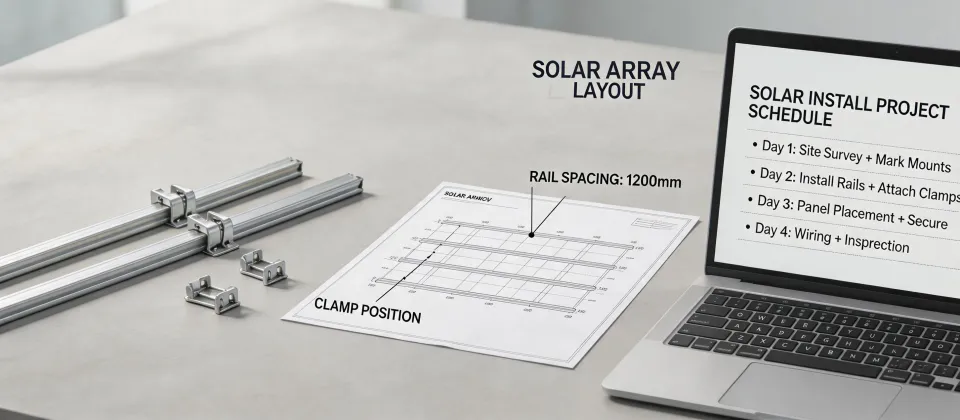
Eleven years ago, I approved a mounting-system order for a roof I had never seen. The mistake cost us $7,300 and nine days of schedule time. I still wince when I think about it.
Since then, I’ve spent a lot of time reviewing solar PV mounting systems for commercial projects. I’m not a licensed structural engineer, and I don’t pretend to be one. I’m the person who checks drawings, orders the parts, and catches the mismatches before they become a problem on the roof. Sometimes I don’t catch them in time.
Here’s the opinion I no longer soften: there’s no single “best” solar mounting system. A system can be excellent and still be the wrong choice for a specific roof. The job of the supplier is not to sell you a magic product. It’s to tell you which product belongs in your actual conditions.
The expensive lesson from the flat roof with drains
In August 2023, I reviewed a 98-module ballasted system on a low-slope commercial roof. The wind calculation was fine, the module layout looked correct, and the rail spacing matched the panel manufacturer’s requirement. What I didn’t ask about was the drainage layout, and it cost me.
The building had a roof water flow monitoring system tied to internal drains. Each drain had sensors and access points. My layout placed a long row of ballast blocks so close to one drain that after the next rain, the water pooled behind it. The monitoring system flagged it almost immediately, and I got to explain to the owner why our mounting system was creating a pond on his roof. It was not the racking’s fault. It was my fault for treating the system as if the roof didn’t exist.
The fix required moving a row of ballast, re-setting 14 supports, and sending a crew back for a day. Total cost: roughly $4,200 plus seven days of delay. Nobody needed to tell me that the specification process was broken. I already had a reminder.
The mounting system didn’t fail. The system selection failed.
What I ask before any racking order
Search for “solar panels mounting systems roof” and you’ll see the same catalog page repeated: rails, clamps, flashings. What those listings rarely show is what matters most—the roof underneath. So now I ask about the roof first, not the brand.
I need three things before I trust a proposal. First, the roof type and age, especially the membrane or metal seam profile. Second, the drainage plan—internal drain locations, scuppers, or gutters. Third, the module model and frame dimensions. If a supplier can’t provide a drawing and a torque spec for exactly that combination, I treat it as a red flag.
That’s not over-engineering. That’s the minimum necessary to avoid the mistake I made.
Accessories are part of the mounting system
One thing I see buyers underestimate is how many accessories are involved in a complete quote. Racking is not just rail and clamps. Inverter mounts, grounding lugs, cable trays, surge protectors, module-level power electronics brackets—they all have to be in the bill of materials.
I’ve seen projects where the racking price looked great on paper, but the electrical accessories for solar mounting systems were missing. The change order came later, at emergency-shipping prices. I’ve ordered 120 clamps for the wrong module frame thickness myself. It’s an expensive way to learn that “compatible with most modules” is not a specification.
Not every solar question is a commercial PV question
I’d rather lose an order than oversell an answer. If your actual search history looks like “google camera solar panel,” stop before you buy a full PV racking system. A small solar panel for a security camera is not a commercial array. It doesn’t need a ballasted racking design. It needs a small, purpose-built bracket and a charge controller. That’s a different product category, and I’m not going to convince you otherwise.
The same goes for someone who arrives because they need a water flow monitoring system. I can mount solar modules near a flow sensor, but I do not design the water-flow system. That requires a different specialist. If a vendor says yes to everything, they are not a consultant; they’re just trying to close a sale.
The objection: “But mounting systems are just aluminum rails”
I hear this from owners and general contractors more than I expected. Yes, the visible pieces are rails and clamps. But the differences are in the details: how the clamp interacts with the module frame, how the grounding path is maintained, what happens with thermal movement, how the flashing handles water runoff. Those factors won’t appear in a side-by-side product photo.
I do not mean that every expensive system is good or every economical one is bad. Price alone never tells you whether a product fits your wind region. But if a manufacturer cannot give you project-specific sheets and an installation manual, the price doesn’t matter. You won’t have the information to install it correctly.
And if a supplier cannot name the conditions where their product is not the right fit? That’s also a red flag. Nobody has a mounting system that is right for every roof.
So, which is the best one?
By now, you know my answer: it depends. That’s not being neutral. It’s being honest.
The phrase “how many moons in the solar system” is a good comparison. The answer changes as astronomers confirm new objects, and it depends on whether you count moons of dwarf planets. If someone gives you one fixed number without context, be suspicious. The same applies to someone who gives you one “best” solar racking product before asking about your roof.
If you need an exact planetary moon count, check NASA’s current planetary fact sheet. For an exact answer about which mounting system you should buy, the best source is the structural engineer who reviews your roof and the supplier who asks questions before quoting.
There’s no single best mounting system. There is only the one that was designed for your roof, your modules, and your local loads. Find that one, and the installation will be a lot easier. Trust me—I’ve made the mistake of doing it the other way.

Renata Silva
Renata Silva is a photovoltaic module analyst covering monocrystalline solar panels, bifacial modules, TOPCon and heterojunction designs, glass-glass construction, junction boxes, and module warranties. She interprets IEC 61215 and IEC 61730 evidence while comparing rated power, conversion efficiency, temperature coefficient, bifaciality, insulation, mechanical-load results, degradation assumptions, and tolerance. Her technical guides help EPC engineers, distributors, and project buyers separate qualification evidence from site-specific energy yield, climate exposure, installation constraints, and long-term performance risk.