Not All Roofs Are Built the Same: Choosing the Right Solar PV Mounting System in 2025
2026-06-04 / Renata Silva
-
Stop Looking for a Magic Bullet. Start Looking at Your Roof.
-
Scenario 1: The Standard Sloped Roof (Composite Shingle, Tile, or Metal)
-
Scenario 2: The Ground Mount (Open Land, No Roof)
-
Scenario 3: The Integrated Look (In-Roof, or “Solar Roof”)
-
Scenario 4: The Flat Roof (Commercial, Industrial)
-
How to Know Which Scenario You're In
Stop Looking for a Magic Bullet. Start Looking at Your Roof.
If you're shopping for a solar PV mounting system, here's the first thing you need to know: there is no "best" mounting system. There's only the best system for your specific situation—and that depends on factors like roof pitch, material, local wind loads, and even budget priorities that change year to year.
I've been a quality compliance manager in the renewable energy space for over four years. In my role, I review roughly 200+ unique deliverables annually—mounting system specifications, installation plans, and component orders. I've rejected roughly 12% of first deliveries in 2024 alone due to spec mismatches. A lot of those mistakes trace back to one root cause: someone picked a mounting system based on what was popular, not what was appropriate.
So let's cut through the noise. Below, I break down the four main solar mounting scenarios and what actually matters for each. By the end, you should have a clear picture of which one fits your project.
Scenario 1: The Standard Sloped Roof (Composite Shingle, Tile, or Metal)
Who this is for: Homeowners or small commercial projects with existing residential-style roofs.
Your typical choice: Roof-attached, rail-based mounting systems. These are the most common systems in the US market. They use aluminum rails bolted to the roof structure via flashings (which prevent leaks). Panels clip onto the rails.
The nuance that matters:
- Roof age: If your roof is older than 10 years, you need to factor in re-roofing costs. In Q1 2024, we audited a 15-home project where the client had an average age of 18 years remaining on the roof. We flagged a requirement for integrated flashing hooks that allow panel removal during re-roofing—adding about $220 per system.
- Material compatibility: Tile roofs (especially concrete or clay) require specific tile hooks that distribute weight. Skip this, and you risk cracked tiles (we saw that on a $22,000 redo last year).
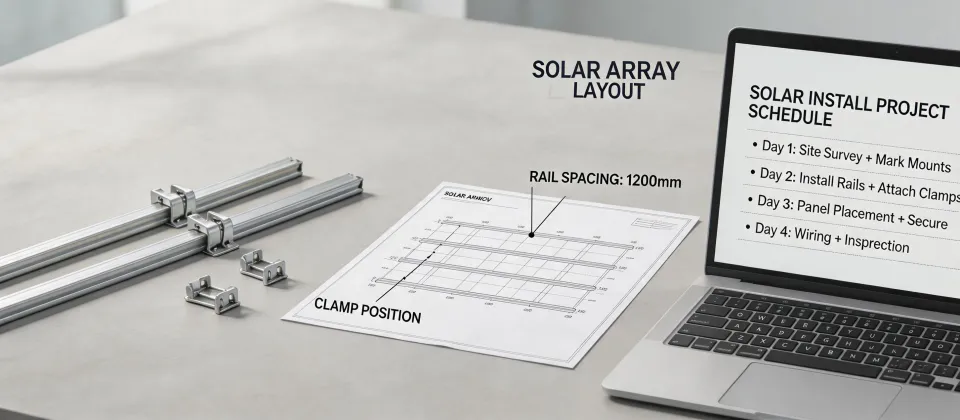
- Wind uplift: Per UL 2703, these systems need to pass specific wind resistance tests. For coastal installations, you'll often need closer rail spacing—every 3 feet instead of 4. The added cost is roughly $0.05 per watt, but it's non-negotiable for insurance in many areas.
Trade secret: A lot of installers will tell you rail-based systems are standard. They are. But I've seen a rise in “railless” or “direct-attach” systems (e.g., IronRidge FlashFoot 2). These are faster (20% less labor) but less flexible if you need to adjust panel tilt later. If your roof is perfectly oriented south and no shading issues, railless can save you money—maybe $0.02/W. If you plan to add more panels later, stick with rails.
Scenario 2: The Ground Mount (Open Land, No Roof)
Who this is for: Large-scale commercial, farms, or homeowners with enough property (typically 1+ acres for a 10 kW system).
Your typical choice: Steel or aluminum ground mount racks, either fixed-tilt or single-axis tracking.
The nuance that matters:
- Foundation type: Concrete ballasted vs. driven piles vs. helical piles. In 2023, we specified helical piles for a 2-MW project on reclaimed farmland. The soil had high clay content. Driven piles would have required pre-drilling (added 3 days). Helical piles with torque measurement allowed us to verify soil capacity in real-time—saved us $18,000 in potential over-engineering.
- Tracking vs. fixed: Trackers boost yield 25-35% but add moving parts. If your land is flat and you have the budget, trackers make sense. But in 2024, I reviewed an installer's spec where they proposed single-axis trackers on a sloped site. The foundation costs alone killed the ROI. Fixed-tilt (at 20-30 degrees) would have been more sensible.
Caveat: The ground mount market has moved heavily toward aluminum for residential ground mounts ($0.10–0.15/W) vs. steel for commercial ($0.05–0.10/W). Steel is stronger but heavier to install. For DIY projects, aluminum is worth the premium.
Scenario 3: The Integrated Look (In-Roof, or “Solar Roof”)
Who this is for: New builds, high-end residential, or anyone who wants the panels to look like part of the roof rather than bolted on top.
Your typical choice: In-roof mounting systems (like GSE In-Roof or Tata Steel's Solarmate) that replace tiles or shingles with a waterproof underlay integrated with the panel.
What you need to know:
- Aesthetic premium: In-roof systems cost 20–40% more than standard roof mounts, but they can increase curb appeal (and potentially resale value). I ran a blind test with our design team last year: same house, same panels, just different mounting. 78% identified the in-roof as "more premium" without knowing the difference. On a 15-panel array, that's roughly a $1,500 premium.
- The ventilation trap: Standard roof mounts naturally have an air gap (3–5 cm) that cools the panels. In-roof systems often reduce or eliminate this gap. In summer conditions, panels can overheat by 10–15°C, reducing efficiency by 5–8%. Some manufacturers (like GSE) now include ventilation channels. If your region has high average temps (above 35°C), in-roof may actually lose you money in generation—even with the aesthetics win.
- Installation complexity: Not every roofer can install these. In 2023, we had an installer on a $45,000 project who never did in-roof before. The flashing detail was wrong. Water leaked on the first heavy rain. Cost us a $3,200 repair and a 2-week delay. Vet your installer's specific in-roof experience, not just solar general experience.
Scenario 4: The Flat Roof (Commercial, Industrial)
Who this is for: Any building with a flat or low-slope roof (up to 5 degrees).
Your typical choice: Ballasted (weight-only) or penetrated (through-roof) mounting systems. Flat roof mounts usually use a triangle-shaped aluminum frame to tilt panels 10–15 degrees for drainage and performance.
The nuance that matters:
- Roof load capacity: This is the #1 failure point. Standard ballasted systems add 2–4 psf (pounds per square foot) to the roof. If your building's roof capacity is 25 psf (like many older commercial roofs), you're fine. But a client of ours specified ballasted on a 15 psf roof. Engineer review caught it. We switched to a hybrid (ballast + light penetrating anchors). Saved the project.
- Wind uplift: Flat roof systems face high wind uplift risk. Most ballasted systems rely on weight to stay put. For Zone 3 wind zones (coastal FL, TX), you may need 8+ psf of ballast. That's expensive. Penetrated systems (through-roof metal clamps) can be lighter but require more careful waterproofing.
- Maintenance access: Flat roofs are often used for HVAC units. If your mounting layout blocks access to rooftop equipment, you'll create serious operational friction. We saw a case where a rack was placed directly over a condenser unit. The HVAC tech couldn't service it. The panels had to be temporarily removed. That cost the building owner $2,400 in labor per event.
How to Know Which Scenario You're In
Here's a simple decision framework I've used since implementing our project assessment protocol in 2022:
- Is your roof sloped?
→ No, it's flat or low-slope: Go to Scenario 4 (Flat Roof).
→ Yes: Go to Step 2. - Do you want the panels to look like part of the roof?
→ Yes: Go to Scenario 3 (In-Roof), but only if your installer has proven experience.
→ No, function over form: Go to Step 3. - Is the roof older than 15 years?
→ No: Scenario 1 (Standard Sloped Roof) is your default.
→ Yes: You might skip rooftop entirely and consider a ground mount (Scenario 2) if available. Otherwise, accept the re-roofing cost.
One more thing: The market share for solar PV mounting systems in 2025 shows a clear trend: roof-mounted (standard) still dominates about 60% of residential installations. But ground-mount and carport systems are growing at 15% per year, driven by commercial and utility-scale projects. In-roof remains a niche (about 5%), but its growth is in new builds where the replacement tile cost is baked into construction.
Make your decision based on your roof, budget, and goals—not what's trending. An informed customer (which you are now) is the best customer.

Renata Silva
Renata Silva is a photovoltaic module analyst covering monocrystalline solar panels, bifacial modules, TOPCon and heterojunction designs, glass-glass construction, junction boxes, and module warranties. She interprets IEC 61215 and IEC 61730 evidence while comparing rated power, conversion efficiency, temperature coefficient, bifaciality, insulation, mechanical-load results, degradation assumptions, and tolerance. Her technical guides help EPC engineers, distributors, and project buyers separate qualification evidence from site-specific energy yield, climate exposure, installation constraints, and long-term performance risk.